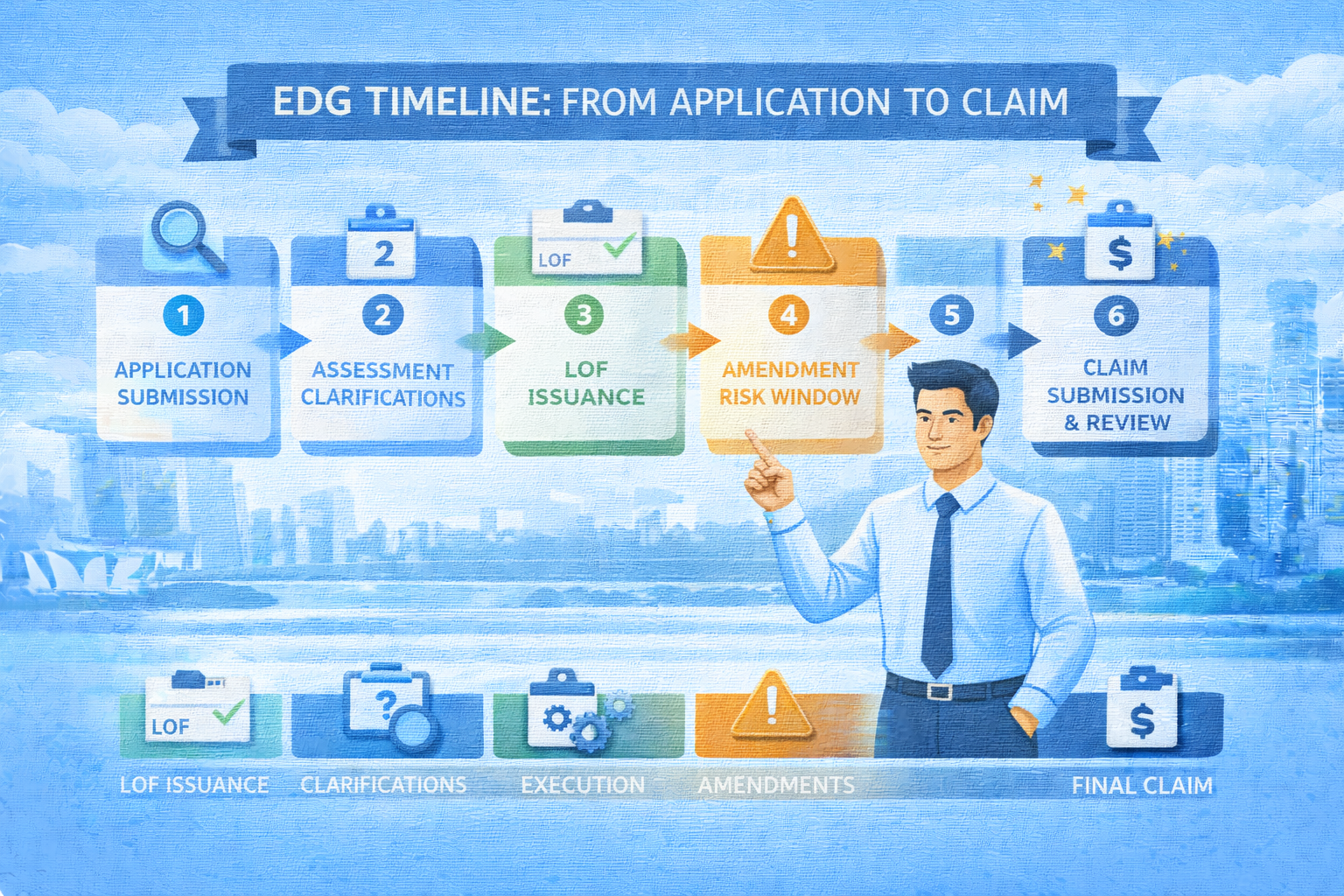
A practical, stage-by-stage breakdown of the EDG project lifecycle—covering submission, assessment, clarification cycles, LOF issuance, execution, amendment risks, and final claim submission—so companies can plan realistically.
At a glance
- EDG timelines are longer than most applicants expect.
- Clarifications are common and affect approval duration.
- Execution discipline determines claim smoothness.
- Poor planning often causes preventable delays.
Table of contents
- Stage 1: Application submission
- Stage 2: Assessment and clarifications
- Stage 3: LOF issuance
- Stage 4: Project execution
- Stage 5: Amendment risk window
- Stage 6: Claim submission and review
- Common timeline misconceptions
- References
- Call us now
Stage 1: Application submission
This includes:
- drafting scope
- budgeting
- outcome definition
- internal alignment
Preparation quality determines how smooth the next stages will be.
Poor preparation often results in extended clarification cycles.
Stage 2: Assessment and clarifications
After submission:
- assessors review scope, cost, and feasibility
- clarification questions may be issued
- applicants respond
This stage varies significantly depending on:
- clarity of proposal
- responsiveness
- alignment between cost and scope
Stage 3: LOF issuance
If approved, the Letter of Offer (LOF) sets:
- approved scope
- approved budget
- project duration
- compliance conditions
Execution must strictly follow the LOF.
Stage 4: Project execution
This is the longest stage.
Companies must:
- monitor milestones
- manage vendors
- document deliverables
- track KPIs
Weak governance here often creates claim problems later.
Stage 5: Amendment risk window
During execution, changes may arise:
- timeline extensions
- vendor adjustments
- scope refinements
Material changes require formal amendment.
Failure to amend can result in disallowed costs.
Stage 6: Claim submission and review
At claim stage:
- financial evidence is reviewed
- deliverables are verified
- outcomes are assessed
Claims are reconciled strictly against the LOF.
Common timeline misconceptions
- Approval is quick if proposal is strong.
- Clarifications mean rejection.
- LOF issuance guarantees smooth claim.
- Execution phase requires minimal oversight.
Most delays originate from weak preparation or weak execution governance.
References
Related Resources (Grant-Consulting.org)
https://www.grant-consulting.org/resources/edg-project-scope-design
https://www.grant-consulting.org/resources/edg-claims-evidence-checklist
https://www.grant-consulting.org/resources/edg-project-amendments-scope-timeline-vendor
Official references
https://www.enterprisesg.gov.sg/financial-support/enterprise-development-grant
https://www.enterprisesg.gov.sg/resources/all-faqs/enterprise-development-grant
Call us now
Book a 20-minute consult (no obligation):
https://www.grant-consulting.org/contact
We help companies:
- plan realistic EDG timelines
- reduce clarification cycles
- structure execution governance
- protect claim-stage outcomes

 WhatsApp us
```
WhatsApp us
```