A practical guide to designing EDG project scope that aligns clearly with business problems, deliverables, and measurable outcomes—reducing clarification cycles and improving approval confidence.
At a glance
- Poor scope design is one of the biggest hidden reasons EDG applications fail.
- Assessors evaluate whether activities logically lead to outcomes.
- Scope must be proportionate, coherent, and internally consistent.
- Over-engineering often hurts more than it helps.
Table of contents
- Why scope design matters
- The 4 components of strong scope
- Linking scope to outcomes
- Avoiding scope inflation
- Common scope design mistakes
- Practical scope structuring template
- References
- Call us now
Why scope design matters
EDG is outcome-driven. The agency is not funding “effort” — it is funding structured transformation initiatives.
A well-designed scope:
- builds assessor confidence
- reduces clarifications
- strengthens LOF alignment
- lowers amendment and claim risk
A poorly structured scope:
- triggers repeated questions
- creates execution confusion
- increases reimbursement disputes
The 4 components of strong scope
1. Problem definition
The scope must clearly respond to a defined business problem:
- operational bottlenecks
- capability gaps
- governance weaknesses
- scalability constraints
If the problem is generic, the scope will feel generic.
2. Defined activities
Activities should:
- be logically sequenced
- clearly contribute to deliverables
- avoid unnecessary expansion
Each activity must serve a purpose.
3. Tangible deliverables
Deliverables should be:
- concrete
- verifiable
- linked to transformation
Examples:
- documented frameworks
- implemented systems
- adopted workflows
4. Measurable outcomes
Outcomes must:
- reflect capability improvement
- connect directly to scope
- be realistically achievable
Activities without measurable outcomes weaken credibility.
Linking scope to outcomes
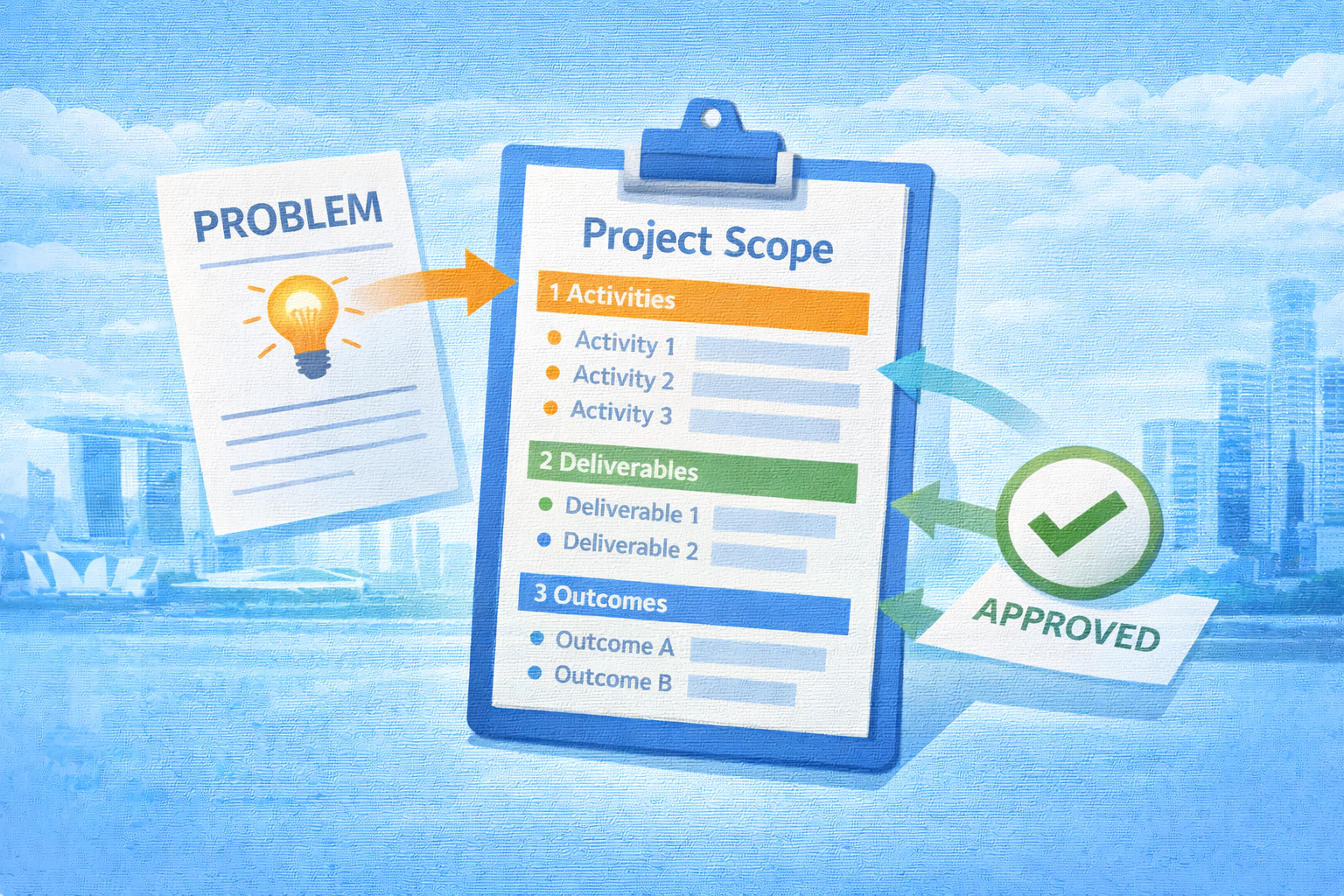
Strong EDG projects follow a clean chain:
Problem → Activity → Deliverable → Outcome
If any link breaks, assessors lose confidence.
For example:
Weak logic:
Activity: Market research
Outcome: Revenue increase
Strong logic:
Activity: Process redesign
Deliverable: Standardised workflow
Outcome: Cycle time reduction
The second chain is measurable and attributable.
Avoiding scope inflation
Many applicants assume that larger scope signals seriousness.
In reality:
- Excessive scope increases execution risk
- Too many deliverables weaken focus
- Disproportionate scope invites scrutiny
Assessors prefer:
- focused transformation
- well-contained workstreams
- credible execution planning
Common scope design mistakes
- Combining unrelated initiatives
- Overstating transformation ambition
- Writing activities that are too broad
- Including deliverables that are hard to verify
- Designing scope without considering internal ownership
Most clarifications originate here.
Practical scope structuring template
When drafting scope, structure it as:
A. Business Problem
Clear, specific constraint.
B. Project Objective
Defined transformation goal.
C. Activities (numbered and sequenced)
- Activity 1
- Activity 2
- Activity 3
D. Deliverables (clearly stated)
Concrete outputs.
E. Expected Outcomes
Measurable improvements.
This structure improves assessor readability significantly.
References
Related Resources (Grant-Consulting.org)
Official references
Call us now
Book a 20-minute consult (no obligation):
https://www.grant-consulting.org/contact
We help companies:
- refine scope before submission
- tighten activity-outcome logic
- reduce clarification cycles

 WhatsApp us
```
WhatsApp us
```