A claim-stage checklist for SMEs submitting EDG reimbursement claims, explaining what evidence is typically required, how claims are assessed against the Letter of Offer (LOF), and the common documentation gaps that cause delays or disallowance.
At a glance
- EDG claims are assessed on evidence, not intent.
- Missing or inconsistent documents are a leading cause of delays.
- All claims are checked strictly against the Letter of Offer (LOF).
- Preparing evidence early reduces clarification cycles and claim risk.
Table of contents
- How EDG claims are assessed
- Core evidence categories
- Financial documentation checklist
- Delivery and completion evidence
- Outcome and KPI evidence
- Common claim pitfalls
- Pre-submission self-check
- References
- Call us now
How EDG claims are assessed
At claim stage, assessors verify whether:
- costs were incurred as approved
- deliverables were completed as scoped
- outcomes were supported by evidence
Claims are reconciled against the approved LOF. Explanations that fall outside the LOF carry limited weight.
Core evidence categories
Most EDG claims rely on four categories of proof:
- financial documentation
- delivery and completion evidence
- outcome and KPI substantiation
- administrative consistency
Weakness in any category can delay or reduce reimbursement.
Financial documentation checklist
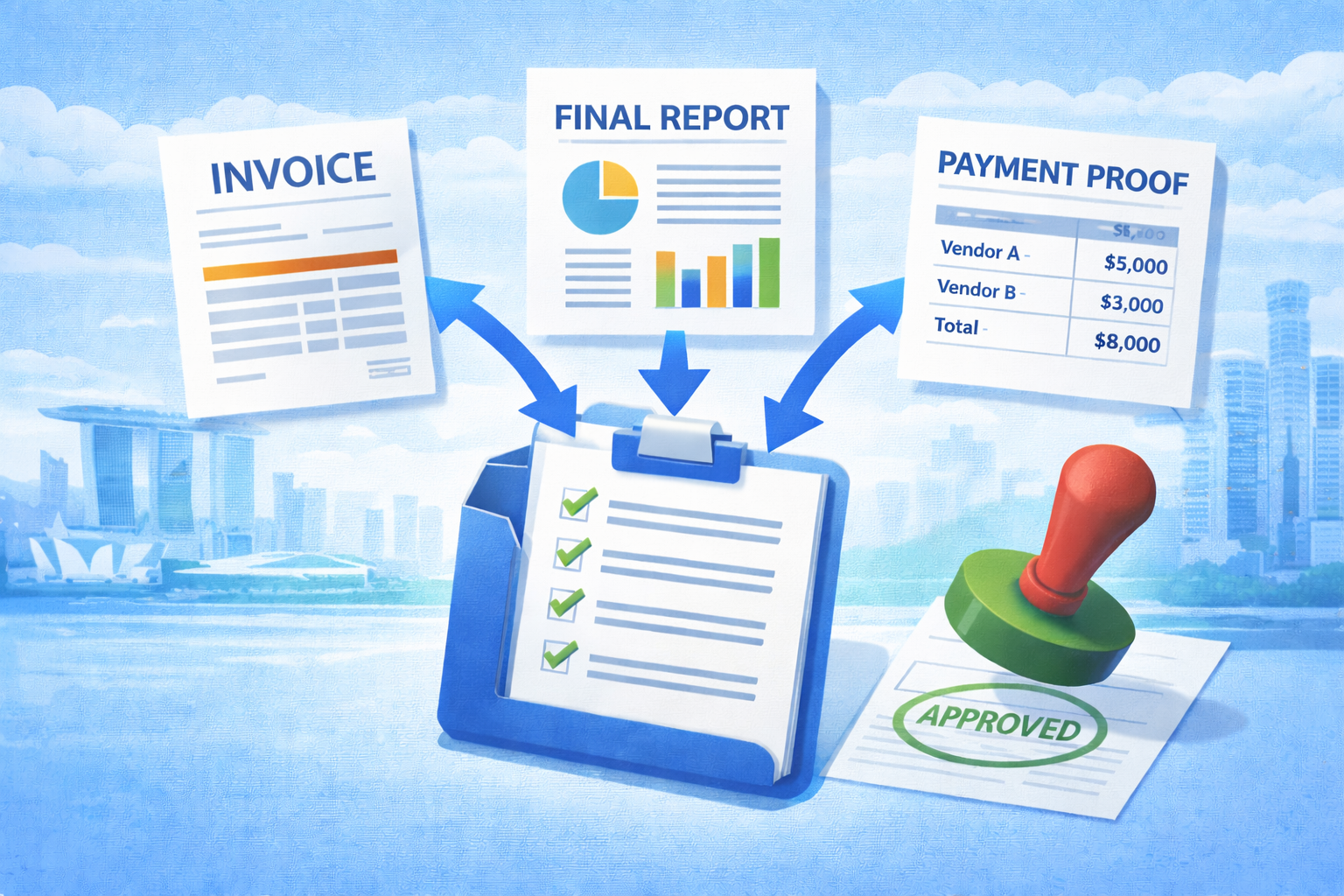
Prepare the following for each approved cost item:
- vendor invoices addressed to the applicant company
- proof of payment (bank statements)
- cost breakdowns matching approved scope
- internal manpower computation (if applicable)
- currency conversion records (if relevant)
Invoices or payments outside the approved project period are commonly disallowed.
Delivery and completion evidence
Assessors typically expect:
- final reports or deliverables
- system screenshots or access logs
- acceptance sign-offs
- implementation artefacts (e.g. SOPs, frameworks, dashboards)
Deliverables should map clearly to the approved scope.
Outcome and KPI evidence
Where outcomes or KPIs were approved, prepare:
- before-and-after comparisons
- baseline documentation
- usage or adoption records
- internal reports supporting claimed improvements
Outcomes that cannot be evidenced may be discounted even if work was completed.
Common claim pitfalls
- Scope mismatch
Evidence does not align with approved activities - Timing issues
Costs incurred outside the approved window - Weak outcome proof
Narrative claims without data - Inconsistent documentation
Invoices, reports, and claims do not reconcile
Most claim issues are preventable with early preparation.
Pre-submission self-check
Before submitting, ask:
- does every cost tie back to the LOF?
- can each deliverable be independently verified?
- are outcomes measurable and evidenced?
- would an external reviewer understand the claim without explanation?
If the answer is “no”, expect clarifications.
References
Related Resources (Grant-Consulting.org)
Official references
Call us now
Book a 20-minute consult (no obligation):
https://www.grant-consulting.org/contact
We can help you:
- pre-review claim evidence
- identify gaps before submission
- reduce clarification and rejection risk

 WhatsApp us
```
WhatsApp us
```