A practical guide explaining the realistic timeline of an Enterprise Development Grant project—from proposal submission and evaluation to project execution and final claims—so companies can plan implementation and funding expectations properly.
Many companies assume the Enterprise Development Grant (EDG) moves quickly from submission to funding.
In reality, the process includes multiple phases:
- Application preparation
- Evaluation and clarifications
- Letter of Offer (LOF) issuance
- Project execution
- Claims submission and reimbursement
Understanding the full lifecycle timeline helps companies plan cashflow, resources, and project milestones properly.
At a glance
- EDG projects typically run 6–12 months from application to final claim.
- Evaluation and clarifications will take 2–3 months.
- Companies must complete the project before submitting claims.
- Funding is reimbursed after milestone completion, not upfront.
Table of contents
- Typical EDG project timeline
- Application preparation phase
- Evaluation and clarification phase
- Letter of Offer (LOF) issuance
- Project execution period
- Claims and reimbursement stage
- References
- Call us now
Typical EDG project timeline
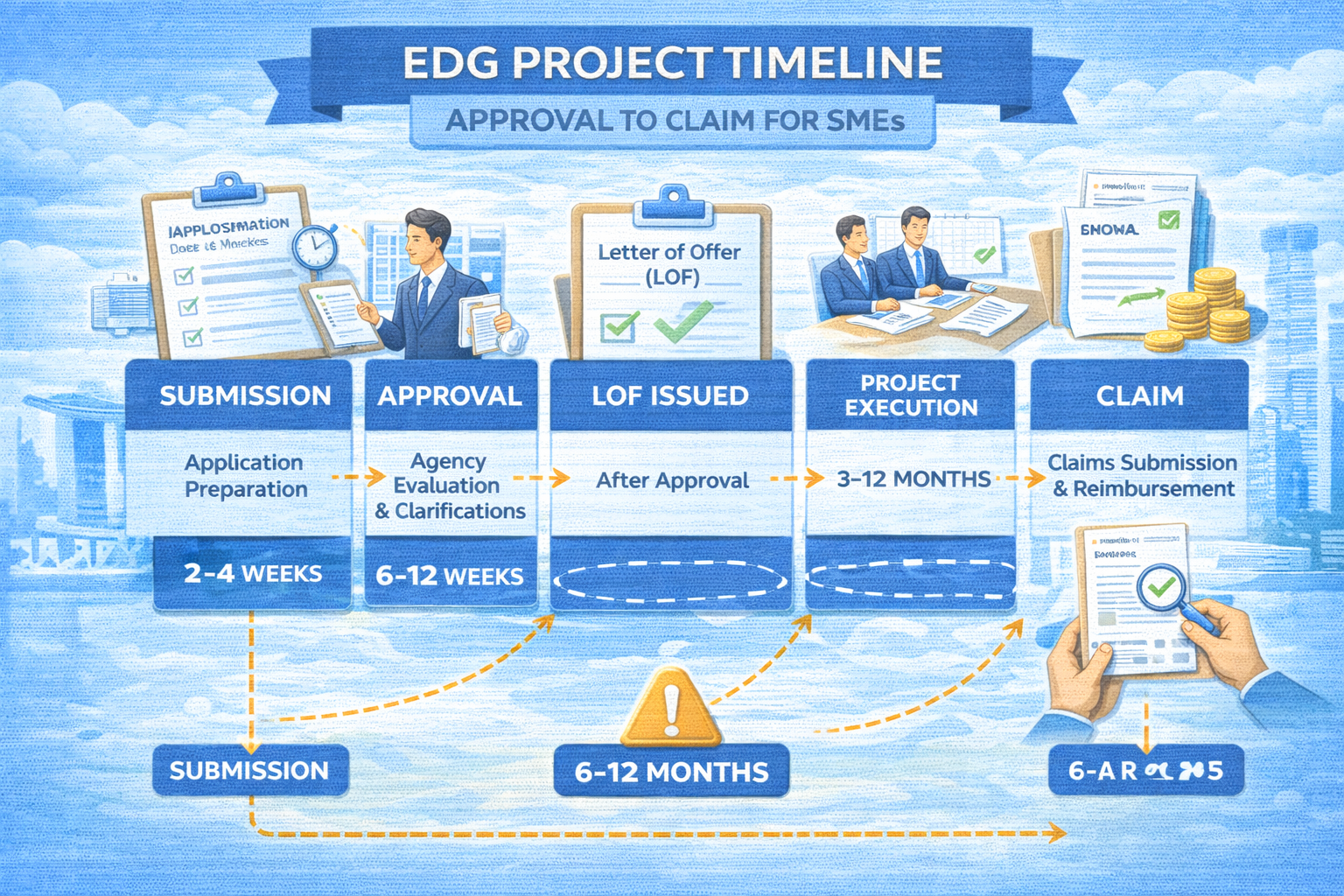
A realistic EDG lifecycle often follows this structure:
- Application preparation: 2–4 weeks
- Agency evaluation: 6–10 weeks
- Clarifications (if any): 1–3 weeks
- Letter of Offer issuance
- Project execution: 3–12 months
- Claims processing: 2-3 months
Actual timelines vary depending on project complexity.
Application preparation phase
Before submission, companies must prepare:
- project scope and deliverables
- vendor quotations
- financial projections
- capability justification
Preparation quality directly affects approval speed and clarification cycles.
Evaluation and clarification phase
After submission through the Business Grants Portal, the proposal enters evaluation.
Assessors review:
- project rationale
- vendor scope and pricing
- capability outcomes
- implementation feasibility
Clarification questions are common and usually request:
- additional scope details
- cost justification
- deliverable clarification
Letter of Offer (LOF) issuance
Once approved, the agency issues a Letter of Offer (LOF).
The LOF outlines:
- approved scope
- funding support level
- claim conditions
- project start date
Project execution period
During implementation, companies must:
- complete approved project activities
- track deliverables
- maintain supporting documentation
Typical documentation includes:
- consultant deliverables
- meeting records
- project reports
These are required during claims.
Claims and reimbursement stage
After completing the project, companies submit claims through the Business Grants Portal.
Typical claim documents include:
- invoices and proof of payment
- project deliverables
- final report
After verification, funding is reimbursed.
Processing normally takes 2-3 months.
References
https://www.grant-consulting.org/resources/the-definitive-edg-2026-guide-for-smes
https://www.grant-consulting.org/resources/edg-project-budgeting-pitfalls
https://www.grant-consulting.org/resources/edg-project-scope-design
Call us now
If you are planning an EDG project and want to structure it correctly from the start:
Book a 20-minute consultation (no obligation)
https://www.grant-consulting.org/contact
We help companies:
- design EDG-ready project scope
- structure vendor quotations properly
- reduce clarification cycles
- improve approval probability
 WhatsApp us
```
WhatsApp us
```