A structured guide to EDG project budgeting, explaining how assessors evaluate cost realism, common red flags in budgets, and how SMEs can structure defensible, proportionate financial proposals that align with project scope and outcomes.
At a glance
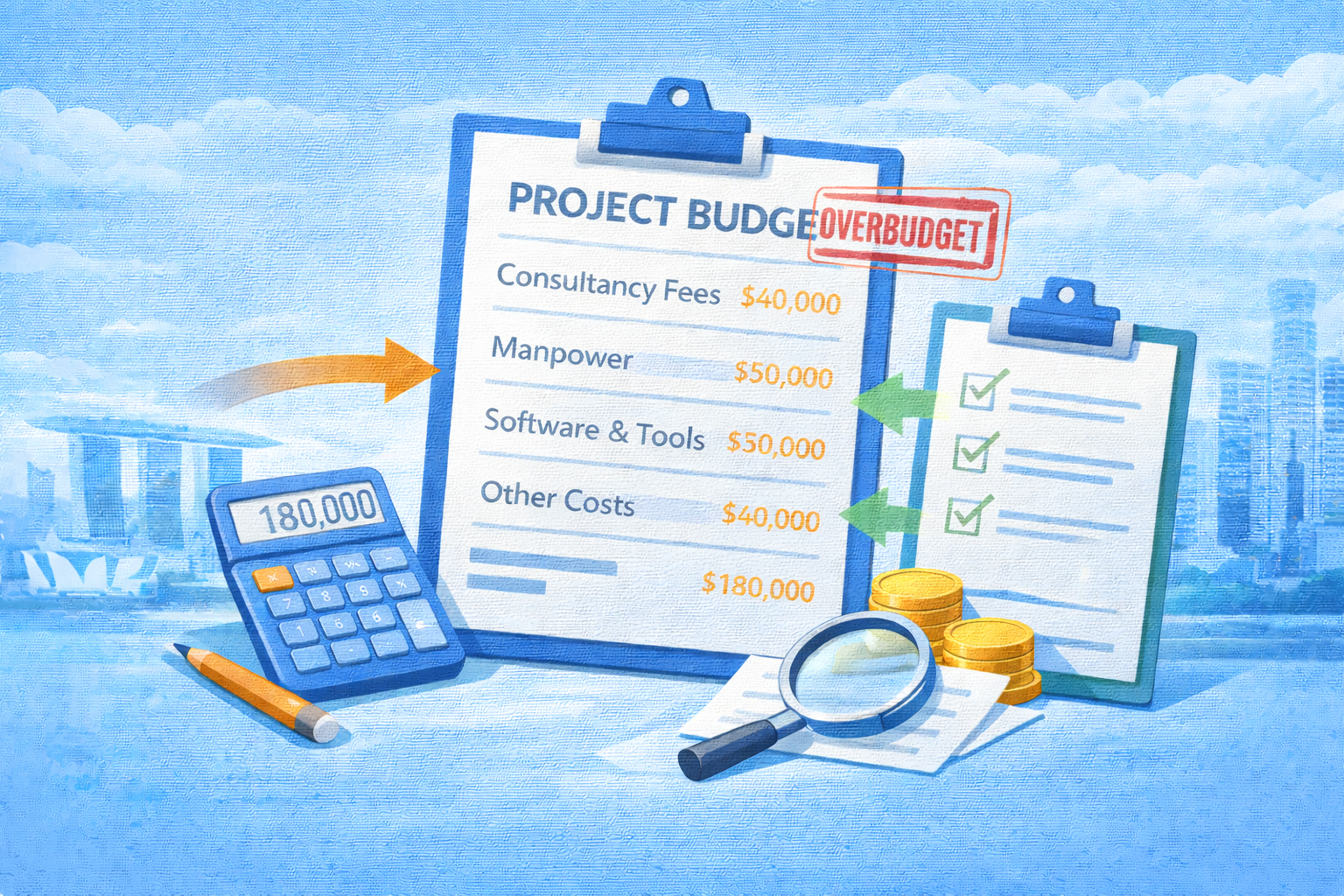
- Inflated or poorly justified budgets are a leading cause of EDG clarifications.
- Assessors look for proportionality between scope and cost.
- Budgets must align directly with approved deliverables and outcomes.
- Overbudgeting increases scrutiny; underbudgeting raises feasibility risk.
Table of contents
- Why budgeting discipline matters
- How assessors review EDG budgets
- Red flags in project budgets
- Common budgeting mistakes
- Structuring a defensible budget
- Investment case beyond the numbers
- References
- Call us now
Why budgeting discipline matters
EDG is not designed to maximise grant quantum. It is designed to support credible transformation initiatives.
Assessors evaluate:
- whether costs are necessary
- whether amounts are proportionate
- whether the budget reflects understanding of scope
A weak budget signals weak project planning.
How assessors review EDG budgets
Assessors typically review budgets for:
- cost-to-scope alignment
- proportionality across activities
- duplication of costs
- realism of manpower allocation
- justification clarity
Budgets are evaluated alongside scope — not in isolation.
Red flags in project budgets
Common warning signs include:
- high consultancy cost with minimal deliverables
- identical cost figures across unrelated items
- disproportionate internal manpower allocation
- lump-sum line items without breakdown
- misalignment between LOF scope and cost categories
These issues often trigger clarification requests.
Common budgeting mistakes
- Copy-pasting vendor quotations without integration
- Treating maximum support level as target
- Adding unnecessary cost buffers
- Failing to tie costs to measurable outcomes
- Ignoring internal execution capability
Budget structure should reflect strategic intent, not just funding opportunity.
Structuring a defensible budget
A strong EDG budget should:
- break costs into logical components
- match activities one-to-one
- justify each cost in plain language
- reflect realistic implementation effort
Example structure:
A. Consultancy Fees
Linked directly to Activity 1 and 2 deliverables.
B. Internal Manpower
Time-bound and tied to implementation milestones.
C. Software or Tools (if applicable)
Clearly supporting scope objectives.
Every line item must support transformation logic.
Investment case beyond the numbers
EDG approval depends on more than arithmetic.
Assessors also evaluate:
- strategic importance of the project
- expected operational improvement
- sustainability of impact
The budget must reinforce — not undermine — the investment case.
References
Related Resources (Grant-Consulting.org)
https://www.grant-consulting.org/resources/edg-project-scope-design
https://www.grant-consulting.org/resources/how-edg-projects-are-evaluated
https://www.grant-consulting.org/resources/edg-project-kpis-outcomes-metrics
Official references
https://www.enterprisesg.gov.sg/financial-support/enterprise-development-grant
https://www.enterprisesg.gov.sg/resources/all-faqs/enterprise-development-grant
Call us now
Book a 20-minute consult (no obligation):
https://www.grant-consulting.org/contact
We help companies:
- stress-test EDG budgets
- align cost with scope
- reduce clarification risk
- strengthen investment logic

 WhatsApp us
```
WhatsApp us
```