A practical, claim-focused guide for Singapore SMEs on how EDG reimbursement works after project execution, including claim timing, mandatory documents, evidence requirements, and common pitfalls that delay payouts.
At a glance
- EDG funding is reimbursed, not paid upfront.
- Claims are submitted through the Business Grants Portal (BGP) after approved milestones are completed.
- Claims succeed when scope, costs, invoices, payments, and deliverables align exactly with the approved Letter of Offer (LOO).
- Most delays arise from documentation gaps and inconsistencies, not eligibility issues.
Table of contents
- Key definitions for EDG claims
- When you can submit an EDG claim
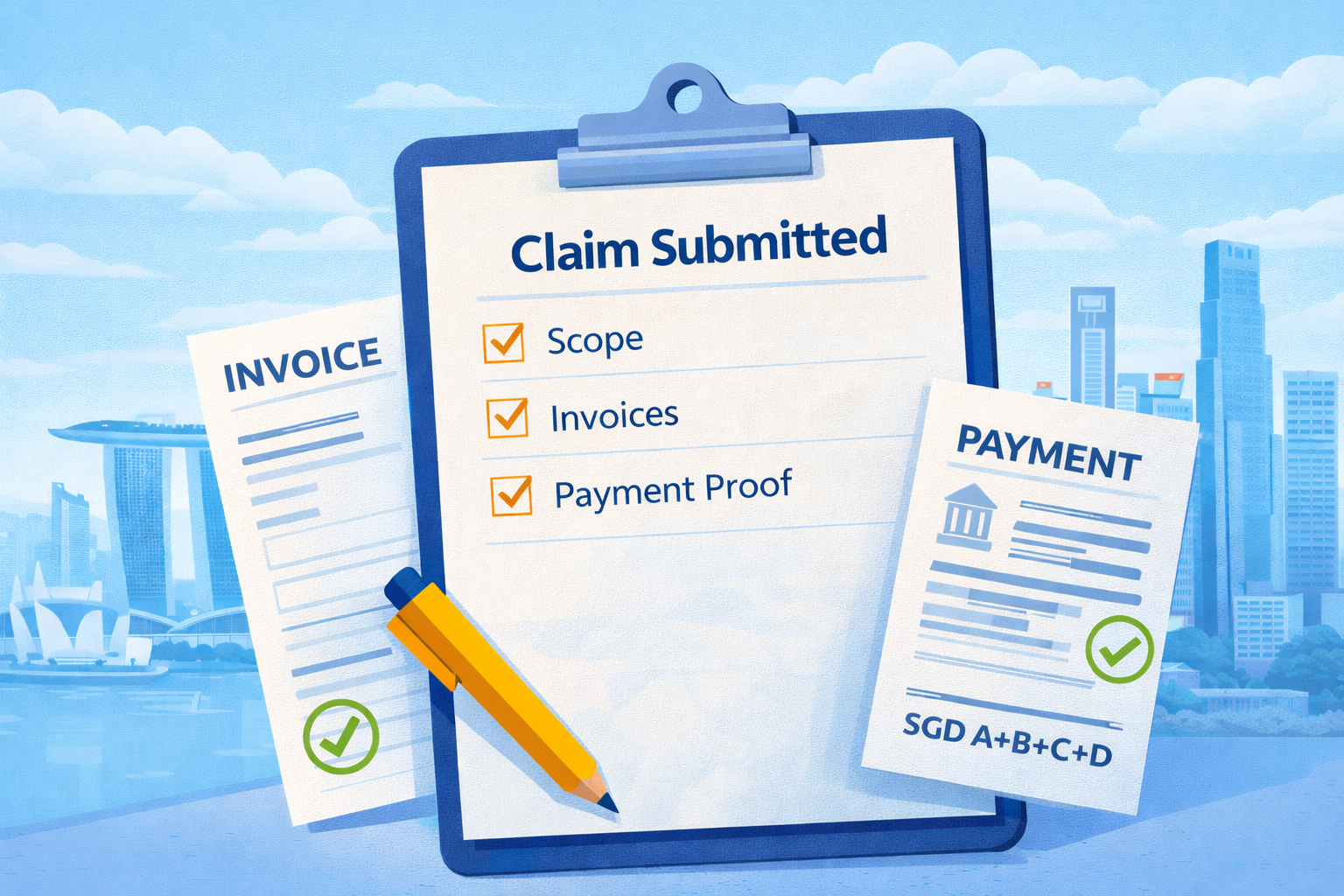
- Documents required for EDG reimbursement
- Step-by-step: how to submit an EDG claim in BGP
- How agencies assess EDG claims
- Common claim rejection or delay reasons
- Practical examples (clean vs risky claims)
- References
- Call us now
Key definitions for EDG claims
Claim milestone
A claimable stage defined in your approved project where specific deliverables have been completed and accepted.
Claimable costs
Costs incurred after approval and within the approved project period, directly tied to the approved scope and milestones.
Proof of payment
Objective evidence showing that the company has paid the vendor or staff cost (e.g., bank transfer confirmation, bank statement excerpt).
When you can submit an EDG claim
You may submit a claim only after:
- the project is approved and the Letter of Offer is accepted in BGP, and
- the relevant milestone’s deliverables are completed.
Claims are typically submitted:
- milestone-by-milestone, or
- as a final claim at project completion (depending on approved structure).
Submitting too early or outside the approved project period commonly leads to clarifications or rejection.
Documents required for EDG reimbursement
Prepare these before you start the claim submission.
Core documents (almost always required)
- Vendor invoices matching approved scope and quotation
- Proof of payment for each invoice
- Evidence of deliverables (reports, system screenshots, training materials, SOPs, etc.)
- Signed contract / quotation / PO (if applicable)
Internal manpower (if claimed)
- Roles and responsibilities tied to project scope
- Evidence of time/effort allocation (as required)
- Payroll or internal cost computation records (as applicable)
Good practice
Name files clearly and consistently:
Invoice_Milestone1_VendorA.pdfPaymentProof_Milestone1.pdfDeliverables_Milestone1.zip
Step-by-step: how to submit an EDG claim in BGP
Step 1 — Log in to Business Grants Portal
Access your approved EDG project via CorpPass and open the Claims section.
Step 2 — Select the milestone to claim
Ensure the milestone selected matches:
- the approved scope, and
- the deliverables you are submitting evidence for.
Step 3 — Declare claim amounts
Enter claim amounts exactly as incurred, ensuring:
- amounts do not exceed approved limits, and
- line items correspond to approved cost categories.
Step 4 — Upload supporting documents
Attach invoices, proof of payment, and deliverables for each cost item.
Step 5 — Review before submission
Do a final consistency check:
- invoice totals = claim totals
- invoice descriptions = approved scope
- payment proof dates align with invoices
Step 6 — Submit claim and track status
After submission, track status in BGP. Agencies may request clarifications before approval and payout.
How agencies assess EDG claims
Assessors typically check:
- Eligibility of costs (within scope, within period)
- Authenticity (real invoices and payments)
- Completion of deliverables
- Consistency across proposal, quotation, invoice, and claim declaration
Claims are delayed most often due to mismatch, not intent.
Common claim rejection or delay reasons
- Invoices include items not approved in scope
- Proof of payment missing or unclear
- Deliverables not matching milestone description
- Costs incurred outside approved project period
- Internal manpower claims without clear linkage to scope
Practical examples
Example A — Clean claim
- Milestone: Process redesign completed
- Evidence: final report, SOPs, training slides
- Invoice: matches approved quotation line-by-line
- Payment: bank transfer proof uploaded
Result: smooth processing and payout
Example B — Risky claim
- Invoice bundles extra “support” work not in scope
- Deliverables partially completed
- Payment proof unclear
Result: clarification requests or partial rejection
References
Related Resources (Grant-Consulting.org)
Official references
Call us now
Book a 20-minute consult (no obligation):
https://www.grant-consulting.org/contact
We can help you:
- pre-check claim documentation before submission
- flag scope or invoice risks early
- reduce back-and-forth during claim assessment

 WhatsApp us
```
WhatsApp us
```