A practical reference for Singapore SMEs on what EDG typically supports, what is commonly not supported, and how to structure vendor quotations and cost documentation so your application and claims are consistent and assessable.
At a glance
- What this is: A checklist + template to align EDG scope, costs, and vendor quotations (so your budget is assessable and your claim is defensible).
- Common EDG cost categories: third-party consultancy, software/equipment, and qualifying internal manpower (project-related).
- What goes wrong most often: quotations don’t map to deliverables, vague scope, “lump sum” pricing, and missing evidence for claim.
Table of contents
- Definitions you need
- EDG cost categories (what’s typically claimable)
- What’s commonly not supported (practical examples)
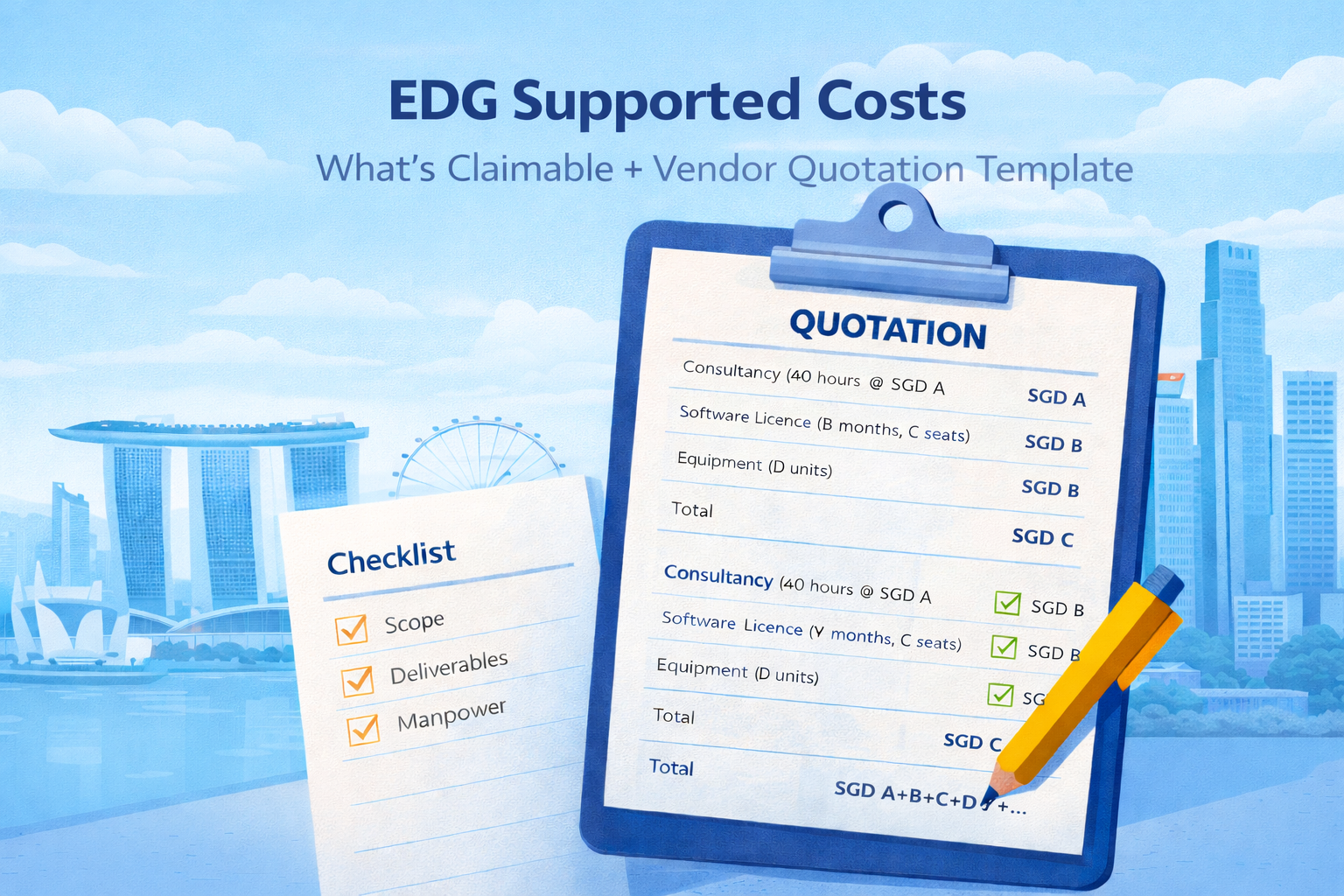
- Vendor quotation template (copy/paste)
- Cost-to-scope mapping checklist (application + claim readiness)
- Example quotations (good vs risky)
- Common pitfalls (and how to avoid delays)
- References
- Call us now
Definitions you need
Qualifying project costs
Costs that are directly tied to the approved scope and deliverables, supported by documentary evidence (e.g., invoices, payment proof, timesheets where relevant).
Third-party consultancy fees
Fees paid to external service providers for scoped project work with defined deliverables and milestones.
Software and equipment
Software subscriptions/licences or equipment items that are necessary for the project scope and can be clearly linked to deliverables and outcomes.
Internal manpower
Internal staff time that is directly spent delivering the approved project scope (and can be supported with evidence, depending on requirements for the claim).
EDG cost categories (what’s typically claimable)
Use these as a starting point when structuring your budget and quotations.
1) Third-party consultancy fees
Typically appropriate when:
- the work has defined deliverables (e.g., process redesign blueprint, implementation plan, system design, market entry plan)
- milestones and outcomes are measurable
What to include in quotation:
- itemised scope by work packages
- deliverables per milestone
- start/end date and assumptions
- daily rates or itemised fees, not a single lump sum
2) Software and equipment
Typically appropriate when:
- the software/equipment is required to deliver the project outcomes (not “general IT refresh”)
- the items map to specific deliverables (e.g., system implementation, automation module, data capture equipment for a new workflow)
What to include in quotation:
- SKU / licence tier, number of seats, duration
- implementation/configuration work separated from licensing (if applicable)
- a short justification: “why this is necessary for the project scope”
3) Qualifying internal manpower
Typically appropriate when:
- staff are clearly assigned to the project (roles, responsibilities)
- effort can be reasonably estimated by project phase (e.g., PM, process owner, data lead)
What to prepare:
- named roles (not necessarily names), responsibilities, and effort assumptions
- internal project plan showing who does what, when
What’s commonly not supported (practical examples)
These items often create confusion and delays when mixed into EDG budgets.
General operating expenses
- routine rent, utilities, general admin overhead
- ongoing “business-as-usual” expenses unrelated to the defined project
Vague “retainers” or unscoped services
- “monthly advisory retainer” with no deliverables
- “support as needed” without milestones/outcomes
Purchases not tied to project deliverables
- broad IT refresh (unless clearly tied to the project’s delivery)
- generic software subscriptions without project linkage
Rule of thumb: if you cannot point from cost line item → scope section → deliverable → outcome, it’s risky.
Vendor quotation template (copy/paste)
Use this template for every vendor quote you request. It increases assessability and reduces back-and-forth.
Quotation header (must-have)
- Vendor legal name (UEN), address, contact person
- Quotation number + date
- Customer legal name (UEN)
- Project title (match your EDG title as closely as possible)
- Validity period
- Payment terms
- Currency (SGD)
Scope & deliverables (itemised, not lump sum)
Work Package A — Discovery / Assessment (Dates: ___ to ___)
Deliverables:
- D1: __________________
- D2: __________________
Fees: - Item / hours / rate / subtotal
Work Package B — Design / Implementation (Dates: ___ to ___)
Deliverables:
- D3: __________________
Fees: - Item / hours / rate / subtotal
Work Package C — Testing / Training / Handover (Dates: ___ to ___)
Deliverables:
- D4: __________________
Fees: - Item / hours / rate / subtotal
Milestones & acceptance criteria
- Milestone 1 (date): Deliverables + acceptance criteria
- Milestone 2 (date): Deliverables + acceptance criteria
- Milestone 3 (date): Deliverables + acceptance criteria
Cost breakdown (separate these clearly)
- Consultancy fees (itemised)
- Software licence/subscription (SKU, seats, duration)
- Equipment (model, quantity, unit price)
- Implementation/configuration fees (if any)
- Taxes (if applicable)
Assumptions & exclusions (avoid future disputes)
- what’s included vs excluded
- dependency on customer inputs
- change request process (if scope changes)
Cost-to-scope mapping checklist (application + claim readiness)
Use this checklist before you submit.
Mapping checklist
- Every cost item appears in exactly one scope work package
- Every work package has at least one deliverable
- Every deliverable supports at least one outcome/KPI
- Total quotation = total budget line items (no mismatch)
- Dates align across proposal, quotation, and project plan
- No “miscellaneous” or “admin” cost buckets without explanation
Evidence checklist (plan ahead for claim)
- Signed quotation / contract / PO
- Invoices that match quotation line items
- Proof of payment (bank advice/statement excerpts)
- Deliverables produced (reports, configs, training materials, etc.)
- Internal manpower evidence (project plan + role allocation)
Example quotations (good vs risky)
Example A — Good (assessable)
- 3 work packages
- deliverables listed under each
- fees itemised by days/rates
- software licensing separated from implementation
- milestones with acceptance criteria
Example B — Risky (likely clarification)
- “One-time fee: S$XX,XXX”
- no deliverables, no milestones
- “support and advisory as needed”
- includes unrelated subscriptions
Common pitfalls (and how to avoid delays)
- Lump-sum quotes → Require itemised work packages + deliverables
- Costs don’t map to outcomes → Add a cost-to-outcome mapping table in your proposal
- Software bundled with “services” → Separate licensing vs implementation in quotations
- Scope creep → Define assumptions + change control
- Inconsistent totals → Do a final reconciliation pass before submission
References
Related Resources (Grant-Consulting.org)
Service pages
Official pages
Call us now
Book a 20-minute consult (no obligation): https://www.grant-consulting.org/contact
What you’ll get:
- confirm which cost items are likely supportable vs risky
- tighten your quotation request template
- align scope → deliverables → costs → outcomes (to reduce clarifications)

 WhatsApp us
```
WhatsApp us
```