A practical, step-by-step guide for Singapore SMEs to apply for the Enterprise Development Grant (EDG) via the Business Grants Portal (BGP). Includes mandatory documents, proposal checklist, what happens after submission, and common mistakes that delay approvals.
At a glance
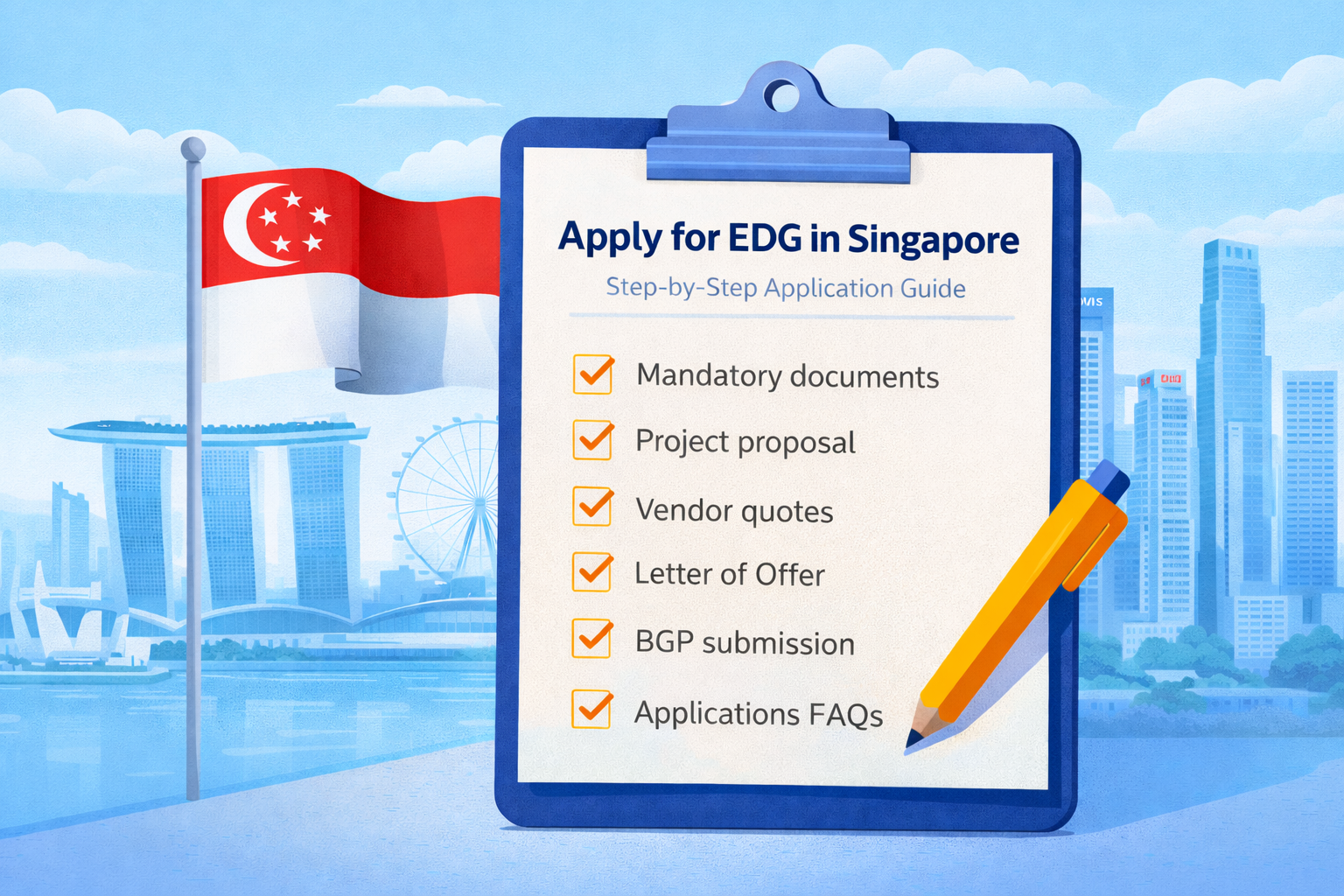
Applying for EDG is straightforward if your proposal is structured and your documentation is complete. This guide walks Singapore SMEs through the end-to-end EDG application workflow on the Business Grants Portal (BGP), including a document checklist, proposal structure, and common errors that slow approvals.
- Where you apply: Business Grants Portal (BGP) using CorpPass
- What you must prepare: ACRA profile (recent), financials, and a project proposal
- What happens after submission: evaluation + clarifications via BGP and email notifications
- What “approval” looks like: acceptance of the Letter of Offer in BGP
Table of contents
- Definitions you need
- Mandatory documents checklist (before you even start)
- How to structure a strong EDG project proposal
- Step-by-step: submitting EDG in BGP
- After submission: clarifications, Letter of Offer, and next steps
- Common mistakes (and how to avoid them)
- Examples you can model
- CTA
- FAQ
Definitions you need (so this is citeable)
Business Grants Portal (BGP)
The government portal where companies submit grant applications, track status, accept Letters of Offer, and manage claims.
Letter of Offer (LOF)
The formal offer issued after an application is approved; applicants typically need to accept it in BGP as part of the process flow.
Project proposal
A structured write-up describing the business need, scope, deliverables, milestones, outcomes, and budget for assessment.
Mandatory documents checklist (prepare these first)
Enterprise Singapore lists mandatory documents for EDG applications. Prepare them upfront to avoid “stop-start” drafting and delays.
Mandatory documents (typical)
- Latest ACRA search / instant information dated no earlier than 6 months from the application date
- Audited financial statements or certified management accounts for the last Financial Year (FY)
- Consolidated financial statements for the ultimate parent (if applicable)
- Project proposal (the core assessment document)
Practical checklist (copy this)
- ACRA profile downloaded (within 6 months)
- Latest FY financials finalised (audited or certified management accounts)
- Group/parent consolidated financials (if relevant)
- Vendor quotation(s) that map cleanly to scope + deliverables (recommended)
- Project plan: milestones, dates, owners, KPIs/outcomes
- Budget that ties line-by-line to proposal sections (no orphan costs)
How to structure a strong EDG project proposal (use this outline)
A good EDG proposal is not “marketing copy.” It is an assessment-ready plan.
Section 1 — Company context (short, factual)
- What you do, who you sell to, and what constraint you’re solving
- What capability gap exists today (process, people, tech, market)
Section 2 — Problem statement (specific)
- What is broken or limiting growth today
- Evidence (metrics, ops pain points, customer churn, inefficiencies)
Section 3 — Project scope (what you will do)
Write scope as work packages, not vague goals.
- Work Package A: discovery / requirements / design
- Work Package B: build / implement
- Work Package C: testing / training / rollout
Section 4 — Deliverables (what you will produce)
Deliverables must be tangible:
- reports, playbooks, SOPs, architectures, systems configured, integrations completed, certifications achieved, etc.
Section 5 — Milestones (when deliverables happen)
- Milestone 1 → deliverables → date
- Milestone 2 → deliverables → date
- Milestone 3 → deliverables → date
Section 6 — Outcomes (measurable)
Outcomes should be metrics, e.g.:
- reduce processing time by X%
- reduce errors by X%
- increase sales conversion by X%
- shorten lead time from A to B days
Section 7 — Budget justification (tie costs to scope)
Every cost item should point back to a scope line and deliverable.
Step-by-step: submitting EDG in BGP
BGP provides the overall “how it works” flow (apply → track → accept offer). Use the checklist below as a practical execution sequence.
Step 1 — Access BGP via CorpPass
- Ensure the correct CorpPass access is in place for the person submitting.
Step 2 — Create the EDG application in BGP
- Fill in the application fields carefully (contact details, addressee, etc.).
Step 3 — Upload mandatory documents
Use the mandatory document list above; missing docs is the #1 avoidable delay.
Step 4 — Review before submit (30-minute “audit”)
- Numbers consistent across proposal + budget + quotations
- Milestones align to deliverables
- Outcomes are measurable
- No “generic copy” paragraphs without specifics
Step 5 — Submit and track status
Track application status in BGP; agencies may request clarifications through the portal and via email notifications.
After submission: what happens next
Clarifications
Be ready to respond quickly if clarifications are requested. Clarifications usually relate to:
- scope clarity
- budget alignment
- outcomes and measurement method
- vendor quotation mapping to deliverables
Letter of Offer (LOF)
BGP’s process includes accepting the Letter of Offer after approval. Treat this as the formal transition point into the project execution phase.
Common mistakes (and how to avoid them)
- Vague scope → Fix by writing work packages + deliverables
- Outcomes are “fluffy” → Fix by making outcomes measurable
- Budget doesn’t map to scope → Fix by adding a cost-to-scope mapping table in your proposal
- Quotations don’t match deliverables → Fix by requiring vendors to itemise to your milestones
- Inconsistent facts (dates, totals, manpower) → Fix by doing the 30-min review pass
Examples you can model
Example A — Operations digitisation (SME services firm)
- Scope: redesign workflow + implement system configuration + train staff
- Deliverables: new SOPs, configured system modules, training materials, rollout plan
- Outcomes: reduce cycle time by 30%, reduce rework by 20%
Example B — Market access readiness (B2B exporter)
- Scope: overseas go-to-market plan + channel strategy + capability build
- Deliverables: market entry plan, partner shortlist, pricing strategy, execution roadmap
- Outcomes: reduce time-to-market by X months, increase qualified leads by X%
References
- EDG Definitive Guide (Post #1):
- EDG Eligibility (Post #2):
- EDG Service Page:
Call us now
Book a 20-minute consult (no obligation): https://www.grant-consulting.org/contact
What you’ll get:
- quick eligibility sense-check
- proposal risk flags upfront
- document checklist + recommended next steps
 WhatsApp us
```
WhatsApp us
```