A decision-oriented guide for SMEs choosing between single-vendor and multi-vendor structures in EDG projects, explaining how assessors view each model, the governance trade-offs involved, and the execution risks that commonly surface.
At a glance
- EDG does not mandate single or multiple vendors—but structure affects risk.
- Assessors focus on governance clarity, not vendor count.
- Multi-vendor projects introduce coordination risk that must be explicitly managed.
- Poorly structured vendor models often trigger amendments or claim issues.
Table of contents
- What vendor structure means in EDG
- Single-vendor EDG projects
- Multi-vendor EDG projects
- How assessors view vendor structure
- Common failure modes
- Choosing the right model
- References
- Call us now
What vendor structure means in EDG
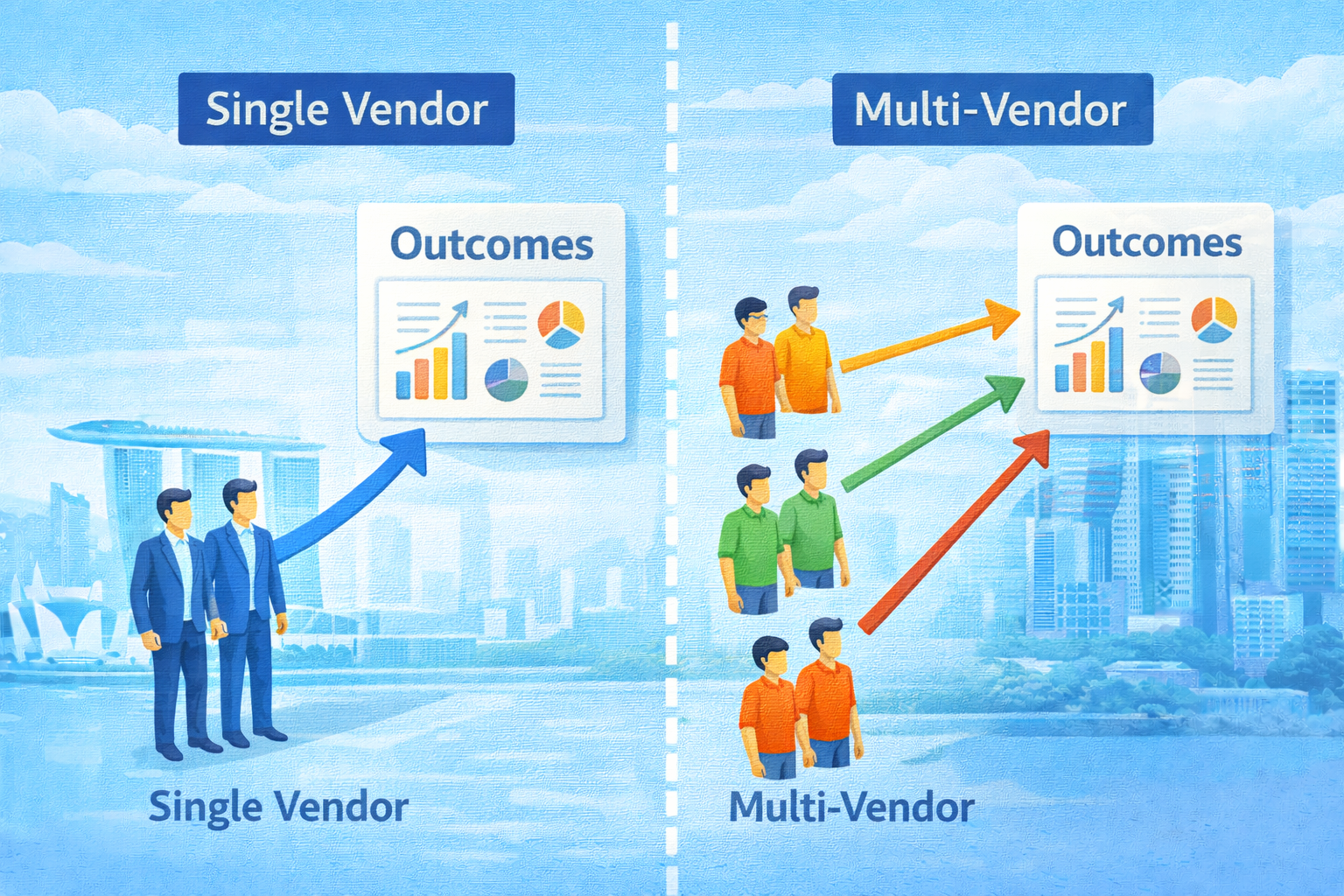
Vendor structure refers to how delivery responsibility is allocated across one or more third-party providers within an approved EDG project.
This matters because:
- EDG projects are outcome-driven
- assessors look for clear accountability
- delivery risk increases as interfaces multiply
Vendor structure is therefore a governance decision, not just a procurement choice.
Single-vendor EDG projects
When single-vendor works well
Single-vendor structures are often effective when:
- scope is tightly integrated
- deliverables are sequential or interdependent
- one vendor has end-to-end capability
Advantages
- simpler governance and communication
- clearer accountability
- lower coordination risk
Trade-offs
- dependency on one provider
- limited competitive benchmarking
- harder vendor substitution mid-project
Single-vendor projects tend to be easier to assess and execute, all else equal.
Multi-vendor EDG projects
When multi-vendor makes sense
Multi-vendor structures can be appropriate when:
- scope naturally splits into distinct workstreams
- specialised expertise is required
- internal team can actively coordinate vendors
Advantages
- access to specialised capabilities
- reduced dependency on a single provider
- potential resilience if one vendor underperforms
Trade-offs
- higher coordination and integration risk
- blurred accountability if governance is weak
- increased likelihood of scope drift
Without strong internal ownership, multi-vendor projects often struggle.
How assessors view vendor structure
Assessors do not inherently prefer one model, but they infer risk from:
- clarity of roles and responsibilities
- how deliverables interface across vendors
- whether internal ownership is credible
- whether risks are acknowledged and managed
A multi-vendor project with weak governance often appears riskier than a well-structured single-vendor project.
Common failure modes
- Diffuse accountability
- no single owner for outcomes
- Vendor finger-pointing
- delivery issues blamed across parties
- Hidden scope gaps
- tasks fall between vendors
- Unplanned vendor changes
- triggering amendment and claim risk
These issues often surface late, during execution or claims.
Choosing the right model
Choose single-vendor when:
- outcomes depend on tightly coupled activities
- internal bandwidth is limited
- speed and simplicity matter
Choose multi-vendor when:
- workstreams are clearly separable
- internal team can actively coordinate
- governance roles are explicit and enforced
Rule of thumb: complexity in vendor structure must be matched by governance strength.
References
Related Resources (Grant-Consulting.org)
Official references
Call us now
Book a 20-minute consult (no obligation):
https://www.grant-consulting.org/contact
We can help you:
- design a vendor structure assessors are comfortable with
- clarify accountability across vendors
- reduce execution and claim risk

 WhatsApp us
```
WhatsApp us
```