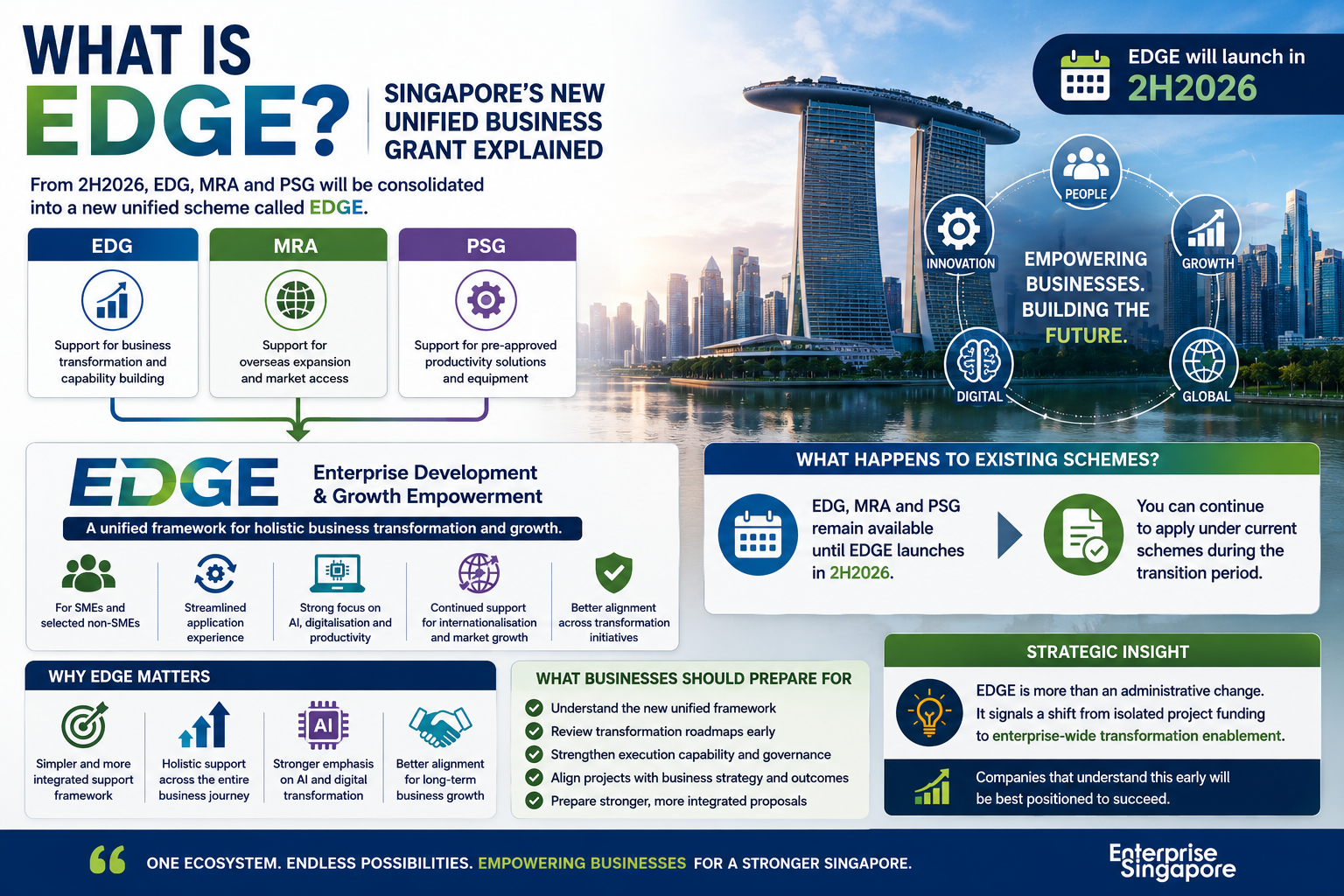
Singapore is introducing a major change to its business grant landscape.
From 2H2026 onwards:
will progressively be consolidated into a new unified scheme called:
EDGE
This marks one of the biggest structural changes to Enterprise Singapore’s grant ecosystem in recent years.
Historically, companies had to navigate multiple schemes separately:
While effective, the ecosystem could sometimes feel fragmented.
EDGE is intended to simplify this experience by creating:
While detailed operational guidelines are still expected progressively, current announcements indicate that EDGE will:
This suggests a move toward:
“holistic enterprise transformation support”
rather than isolated grant categories.
Even though EDGE simplifies the ecosystem, one thing is unlikely to change:
Assessors will still evaluate:
In other words:
The scheme structure may evolve.
But strong project fundamentals will still matter.
Current schemes remain active until EDGE launches fully in 2H2026.
This means businesses can still:
during the transition period.
Companies with immediate projects generally should not wait unnecessarily for EDGE unless strategic reasons justify doing so.
The introduction of EDGE likely signals several broader shifts:
1. Greater emphasis on integrated transformation
Projects may increasingly be evaluated as part of broader business capability development.
2. Stronger focus on AI and digital adoption
Singapore’s push toward enterprise AI readiness is likely to become more central.
3. More scrutiny on strategic alignment
As grants consolidate, assessors may focus more heavily on transformation coherence.
4. Increased importance of governance and execution capability
Larger, more integrated projects may require stronger internal capability demonstration.
Many businesses will focus on the administrative change.
But the bigger shift is likely strategic.
EDGE appears to reflect a transition from:
toward:
Companies that understand this early will position themselves more effectively.
If you are unsure how the transition from EDG, MRA, and PSG to EDGE affects your business plans, it is worth reviewing your strategy early.
We help companies position projects strategically under the evolving grant landscape and prepare for the transition into EDGE.
https://www.grant-consulting.org/contact
 WhatsApp us
```
WhatsApp us
```