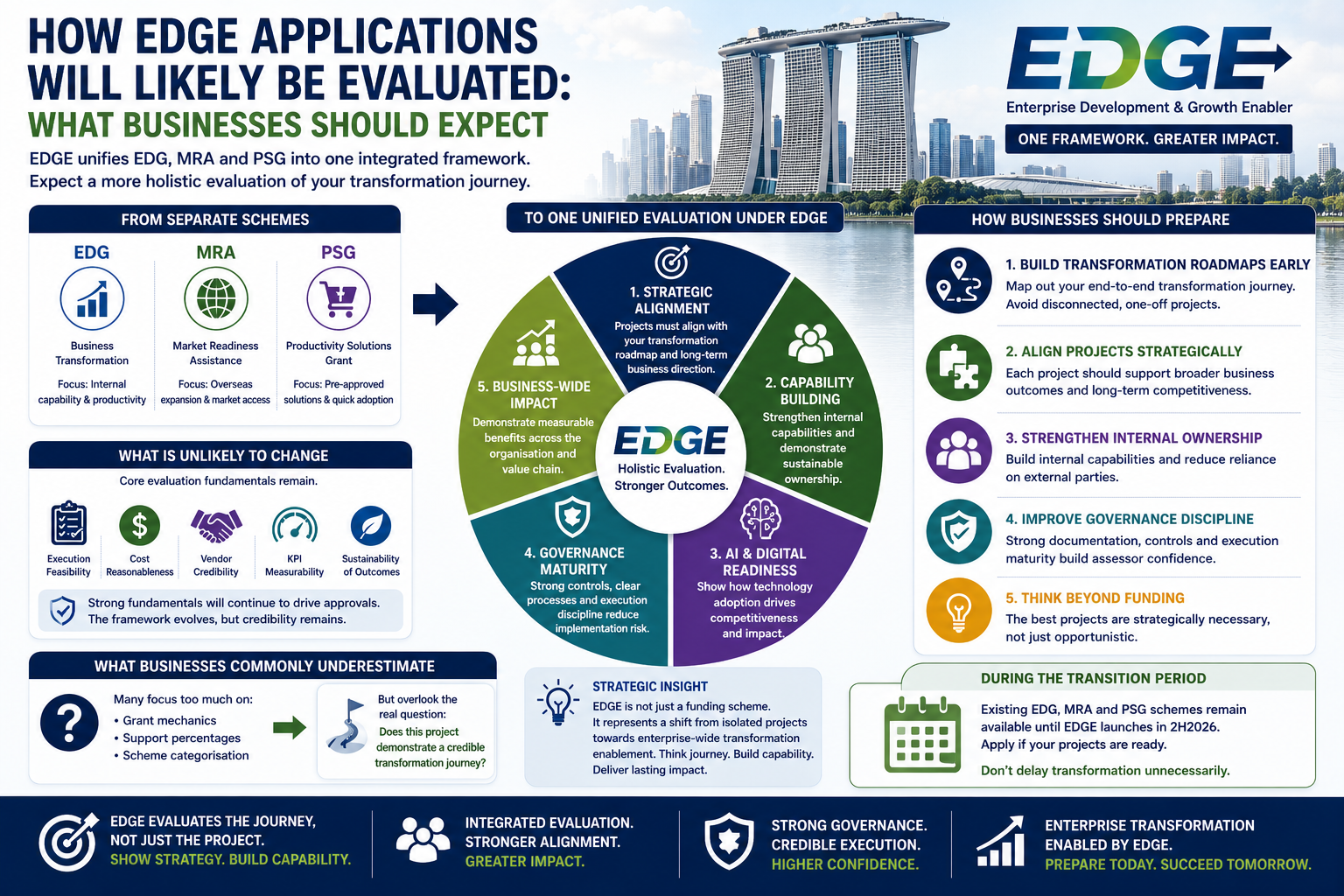
Many businesses are assuming that because EDGE simplifies the grant ecosystem, applications may become simpler to approve.
That is unlikely.
In fact, the opposite may happen.
Because while EDGE consolidates:
into a unified framework, it may also lead to:
Under previous schemes, projects were often evaluated somewhat independently:
EDGE appears to move toward evaluating businesses more holistically.
This means assessors may increasingly ask:
“Does this entire transformation journey make sense?”
—not just:
“Does this single project make sense?”
Although detailed implementation guidelines are still emerging, businesses should likely prepare for stronger focus on:
1. Strategic transformation alignment
Projects may need to connect more clearly to long-term business direction.
2. Capability building
EDGE is likely to emphasise sustainable internal capability—not outsourced dependency.
3. AI and digital readiness
Businesses may increasingly need to justify how technology adoption drives competitiveness.
4. Governance maturity
Integrated transformation projects may attract stronger scrutiny on controls and execution discipline.
5. Business-wide impact
Projects may increasingly be evaluated based on broader organisational outcomes.
Even under EDGE, assessors will still likely evaluate:
This means many approval fundamentals from EDG, MRA, and PSG still remain highly relevant.
Many companies focus too heavily on:
But overlook the more important question:
“Does this project demonstrate a credible transformation journey?”
EDGE likely increases the importance of answering this convincingly.
To strengthen future EDGE applications:
1. Build transformation roadmaps early
Avoid disconnected projects.
2. Align projects strategically
Each initiative should support broader business direction.
3. Strengthen internal ownership
Capability building will likely matter more than ever.
4. Improve governance discipline
Documentation and execution maturity remain critical.
5. Think beyond funding
The strongest projects will likely feel strategically necessary—not opportunistic.
EDGE is not simply:
It likely represents a broader evolution toward:
enterprise-wide transformation enablement.
Businesses that continue thinking transactionally may struggle.
Businesses that think strategically will likely benefit most.
If you are preparing projects under the upcoming EDGE framework, it is important to position them strategically from the start.
We help companies align transformation initiatives, capability building, governance, and business outcomes for stronger approval confidence.
https://www.grant-consulting.org/contact
 WhatsApp us
```
WhatsApp us
```