The announcement of EDGE has generated significant attention.
Many businesses are asking:
“Does this mean everything changes?”
The answer is:
yes and no.
While the structure of Singapore’s grant ecosystem is evolving significantly, many core evaluation principles are likely to remain fundamentally consistent.
Understanding both sides is critical.
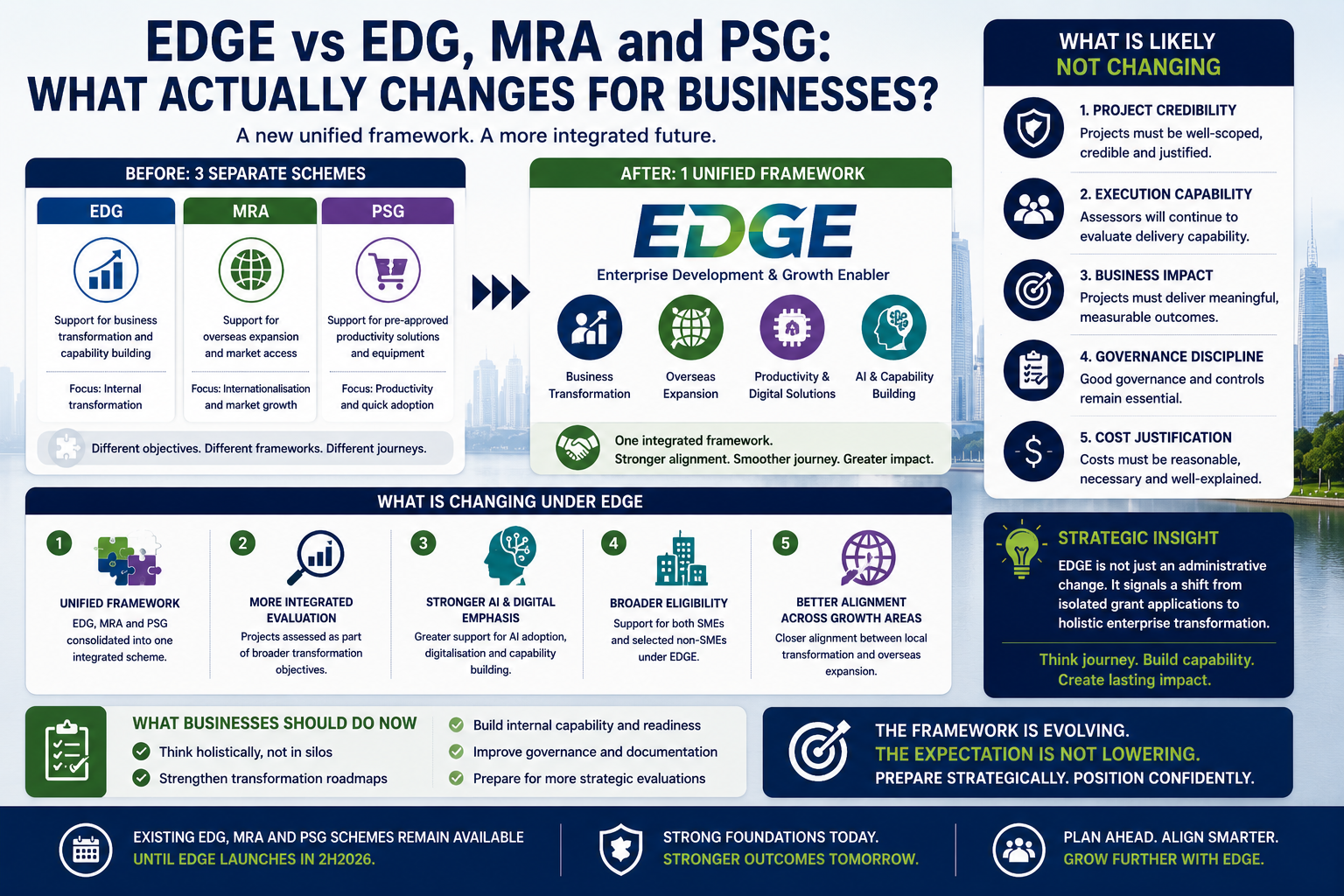
The most visible change is structural.
Instead of navigating separate schemes:
businesses will progressively move into:
one unified framework called EDGE.
This likely means:
The intent appears to be:
“supporting the business journey more holistically.”
Based on current announcements, businesses may eventually experience:
1. More integrated project evaluation
Projects may increasingly be assessed as part of broader business transformation rather than isolated activities.
2. Stronger AI and digitalisation emphasis
AI adoption and enterprise capability building are expected to become more central.
3. Broader eligibility framework
EDGE is expected to support both SMEs and selected non-SMEs.
4. Better alignment between local transformation and overseas growth
The separation between “domestic transformation” and “internationalisation” may become less rigid.
Despite the structural consolidation, businesses should not assume approvals become easier.
Assessors will almost certainly continue evaluating:
In other words:
The framework evolves.
But strong fundamentals still matter.
The deeper shift is philosophical.
Under older grant structures, companies often thought in terms of:
EDGE appears to encourage businesses to think instead about:
This is a very different mindset.
And likely a more strategic one.
Forward-looking companies should begin preparing by:
1. Thinking more holistically
Avoid isolated project planning.
2. Strengthening transformation roadmaps
Projects should connect strategically over time.
3. Building stronger internal capability
Capability building will likely matter even more.
4. Improving governance and documentation discipline
Integrated frameworks may increase scrutiny on execution maturity.
5. Preparing for more strategic evaluations
Transformation coherence may become increasingly important.
Many businesses will focus on the administrative simplification.
But the companies that benefit most from EDGE will likely be those that understand:
EDGE is not just about funding projects.
It is about enabling long-term enterprise transformation.
That distinction changes how applications should be positioned moving forward.
If you are unsure how to reposition your transformation roadmap under the upcoming EDGE framework, it is worth reviewing your strategy early.
We help companies align projects, capability building, and growth initiatives with Singapore’s evolving enterprise support landscape.
https://www.grant-consulting.org/contact
 WhatsApp us
```
WhatsApp us
```