Under EDGE, Singapore businesses are expected to have a simpler grant entry point as EDG, MRA and PSG progressively consolidate into one scheme.
This is helpful.
But it does not mean businesses can treat vendor selection casually.
For many projects, the selected consultant, technology provider or implementation partner will strongly influence whether the project is credible, executable and claim-ready.
A weak vendor proposal can make a good business idea look unclear.
A strong vendor proposal can help translate a business problem into a structured project with clear deliverables, timeline, cost logic and measurable outcomes.
This is why vendor selection should not be treated as an afterthought.
It is part of the business case.
EDGE is intended to streamline support across different business activities.
That means businesses may increasingly apply based on what they are trying to achieve, rather than first deciding whether the project sits under EDG, MRA or PSG.
However, the fundamental assessment logic does not disappear.
A business will still need to show that the project is necessary, properly scoped, commercially relevant and supported by reasonable costs.
The vendor plays a major role in this.
If the vendor cannot explain the methodology, deliverables and implementation plan clearly, the application may appear weak even if the business need is genuine.
If the vendor’s quote is vague, inflated or disconnected from business outcomes, the project may raise questions.
If the vendor appears to be selling a generic package rather than solving the company’s specific problem, the application may lose strategic credibility.
Many SMEs treat vendor selection as a procurement exercise.
They ask for three quotations, compare prices, and choose one.
That may be necessary, but it is not sufficient.
For an EDGE project, vendor selection should also answer deeper questions:
Does the vendor understand the company’s business problem?
Does the vendor have relevant experience?
Is the proposed scope specific enough?
Are the deliverables tangible?
Is the timeline realistic?
Is the pricing transparent?
Will the vendor help the company build capability, or simply deliver a one-off output?
Can the vendor support documentation, implementation and claims evidence?
The goal is not just to appoint a provider.
The goal is to appoint the right provider for a grant-supported transformation project.
A common mistake is to let the vendor define the problem.
This happens when a company begins by asking:
“What grant can I use?”
“What solution can you sell me?”
“What package is grant-supported?”
That approach often leads to weak applications.
A stronger approach is to first define the internal business issue.
For example:
The company’s sales process is inconsistent and management cannot track conversion performance.
The finance team spends too much time reconciling manual reports.
The company wants to expand overseas but lacks qualified distributor relationships and market-entry evidence.
The operations team faces repeated errors due to disconnected systems.
Once the problem is clear, the business can then evaluate which vendor is best suited to solve it.
The right sequence is:
Define the business problem.
Identify the capability gap.
Clarify the desired outcome.
Determine what external support is needed.
Request proposals from suitable vendors.
Compare scope, deliverables, methodology and price.
Select the provider with the strongest fit.
This creates a much stronger foundation for an EDGE application.
Businesses commonly make five vendor selection mistakes.
Price matters.
But the cheapest quote may not be the best quote.
A low-cost vendor may provide a thinner scope, weaker methodology or less implementation support.
If the project involves strategic work, workflow redesign, AI adoption, overseas expansion or complex digital implementation, under-pricing can create execution risk.
A grant project should be cost-conscious, but not shallow.
The better question is:
“Is the price reasonable for the scope, deliverables, expertise and expected outcome?”
The opposite mistake is choosing a vendor solely because it has a strong brand.
A large or well-known provider may not always be the best fit for an SME’s project.
The provider must still show:
Relevant experience
Practical methodology
Suitable project team
Clear deliverables
Reasonable pricing
Ability to work with the company’s operating reality
Brand reputation can help, but it does not replace project fit.
A quotation that says “consulting services”, “digital transformation package” or “market-entry support” is usually too vague.
A stronger quotation should break down the scope into phases, activities and deliverables.
For example:
Discovery and requirements gathering
Current-state assessment
Future-state design
Vendor configuration or implementation
Testing
Training
Final report
Handover
Post-implementation review
The clearer the quotation, the easier it is to understand what the company is paying for.
Some vendors include everything.
This can make the project look sophisticated, but it can also make the scope bloated.
A bloated project may include features, reports, modules or services that are not clearly linked to the business problem.
This creates two risks.
First, the application may become harder to justify.
Second, the company may struggle to execute the project properly.
A strong EDGE project should be focused.
The vendor should help the company prioritise what matters, not simply maximise the project size.
Businesses often focus on approval and forget about reimbursement.
This is risky.
A vendor should be able to provide proper documentation to support claims, such as:
Signed quotation
Detailed scope of work
Project timeline
Deliverables
Invoices
Payment evidence
Completion reports
Training records
Meeting notes
System screenshots
Final handover documents
If the vendor cannot support documentation discipline, the company may face problems later.
A strong proposal should not merely state the price.
It should explain the project clearly.
At minimum, it should include:
Company understanding
Problem statement
Proposed approach
Scope of work
Project phases
Deliverables
Timeline
Project team
Commercial terms
Assumptions
Exclusions
Client responsibilities
Expected outcomes
Documentation support
This helps the company, the advisor and the assessor understand the project properly.
Under EDGE, businesses may work with different types of providers.
A consultant usually helps with analysis, strategy, process redesign, capability building, overseas market development or transformation planning.
A solution provider usually provides software, systems, equipment, implementation, integration or technical deployment.
Some projects require both.
For example, an AI adoption project may need:
A strategy or process consultant to define the business use case.
A technology provider to implement the solution.
Internal business owners to manage adoption and workflow change.
A vendor who only sells software may not solve the business problem.
A consultant who only writes reports may not drive implementation.
The right structure depends on the project.
A key question businesses should ask is:
“What capability will remain after the vendor leaves?”
For example:
Will the team know how to use the new system?
Will management have better dashboards?
Will the sales process become more disciplined?
Will the company have a repeatable overseas expansion process?
Will the finance team have a stronger reporting workflow?
Will the business have clearer SOPs?
If the answer is unclear, the vendor’s role may need to be redefined.
The strongest EDGE projects are not just outsourced tasks.
They create lasting enterprise capability.
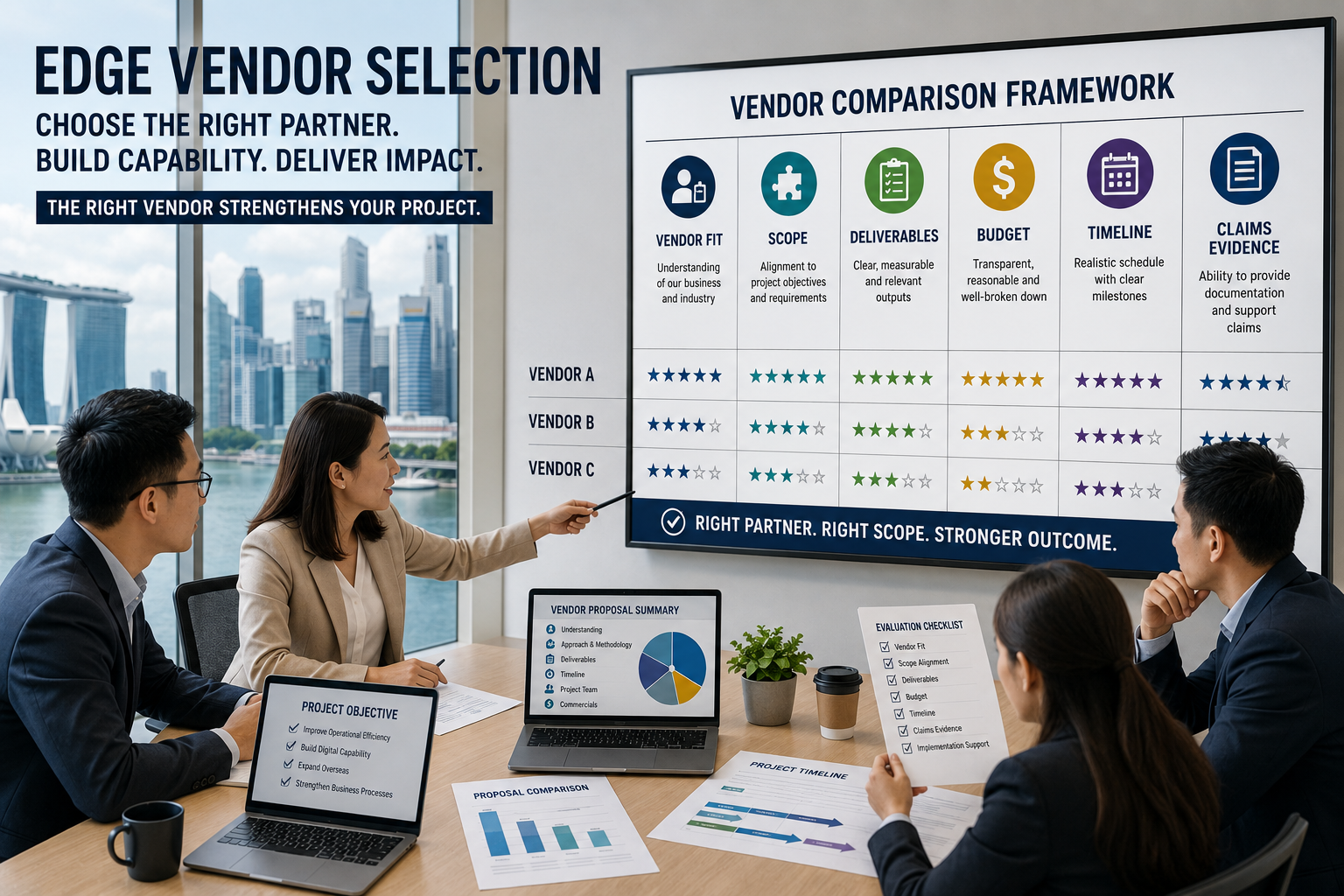
Businesses should evaluate vendors across multiple dimensions.
Does the vendor understand the company’s industry, customers, operating model and constraints?
A vendor with generic experience may still be useful, but the proposal must show that it has understood the company’s specific situation.
Does the proposed scope directly solve the business problem?
Avoid scopes that are either too thin or too broad.
The scope should be proportionate to the company’s size, maturity and project objective.
Does the vendor explain how the work will be done?
A strong methodology shows that the vendor has a repeatable process and is not merely improvising.
Are deliverables specific, tangible and useful?
Examples include reports, workflows, dashboards, system configurations, training materials, documentation, implementation records and final recommendations.
Who will actually perform the work?
A proposal may look strong at company level, but the assigned project team matters.
Businesses should understand the experience of the consultants, developers, trainers or project managers involved.
Is the pricing broken down clearly?
Transparent pricing helps assess whether costs are reasonable.
It also reduces disputes later.
Will the vendor support adoption, training and handover?
A project that ends with a report or system installation but no adoption plan may not create lasting value.
Can the vendor support grant-related documentation and completion evidence?
This is important for claims and audit readiness.
Before selecting a provider, ask:
Have you delivered similar projects before?
What is your proposed methodology?
What are the exact deliverables?
What is excluded from your scope?
Who will be assigned to the project?
How much time will your team spend on each phase?
What inputs do you need from us?
How will we know the project is successful?
What evidence will you provide at completion?
How will you support claims documentation?
What happens if project requirements change?
These questions help separate serious providers from generic vendors.
Businesses should be cautious if a vendor:
Guarantees grant approval.
Focuses mainly on subsidy amounts.
Provides a vague one-line quotation.
Cannot explain the methodology.
Cannot define deliverables clearly.
Uses a generic template with no customisation.
Pushes the company to sign quickly before scoping is complete.
Includes unnecessary features or services.
Cannot explain how the project builds capability.
Does not understand claims evidence.
Treats the grant as the main reason for doing the project.
These are warning signs.
A credible vendor should be willing to discuss business logic, implementation discipline and documentation requirements.
In many cases, getting multiple quotations is useful.
It helps the company compare market pricing, scope, deliverables and vendor quality.
However, the purpose is not merely to collect the cheapest quote.
The company should be able to explain why the selected vendor is suitable.
A proper comparison should look at:
Scope
Price
Deliverables
Experience
Timeline
Team
Methodology
Fit with business objectives
The vendor selection rationale should be logical and defensible.
The vendor’s proposal often becomes the backbone of the grant application.
It influences:
Project description
Scope of work
Cost breakdown
Timeline
Deliverables
Expected outcomes
Claims evidence
If the proposal is weak, the application becomes harder to write.
If the proposal is strong, the application becomes clearer and more credible.
This is why businesses should not rush vendor appointment.
A well-structured vendor proposal saves time later.
AI projects require extra care.
Many vendors now describe their solutions as AI-enabled, but not all AI projects are equally meaningful.
Businesses should ask:
What business problem does the AI solve?
What data is required?
How will the AI workflow be used?
Who will review the AI output?
What are the risks of inaccurate output?
What human oversight is required?
How will the solution be maintained?
How will staff be trained?
An AI project should not be scoped around novelty.
It should be scoped around productivity, decision quality, customer experience, operational efficiency or capability building.
For overseas expansion, the vendor should have relevant market knowledge and business development capability.
Businesses should assess whether the provider can support:
Market research
Customer segmentation
Distributor or partner mapping
Business matching
Meeting facilitation
Market-entry recommendations
Regulatory or commercial considerations
Documentation of outreach and meetings
For overseas projects, proof of work matters.
The vendor should be able to provide evidence of activities completed, not just a high-level final report.
For productivity projects, the vendor should understand workflow change.
A good productivity vendor should be able to show:
Current-state process understanding
Future-state workflow design
System or equipment relevance
Manpower savings logic
Training plan
Implementation timeline
Post-project adoption support
Productivity projects should not be framed only as purchases.
They should be framed as operational improvement.
Before appointing a vendor for an EDGE project, businesses should check:
Is the business problem clearly defined?
Does the vendor’s proposal address that problem?
Are deliverables specific?
Is the timeline realistic?
Is the price transparent?
Is the vendor experienced in similar work?
Is the implementation plan practical?
Are client responsibilities clear?
Is documentation support included?
Can the company explain why this vendor was selected?
If the answer is yes, the vendor selection is likely to be much stronger.
If you are preparing an EDGE project and need help assessing vendor proposals, comparing quotations, structuring deliverables or aligning the project scope with grant requirements, speak with us before committing.
We help Singapore businesses define grant-ready projects, prepare compliant applications, manage clarifications, and support the process through approval and claims.
Book a 30-minute, no-obligation discussion here:
https://www.grant-consulting.org/contact
 WhatsApp us
```
WhatsApp us
```