Many businesses have several transformation priorities at the same time.
They want a new CRM.
They want better reporting.
They want AI.
They want to automate processes.
They want to expand overseas.
They want to improve productivity.
They want stronger management systems.
The problem is not identifying opportunities.
The problem is deciding what comes first.
A business can have five good transformation ideas and still execute poorly if those initiatives are implemented in the wrong sequence.
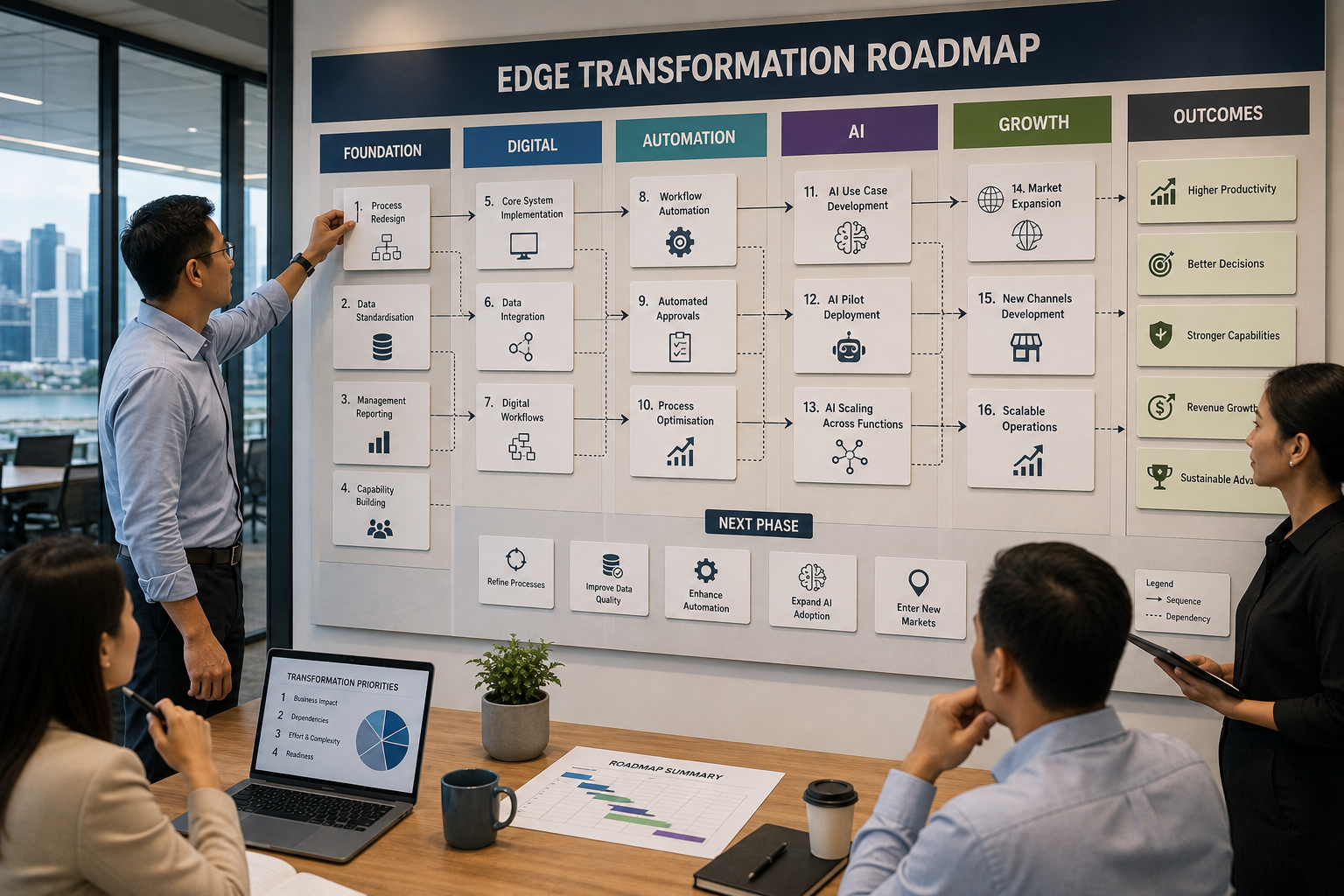
This is why an EDGE transformation roadmap matters.
The objective is not to implement everything simultaneously.
The objective is to build the right capabilities in the right order.
EnterpriseSG's Business Refresh Package describes EDGE as a new streamlined enterprise support framework that will consolidate support currently provided through EDG, MRA and PSG. Existing schemes remain accessible until EDGE launches in 2H 2026.
For businesses, the strategic implication is important.
The grant framework may become more integrated.
But transformation still needs to be managed as a business programme.
An EDGE transformation roadmap is a structured plan showing:
What the business needs to improve
Which projects should be prioritised
Which initiatives depend on others
What should happen first
What can happen later
Who owns each initiative
What outcomes are expected
How the projects contribute to the company's broader strategy
A roadmap prevents transformation from becoming a collection of unrelated purchases.
Instead, it connects individual projects into a coherent business development journey.
Consider a company that wants to implement:
A CRM
An AI sales assistant
A management dashboard
An automated quotation system
An overseas expansion programme
All five may be sensible.
But implementing them simultaneously could create problems.
The CRM may not contain clean customer data.
The AI assistant may therefore have weak information to work with.
The dashboard may rely on inconsistent sales definitions.
The quotation automation may depend on product data that has not been standardised.
The overseas expansion team may lack a reliable sales process.
The problem is not that any individual project is necessarily wrong.
The sequence is wrong.
Some projects create foundations for others.
For example:
Data standardisation can support digitalisation.
Digitalisation can create better data.
Better data can support AI.
Process redesign can make automation more effective.
Capability building can improve adoption.
Management reporting can help measure the impact of all of the above.
This creates a transformation chain.
The roadmap should recognise those dependencies.
Businesses can think about their transformation roadmap across five levels.
Examples:
Business strategy
Management processes
Financial visibility
Organisational structure
Governance
Customer understanding
These initiatives clarify what the company is trying to achieve.
Examples:
Workflow redesign
SOPs
Process standardisation
Approval structures
Role clarity
These initiatives improve how work is performed.
Examples:
Core business systems
Data structures
System integration
Reporting infrastructure
Digital workflows
These initiatives create the technology foundation.
Examples:
AI
Advanced automation
Predictive analytics
Advanced customer intelligence
Integrated management systems
These initiatives build on earlier foundations.
Examples:
Overseas expansion
New channels
New products
New markets
Multi-location operations
Strategic partnerships
These initiatives leverage the capabilities built earlier.
Not every company needs all five levels.
But understanding the sequence helps management avoid jumping directly to advanced solutions without the necessary foundation.
AI receives attention.
Automation sounds attractive.
Advanced analytics looks impressive.
But the business may still have poorly defined processes.
Technology cannot compensate for unclear operating requirements.
Management may approve several initiatives because each one appears worthwhile.
The result is:
Too many vendors
Too many meetings
Too many implementation decisions
Employee fatigue
Poor adoption
Weak management attention
Transformation becomes fragmented.
A business may think:
“This is our CRM project.”
Then:
“This is our productivity project.”
Then:
“This is our overseas project.”
But management should also ask:
“How do these projects fit together?”
That is the roadmap question.
A practical prioritisation framework can consider six factors.
Does the project directly support the company's strategy?
Will the project materially improve productivity, capability, growth or management control?
Is the current problem already limiting the business?
Do other projects depend on this capability?
Can employees and management absorb the change now?
How difficult will the project be to implement successfully?
A project with high strategic value but very low readiness may need preparation first.
Businesses can classify initiatives into four groups.
High dependency.
High strategic importance.
These usually come first.
Examples:
Process redesign
Data standardisation
Core system implementation
Management reporting
High impact.
Relatively manageable implementation.
These can often be executed early.
Examples:
Workflow automation
Productivity improvements
Digital customer management
High potential impact.
Higher dependency.
Examples:
AI
Advanced analytics
Predictive systems
Integrated automation
Important but dependent on stronger foundations.
Examples:
International scaling
Multi-market operating models
New business platforms
The classification will differ between companies.
The important point is to make the logic explicit.
A data clean-up exercise may sound less attractive than AI.
A process redesign may sound less exciting than automation.
A management reporting framework may seem less innovative than a new software platform.
But if those initiatives create the foundation for larger transformation, they may have greater strategic importance.
Good transformation is not a popularity contest.
It is sequencing.
Start with the company's three-year direction.
Ask:
Where should revenue come from?
Which markets matter?
What products should grow?
What operational problems could limit expansion?
What capabilities are missing?
What management information is currently unavailable?
What processes will become bottlenecks?
Then identify transformation initiatives.
Only after that should management determine the sequence.
A roadmap needs a destination.
For example:
Grow overseas revenue.
Increase productivity.
Reduce founder dependency.
Build scalable operations.
Improve customer retention.
Develop new products.
These goals determine which transformation initiatives matter.
Ask what is preventing the business from achieving those goals.
Examples:
Poor visibility
Manual processes
Inconsistent data
Weak management systems
Limited staff capability
Customer information fragmented across systems
Slow decision-making
Operational bottlenecks
The roadmap should address constraints, not simply introduce technology.
Create a list of possible projects.
For example:
CRM implementation
Process redesign
Data standardisation
Management dashboard
AI customer support
Overseas market validation
Digital marketing system
Production automation
Capability-building programme
Then evaluate each project.
Ask:
Does Project B require Project A?
Does Project C depend on clean data?
Does Project D require staff training?
Does Project E require a new management process?
This creates the roadmap architecture.
Every project should have an internal owner.
The owner should understand:
Business objective
Project scope
Expected outcomes
Internal stakeholders
Implementation risks
Adoption requirements
Post-project responsibilities
A roadmap without ownership becomes a wish list.
Not every project needs to start immediately.
Management can create decision gates.
For example:
Gate 1:
Is the business problem sufficiently understood?
Gate 2:
Is the project commercially justified?
Gate 3:
Is the organisation ready?
Gate 4:
Is the vendor or solution appropriate?
Gate 5:
Are outcomes being achieved?
This prevents automatic progression from idea to implementation.
Transformation consumes resources.
Not only money.
It consumes:
Management attention
Employee time
Training capacity
Implementation bandwidth
Data preparation effort
Vendor management
Change-management capacity
If five projects all require the same senior managers, they cannot realistically be executed as five independent projects.
A roadmap makes resource conflicts visible.
Businesses often underestimate how much change employees can absorb.
A company may be technically capable of implementing three systems simultaneously.
But employees may not be capable of learning three new workflows at once.
This creates adoption risk.
Management should therefore consider:
Current workload
Staffing levels
Training capacity
Change fatigue
Management availability
Project complexity
Employee readiness
Transformation should fit the organisation's capacity to absorb change.
A large transformation programme can appear efficient.
One vendor.
One contract.
One implementation.
One major launch.
But large programmes can also create significant risk.
If something goes wrong, several business functions may be affected simultaneously.
A phased approach may be more appropriate.
For example:
Phase 1:
Process and data foundation.
Phase 2:
Core digital system.
Phase 3:
Automation.
Phase 4:
AI.
Phase 5:
Scaling.
Each phase creates learning for the next.
Not every business should avoid large implementations.
A more integrated approach may be appropriate when:
The current system is fundamentally obsolete.
The business has strong internal project management.
Processes are already standardised.
Data quality is relatively strong.
Management has sufficient resources.
The organisation is ready for significant change.
The important point is to make the choice deliberately.
The transition from separate EDG, MRA and PSG pathways towards EDGE may make it easier for businesses to think about transformation more holistically.
But businesses should not interpret consolidation as a reason to bundle unrelated projects together.
A unified support framework does not mean every transformation initiative should become one giant project.
The business case still needs to make sense.
Current EDG guidance, for example, states that individual project proposals should contain business plans and project outcomes, with assessment based on project scope, outcomes and service-provider competency.
That logic reinforces the importance of coherent project design.
Avoid creating a roadmap that says:
Q1: CRM
Q2: AI
Q3: Automation
Q4: Overseas expansion
This is a technology shopping list.
A stronger roadmap explains:
Business objective
↓
Constraint
↓
Transformation
↓
Capability
↓
Outcome
↓
Next capability
That creates a strategic sequence.
Consider a distributor experiencing rapid growth.
Current problems:
Customer information is fragmented.
Sales reporting is manual.
Inventory visibility is weak.
Management relies heavily on the founder.
The company also wants to enter two overseas markets.
A poor sequence might be:
Overseas expansion first.
Then AI.
Then CRM.
Then process redesign.
A stronger sequence could be:
Standardise customer and product data.
Redesign sales and inventory workflows.
Implement integrated digital management tools.
Establish management dashboards.
Introduce targeted automation and AI.
Replicate the operating model into overseas markets.
The second roadmap builds capability progressively.
Current problems:
Project information sits in email.
Timesheets are inconsistent.
Management lacks project profitability visibility.
The company wants AI-assisted knowledge management.
The logical sequence may be:
Process standardisation
↓
Project data structure
↓
Centralised information
↓
Management reporting
↓
Knowledge management
↓
AI-assisted search and analysis
AI becomes more useful because the information foundation is stronger.
Current problems:
Manual production reporting.
Limited equipment visibility.
Inconsistent maintenance records.
The company wants predictive analytics.
A sensible roadmap may be:
Production data capture
↓
Standardised reporting
↓
Equipment data integration
↓
Process automation
↓
Analytics
↓
Predictive maintenance
Again, the advanced capability depends on the foundation.
Better sequencing can improve return on investment because each project can create value for the next.
For example:
Project A reduces manual work.
Project B uses the resulting data.
Project C automates the improved process.
Project D uses the accumulated data for advanced analytics.
The company gets compounding value.
Instead of four unrelated investments, it creates an increasingly capable operating platform.
Do not measure progress only by whether projects were completed.
Track:
Capability created
Process adoption
Data quality
Productivity
Management visibility
System usage
Employee capability
Business outcomes
Strategic milestones
A roadmap is successful when the business becomes more capable over time.
Some companies wait too long because they want the perfect roadmap.
That creates another problem.
Transformation is uncertain.
New information appears during implementation.
A roadmap should therefore be directional rather than rigid.
The company can establish:
Strategic priorities
Dependencies
Major phases
Decision gates
Expected outcomes
Then adjust later phases based on actual results.
The roadmap should not become a bureaucratic document.
If a market opportunity changes, management should be able to adjust.
If a project delivers better results than expected, the next phase may be accelerated.
If adoption is weak, the next project may need to be delayed.
Transformation requires disciplined flexibility.
Before committing to a major transformation programme, ask:
If these questions have clear answers, the company is moving from project thinking towards transformation planning.
The most mature businesses do not treat transformation as an endless sequence of isolated initiatives.
They build capabilities progressively.
Each project should ideally strengthen the next.
That might mean:
Better processes enable better systems.
Better systems create better data.
Better data enables better analysis.
Better analysis supports better decisions.
Better decisions support growth.
This is the transformation flywheel.
The more strategic question is:
“What capability does the business need next?”
That question changes the conversation.
Instead of asking:
“Should we buy this software?”
Management asks:
“What problem are we solving?”
Instead of:
“Can we implement AI?”
Management asks:
“What information and process capability must exist before AI creates value?”
Instead of:
“Can we expand overseas?”
Management asks:
“What operating model must be repeatable before we scale into another market?”
This is the mindset behind a strong EDGE transformation roadmap.
If your company has several transformation priorities and you are unsure which project should come first, speak with us before committing to multiple vendors or disconnected initiatives.
We help Singapore businesses structure transformation roadmaps around strategic priorities, project dependencies, organisational readiness, measurable outcomes and long-term enterprise capability.
Book a 30-minute, no-obligation discussion here:
 WhatsApp us
```