Many businesses approach transformation as a project with a defined start and end date.
The project may include:
These activities are important, but they do not automatically create lasting business improvement.
A project can be delivered successfully and still fail to produce sustainable value if:
This is why businesses need an operating model.
An operating model defines how the organisation turns strategy into consistent execution. It clarifies who does what, how work moves across departments, which systems support the process, how decisions are made and how performance is monitored.
For an EDGE-related project, the operating model is the bridge between project completion and long-term organisational capability.
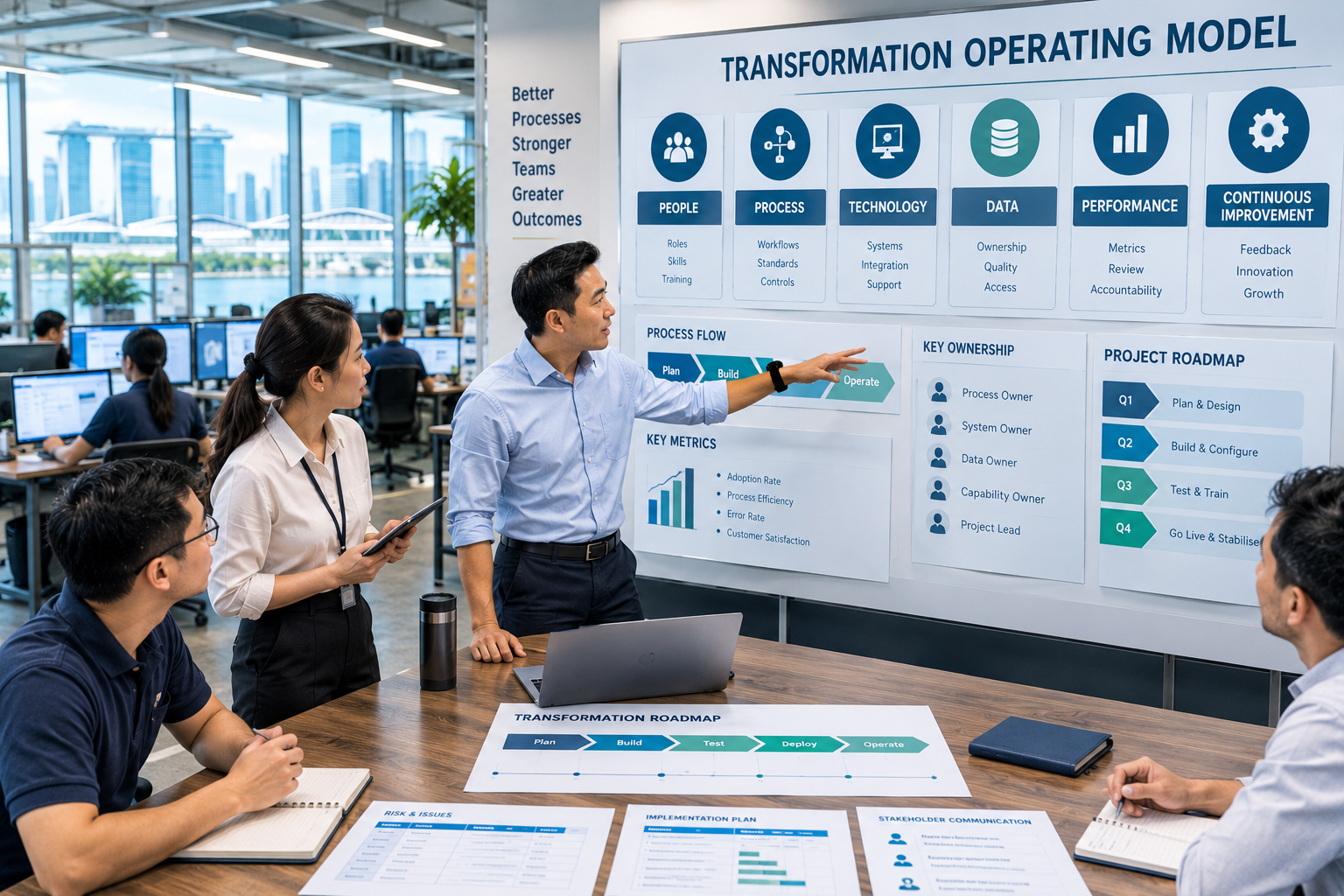
A transformation operating model is the practical structure that determines how a new capability is used, managed and improved after implementation.
It normally covers six connected areas:
These elements must work together.
For example, introducing a new customer relationship management system will not improve sales performance if:
The operating model ensures that the technology, people and management routines reinforce one another.
A project is temporary. An operating model is ongoing.
Project Structure
Operating Model
Focuses on implementation
Focuses on sustained execution
Has a defined start and end
Continues after project closure
Measures deliverables and milestones
Measures adoption and business performance
Often led by a project team
Owned by operational and management teams
Introduces new systems or processes
Makes those systems and processes part of normal work
Relies on temporary coordination
Establishes permanent responsibilities
Resolves implementation issues
Maintains and improves the new capability
The project may deliver a new process. The operating model determines whether the process becomes the standard way of working.
Transformation becomes difficult to sustain when the project is treated as a technical or administrative exercise rather than an organisational change.
Common causes include:
A project team may design a new process without sufficiently involving the people who will use it every day.
This can result in workflows that appear logical on paper but are difficult to execute in practice.
The project may have a project manager, but no permanent owner is assigned to maintain the capability after handover.
Without ownership, issues remain unresolved and standards gradually weaken.
Employees may receive training on a new system but continue following old written procedures, approval rules or reporting formats.
This creates confusion and encourages workarounds.
If employees are still evaluated using the old process, they may have little incentive to adopt the new one.
For example, a new quality-control process may require more accurate documentation, while performance targets focus only on production volume.
A reporting platform will not improve decision-making if management continues relying on informal messages, outdated spreadsheets or personal judgement without reviewing the new data.
If internal employees cannot maintain, adjust or troubleshoot the new capability, the business may become dependent on external support.
A sustainable operating model must include knowledge transfer and internal capability development.
The people layer defines who is responsible for operating and improving the new capability.
It should answer:
A practical structure may include the following roles.
The executive sponsor ensures that the capability remains aligned with the company’s strategic priorities.
This role may review:
The capability owner is accountable for the ongoing performance of the new process, system or organisational capability.
For example, the capability owner may be:
The capability owner should not merely maintain the system. The role should include responsibility for whether the capability continues to create business value.
Process owners manage specific workflows and ensure that employees follow agreed standards.
Examples include:
System owners manage system configuration, access, support and technical coordination.
Data owners are responsible for the quality, definition, access and appropriate use of important data sets.
Frontline users are responsible for applying the new process correctly and identifying practical issues that management may not see.
Their feedback should be part of the continuous-improvement process.
A transformation operating model should document how work is expected to flow after implementation.
This includes:
A process should be clear enough that a trained employee can perform it consistently without relying on informal instructions from one experienced colleague.
Not every transaction will follow the standard workflow.
For this reason, the operating model should distinguish between:
For example, a digital purchasing workflow may require all purchases above a certain value to receive additional approval. The operating model should specify:
Without this clarity, employees may bypass the new process whenever a situation becomes inconvenient.
Technology should support the operating model rather than become the operating model itself.
The business should define how systems will be used in daily work.
This includes:
A new platform should not create uncertainty about where work belongs.
For example, if customer information can be updated in several spreadsheets, email records and software systems, the company may continue to experience inconsistent data even after implementing a new platform.
The operating model should identify the authoritative system and establish rules for how information is created, updated and used.
Data becomes more valuable when ownership and usage are clearly defined.
A practical data operating model should establish:
Businesses should also define which data is used for which decisions.
For example:
The goal is to prevent data from becoming a passive storage resource. It should become part of a repeatable management process.
An operating model must explain how the business will know whether the new capability is working.
Performance measures should cover more than system usage.
A useful framework includes four levels.
These show whether employees are using the new capability.
Examples:
These show whether the redesigned workflow is operating as intended.
Examples:
These show whether the project is producing meaningful organisational value.
Examples:
These show whether the business has become more self-sufficient.
Examples:
The operating model should define who reviews each metric and what action is taken when performance falls below the expected level.
A new capability is more likely to become embedded when management reviews it consistently.
Review routines may include:
These focus on immediate execution issues such as:
These focus on:
These focus on:
Without these review routines, transformation can gradually become disconnected from management priorities.
A new capability should be reflected in the company’s formal operating documents.
These may include:
Documentation should be practical rather than excessive.
A good procedure should make clear:
If the new capability is not reflected in these documents, employees may reasonably continue following older instructions.
External providers may design, configure or implement the transformation solution. However, the business should plan the handover from the beginning.
A proper handover should include:
The company should also confirm that internal employees can perform essential tasks without waiting for the provider.
These tasks may include:
The objective is not necessarily to eliminate external support. It is to ensure that the business retains sufficient internal control and understanding.
Transformation should not be treated as a one-time event.
After implementation, the business will learn more about:
The operating model should create a controlled way to respond.
A continuous-improvement process may include:
This prevents employees from making uncontrolled changes that create inconsistency across departments.
A presentation from the provider is not the same as a structured transfer of operational capability.
Many transformation outcomes depend on business processes, employee behaviour and management decisions. Technology ownership alone is insufficient.
Go-live status does not prove adoption, productivity improvement or business value.
Parallel processes may be useful during a transition, but they can create duplicate work and conflicting information if not phased out.
Employees need to understand how their roles change after transformation.
Workarounds may reveal legitimate process weaknesses. They should be investigated rather than simply prohibited.
New employees, role changes and system updates create ongoing training requirements.
A transformation project becomes strategically valuable when the business can continue using and improving the new capability without depending on constant external intervention.
This requires more than implementation.
It requires:
For EDGE-related projects, this operating discipline is particularly important because the broader objective is enterprise development, capability building and sustainable business improvement.
The strongest businesses do not simply ask, “Has the project been completed?”
They also ask:
Before closing a transformation project, management should confirm:
Is there a permanent owner for the new capability?
Are process owners and system owners clearly identified?
Have responsibilities been updated?
Are standard operating procedures complete?
Are exception and escalation procedures documented?
Is the official system of record clearly defined?
Are data definitions and ownership responsibilities established?
Are adoption, process and business-outcome metrics being tracked?
Are management review routines in place?
Has the provider completed a structured handover?
Can internal employees perform essential support tasks?
Have training materials been updated?
Are old workarounds being monitored and addressed?
Is there a controlled continuous-improvement process?
Will the business review the capability after project closure?
If your Singapore business is planning an EDGE-supported transformation project, Grant Consulting can help you design the operating model needed to sustain the project’s outcomes.
We can assist with capability ownership, process redesign, governance routines, performance measurement, internal readiness and post-implementation planning.
Call us now to discuss how your business can turn transformation investment into lasting operational capability:
 WhatsApp us
```