Business transformation is inherently uncertain.
Whether a company is implementing AI, redesigning workflows, expanding overseas or introducing new technology, there will always be factors that threaten successful delivery.
Many SMEs assume risk management is only necessary for large corporations.
In reality, smaller businesses often have less capacity to absorb project failures, making risk management even more important.
Under EDGE, businesses should view risk management as part of good project governance rather than merely a compliance exercise.
Well-managed projects anticipate challenges before they become expensive problems.
Project risk management is the process of identifying, assessing, monitoring and responding to uncertainties that may affect project outcomes.
Risks may affect:
Good risk management does not eliminate uncertainty.
It improves preparedness.
EDGE is expected to support a wide range of enterprise transformation initiatives.
These projects frequently involve:
Each introduces different risks.
Businesses that identify these risks early are more likely to complete projects successfully while protecting grant eligibility and achieving meaningful transformation.
Some organisations avoid discussing risks because they fear appearing unprepared.
The opposite is usually true.
Professional project management recognises that every project contains uncertainty.
Ignoring risk rarely prevents problems.
Discussing risks early usually reduces them.
Experienced assessors often view realistic risk planning as evidence of organisational maturity.
Common mistakes include:
Assuming the vendor owns all project risks.
Only discussing risks after problems occur.
Ignoring employee adoption risks.
Underestimating data quality issues.
Failing to monitor project milestones.
Treating implementation delays as temporary until deadlines are missed.
Not documenting decisions.
Poor communication between departments.
Each increases the likelihood of project disruption.
Begin by identifying realistic project risks.
Examples include:
Vendor delays.
Resource shortages.
Staff turnover.
Technology integration issues.
Scope misunderstandings.
Poor data quality.
Regulatory changes.
Supplier dependency.
Customer disruption.
Low employee adoption.
The objective is awareness rather than prediction.
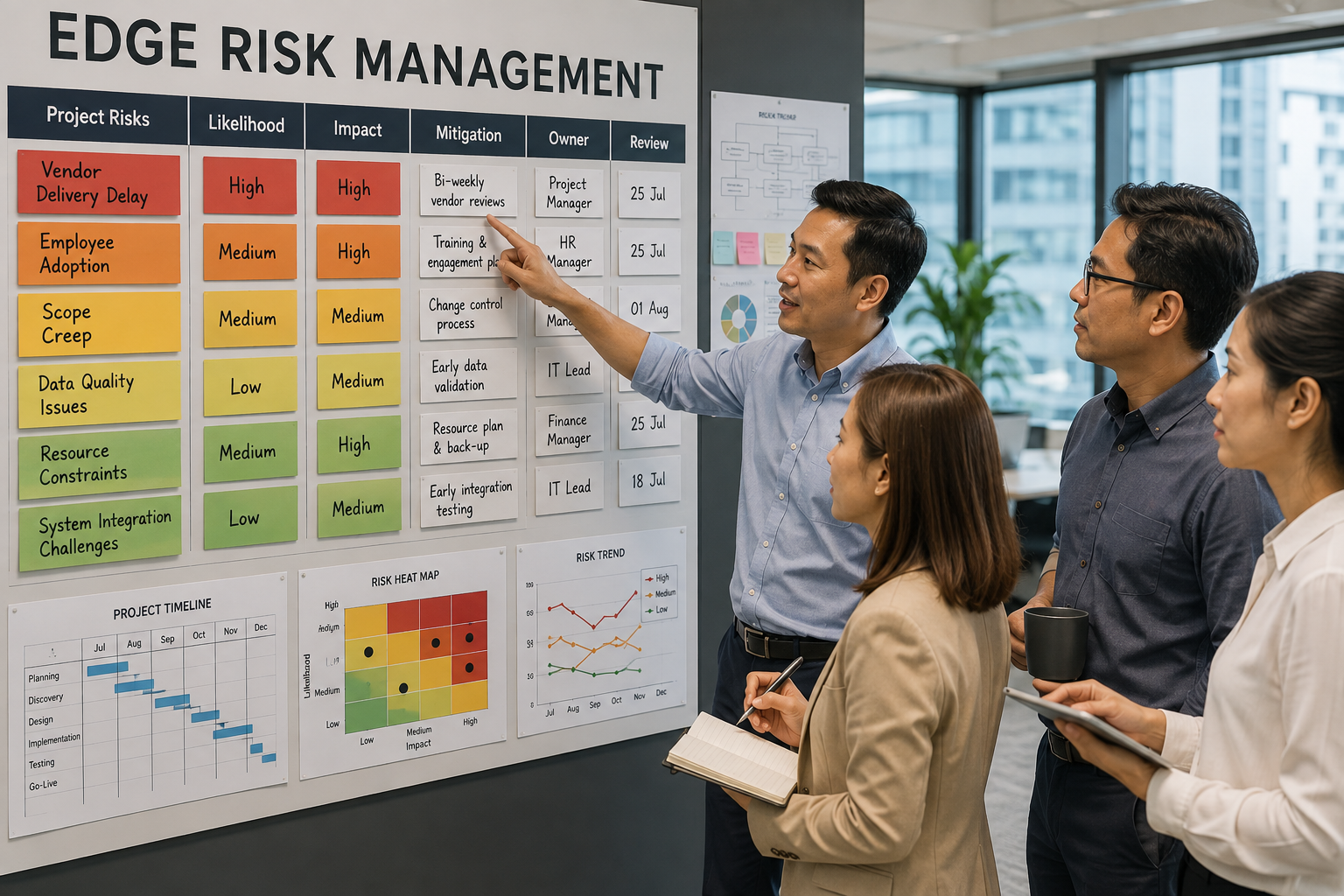
Each risk should be evaluated using two questions:
How likely is it?
How significant would the impact be?
High likelihood and high impact risks deserve immediate attention.
Lower-impact risks may simply require monitoring.
This simple prioritisation prevents management from treating every risk equally.
Every important risk should have an owner.
Examples include:
Project Manager.
Operations Manager.
Finance Manager.
IT Lead.
Department Head.
Senior Management Sponsor.
Without ownership, risks often remain unresolved because everyone assumes someone else is handling them.
Each significant risk should have a practical response.
Examples:
Vendor delay → schedule milestone reviews every two weeks.
Low adoption → conduct additional employee training.
Poor data quality → perform early data validation.
Resource constraints → identify backup personnel.
Scope uncertainty → document change requests formally.
Mitigation reduces probability or impact.
Risk management continues throughout implementation.
Businesses should review risks during:
Project meetings.
Milestone reviews.
Management updates.
Vendor discussions.
Claims preparation.
New risks often emerge as projects progress.
Many failed projects begin with seemingly minor issues.
A delayed workshop.
A missing document.
A postponed training session.
An unclear deliverable.
Left unresolved, these small issues accumulate until the project struggles to meet objectives.
Early intervention is usually far less expensive than late recovery.
Even experienced vendors face challenges.
Potential issues include:
Missed milestones.
Incomplete deliverables.
Poor communication.
Insufficient documentation.
Resource shortages.
Regular milestone reviews reduce these risks.
Systems only create value when employees use them.
Potential issues include:
Resistance to change.
Low training attendance.
Continued use of legacy processes.
Poor management support.
Adoption planning should begin before implementation.
Projects often expand beyond their original objectives.
Examples:
Additional software modules.
Extra consulting activities.
New overseas markets.
Additional reporting requirements.
Without formal control, scope creep affects timelines, budgets and grant compliance.
Delays may arise from:
Internal approvals.
Vendor availability.
Technical complexity.
Competing business priorities.
Unexpected operational demands.
Realistic scheduling reduces unnecessary pressure.
Businesses should monitor:
Cash flow.
Vendor payment schedules.
Budget variance.
Unexpected implementation costs.
Grant reimbursement timing.
Financial planning remains important even with grant support.
Technology projects may encounter:
System compatibility issues.
Data migration challenges.
Cybersecurity considerations.
User access problems.
Integration complexity.
Testing should occur before full deployment.
Transformation should not disrupt normal operations unnecessarily.
Businesses should prepare contingency plans for:
Critical workflows.
Customer service.
Order processing.
Finance operations.
Operational continuity protects both customers and employees.
A practical risk register may include:
Risk description.
Likelihood.
Impact.
Owner.
Mitigation plan.
Review date.
Current status.
This document does not need to be complex.
Consistency matters more than sophistication.
Senior management should regularly review:
Major project risks.
Emerging issues.
Resource allocation.
Vendor performance.
Project health.
Leadership attention signals organisational commitment.
Risk discussions improve decision-making.
Rather than reacting emotionally during project challenges, businesses can evaluate options objectively.
For example:
Continue implementation?
Adjust timeline?
Modify resources?
Escalate vendor concerns?
Review project scope?
Structured risk management improves decision quality.
Indicators include:
Projects completed on schedule.
Limited scope deviations.
High employee adoption.
Strong vendor performance.
Clean claims documentation.
Business outcomes achieved.
These outcomes reflect disciplined project management rather than simply good fortune.
Before implementation, ask:
If several answers are no, risk management should be strengthened before project execution accelerates.
Business transformation is never completely predictable.
The most successful organisations do not eliminate uncertainty.
They build systems that allow uncertainty to be managed intelligently.
That discipline improves project execution, strengthens governance, increases organisational capability and supports better long-term business performance.
Risk management is therefore not simply about protecting grant funding.
It is about building a stronger business.
Planning an EDGE-supported transformation project?
We help Singapore businesses identify project risks, strengthen governance, improve implementation discipline and develop practical risk management frameworks that support successful transformation and grant outcomes.
Book a 30-minute, no-obligation discussion:
https://www.grant-consulting.org/contact
 WhatsApp us
```