EDGE is expected to simplify how Singapore businesses access support by consolidating EDG, MRA and PSG into one grant scheme.
That is helpful for companies that previously struggled to decide which scheme applied to their project.
But easier navigation does not mean every business should rush to submit.
A company may be technically eligible, but not yet ready.
This distinction matters.
Grant readiness is not just about whether the company is registered in Singapore, has local shareholding, meets scheme criteria or can identify a possible project. It is also about whether the company can explain, execute, fund, document and sustain the project properly.
Under EDGE, businesses should think less like subsidy applicants and more like transformation owners.
An EDGE readiness assessment is a practical review of whether a business is prepared to apply for, execute and claim a grant-supported project.
It asks:
Is the business problem clearly defined?
Is the project strategically relevant?
Is management committed?
Is there an internal project owner?
Is the vendor scope credible?
Is the budget reasonable?
Can the company fund the project upfront?
Can the company execute within the proposed timeline?
Can the company provide documentation for claims?
Will the project create lasting business capability?
If the answer to several of these questions is no, the company may need to strengthen the project before applying.
EDGE will create a single scheme across support areas that were previously spread across EDG, MRA and PSG.
This may reduce confusion at the scheme-selection stage.
However, it may also raise the importance of internal project discipline.
When businesses apply based on intended activities, assessors will need to understand whether the activity is commercially meaningful, properly scoped and capable of producing real business outcomes.
A weak application may no longer be able to hide behind scheme terminology.
The question becomes simpler but sharper:
Is this a serious enterprise development project?
That is why readiness matters.
Many businesses ask the wrong first question.
They ask:
“Are we eligible?”
That is important, but incomplete.
A better question is:
“Are we ready to execute a credible project that deserves support?”
Eligibility is the baseline.
Readiness determines whether the project is strong.
A business can be eligible but still unready if:
The project objective is vague.
The vendor proposal is weak.
The budget is not properly broken down.
Management has not committed time.
The company cannot fund the project upfront.
The project owner is unclear.
The expected outcomes are unrealistic.
Claims evidence has not been considered.
A grant application should not be used to force clarity. The business should create clarity before applying.
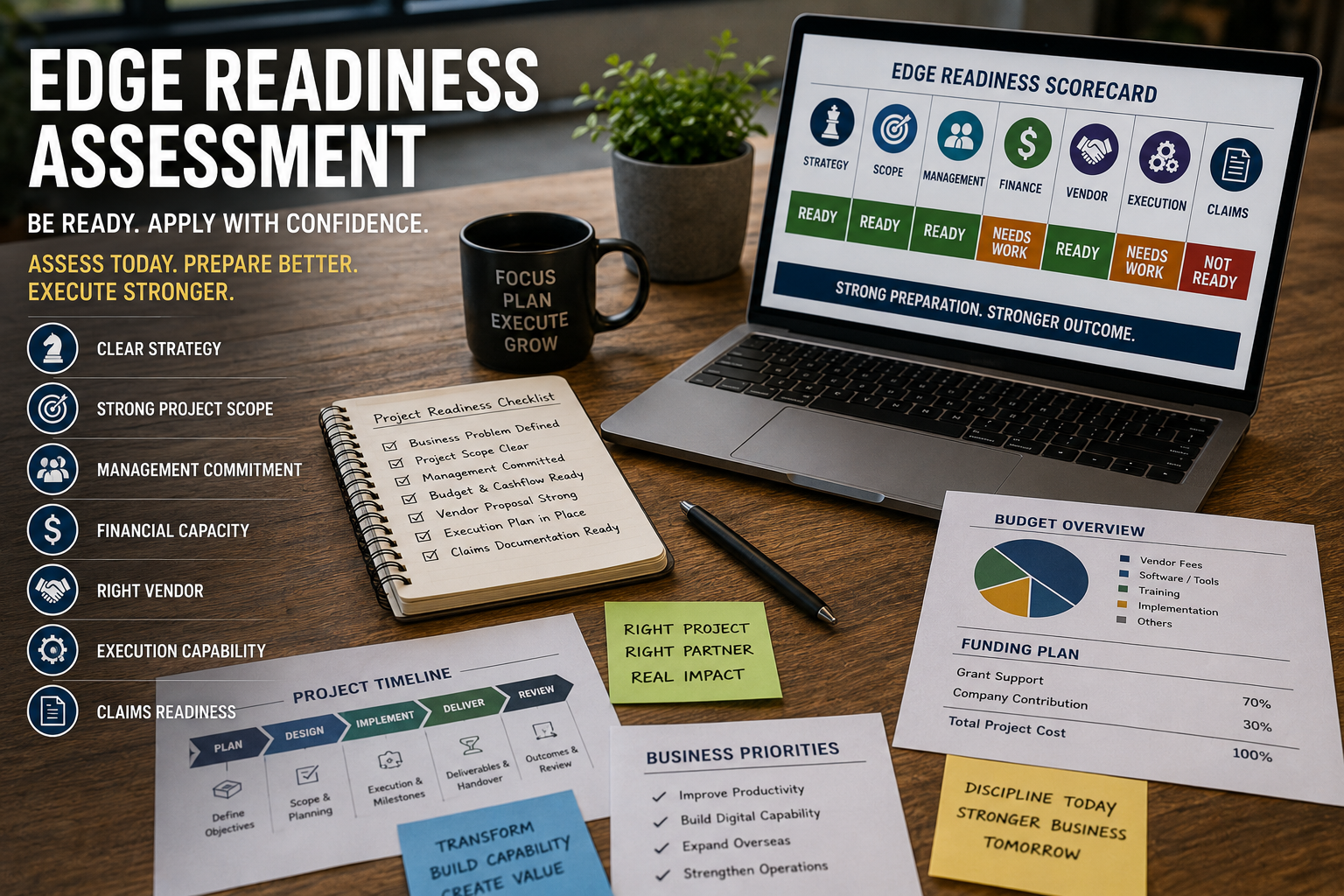
A practical EDGE readiness assessment should cover seven areas.
Strategic readiness asks whether the project matters to the business.
The project should connect to a real business priority, such as:
Improving productivity
Strengthening operational efficiency
Expanding into new markets
Building digital capability
Improving management systems
Developing new business processes
Enhancing customer acquisition
Strengthening governance or reporting
A project is weaker when it is driven mainly by grant availability.
For example, a company should not implement a system simply because funding may be available. It should implement the system because the current operating model is limiting growth, efficiency or control.
Assessors are more likely to understand a project when it is linked to a clear business problem.
A strong strategic rationale explains:
Why the project is needed
Why now
What business constraint it addresses
How it supports growth or transformation
What will improve after completion
Without this, the project may look opportunistic.
Project scope readiness asks whether the company can describe exactly what will be done.
A ready project should have:
Clear objectives
Defined workstreams
Specific deliverables
Practical milestones
A realistic timeline
Named internal owners
Clear vendor responsibilities
Measurable outcomes
A vague project is not ready.
For example:
“We want to digitalise operations” is too broad.
“We want to implement an order processing workflow that reduces manual data entry, improves fulfilment visibility and standardises reporting across sales and operations” is stronger.
Scope clarity helps the business prepare a better application and manage execution after approval.
Many companies confuse intention with scope.
Intention says what the company wants.
Scope says what the project will actually do.
EDGE applications should be based on scope, not aspiration.
Management readiness is often underestimated.
A grant project needs leadership attention.
This is especially true for projects involving:
Digital transformation
AI adoption
Overseas expansion
Process redesign
Productivity improvement
Capability building
Governance improvement
Management must be willing to provide direction, make decisions, allocate resources and resolve trade-offs.
If management treats the project as an administrative grant exercise, implementation may fail.
Vendors can support the project.
Advisors can help prepare the application.
But the business must own the transformation.
Management should be clear on:
Why the project matters
Who is accountable
What decisions are required
What success looks like
How adoption will be managed
How the project will continue after grant support ends
Without management readiness, the project may be approved but poorly implemented.
Financial readiness asks whether the company can fund the project properly.
Many businesses focus on the grant quantum and forget that they may need to pay vendors first before reimbursement.
This creates cash flow pressure.
A company should assess:
Can we pay the vendor according to the agreed milestones?
Do we understand which costs may be supportable?
Do we have sufficient working capital?
Can we absorb non-supported costs?
Can we wait for claims processing?
Can we manage GST, deposits and payment timing?
This is critical.
Grant support should strengthen the business. It should not create cash flow stress.
A company that cannot fund the project upfront may delay implementation, miss milestones or struggle with vendor payments.
This can affect project completion and claims.
Before applying, businesses should prepare a simple project cash flow plan.
This should show:
Vendor payment milestones
Expected grant support
Company co-funding
Timing of invoices
Expected claim timing
Cash buffer
Financial readiness is part of execution discipline.
Vendor readiness asks whether the selected consultant or solution provider is suitable.
A ready vendor proposal should include:
Clear scope of work
Detailed deliverables
Timeline
Cost breakdown
Project team
Assumptions
Exclusions
Client responsibilities
Documentation support
A weak vendor proposal creates application risk.
It also creates implementation risk.
Businesses should be cautious if the vendor:
Uses a generic template
Cannot explain deliverables
Provides a lump-sum quotation without detail
Focuses mainly on grant approval
Cannot support completion documentation
Does not understand the business problem
Over-scopes the project
Under-scopes the project
A strong EDGE application is easier to build when the vendor proposal is clear and commercially logical.
Execution readiness asks whether the company can actually deliver the project.
This includes internal resources such as:
Project sponsor
Project manager
Department representatives
Finance support
Operations support
IT support
End users
Decision makers
The company should know who will attend meetings, review deliverables, test systems, provide data, approve changes and sign off completion.
Execution readiness is especially important for SMEs because the same people often handle daily operations and transformation projects at the same time.
Businesses often underestimate internal workload.
They assume the vendor will do everything.
But even vendor-led projects require company input.
For example, a CRM implementation requires sales process input, user testing, data migration decisions and adoption management.
An overseas expansion project requires management interviews, market positioning, pricing information and follow-up with potential partners.
An AI project requires workflow definition, data access, testing, human review and risk controls.
A business that cannot allocate internal time may not be ready.
Claims readiness asks whether the company can prove that the project was completed properly.
This is often considered too late.
Businesses should think about claims before applying.
Claim evidence may include:
Approved scope
Signed vendor quotation
Invoices
Proof of payment
Project reports
Meeting records
Training records
System screenshots
Deliverable acceptance
Final completion report
Outcome tracking
Claims readiness matters because approval alone is not the end of the process.
The company must be able to complete the project and support reimbursement.
If the company can already visualise the evidence required at completion, the project is usually better scoped.
This forces the business to ask:
What deliverables will exist?
Who will accept them?
How will we prove completion?
What documents will we keep?
How will we show business impact?
This improves both application quality and execution discipline.
Businesses can use a simple internal scorecard before applying.
Rate each area from 1 to 5.
Strategic relevance
Project scope clarity
Management commitment
Financial capacity
Vendor suitability
Execution capacity
Claims documentation readiness
A score of 5 means the area is strong.
A score of 3 means the area needs clarification.
A score of 1 means the project is not ready.
As a practical guide:
31 to 35: Strong readiness
24 to 30: Generally ready, but tighten weaker areas
17 to 23: Significant preparation needed
Below 17: Do not rush the application
This scorecard is not an official government assessment tool. It is a practical management tool to help companies avoid weak submissions.
A Singapore company wants to apply for EDGE to implement an AI customer service chatbot.
It is eligible and has received a vendor quotation.
However:
The company has not defined the customer service problem clearly.
The vendor proposal lists features but not workflow changes.
There is no internal project owner.
The company has not decided who will review AI-generated responses.
There is no training plan.
The budget is a lump sum.
No one has considered what documents are needed for claims.
This company may be eligible, but it is not ready.
The project should be strengthened before application.
Another company wants to improve its sales operations.
It has identified that leads are currently managed across WhatsApp, spreadsheets and email, causing poor follow-up and limited management visibility.
The project scope includes:
CRM workflow design
Lead qualification stages
Pipeline dashboard
User training
Testing
Go-live support
Post-implementation review
The vendor proposal is broken into phases.
Management has appointed a project owner.
The finance team has mapped payment milestones.
The company knows what completion evidence will be collected.
This project is much closer to EDGE readiness.
Your business may not be ready if:
You cannot explain the project in one paragraph.
The main reason for the project is “there is a grant”.
The vendor is driving the entire scope.
The quotation is vague.
The expected outcomes are not measurable.
Management has not reviewed the project.
The internal project owner is unclear.
The company cannot pay the upfront costs.
You have not considered claim documents.
The project feels rushed.
These signs do not mean the project should be abandoned. They mean the project needs more preparation.
Businesses can improve readiness by taking several practical steps.
First, write a clear problem statement.
Second, define project objectives and expected outcomes.
Third, prepare a scope note before collecting vendor proposals.
Fourth, request detailed vendor quotations.
Fifth, appoint an internal project owner.
Sixth, prepare a simple project cash flow plan.
Seventh, identify claim documents before starting.
Eighth, align management on the business case.
This preparation can significantly improve application quality.
Some businesses see readiness assessment as extra work.
It is actually a time saver.
A project that is not ready often leads to:
Repeated clarification requests
Vendor proposal revisions
Internal disagreement
Budget changes
Delayed submission
Execution problems
Claims difficulties
A ready project is easier to write, easier to assess, easier to execute and easier to claim.
The deeper point is this:
EDGE readiness is not just a grant issue.
It reflects whether the company has the management discipline to run transformation projects.
This is why grants should be treated as part of enterprise development, not as administrative subsidies.
A company that learns to scope, fund, execute and document projects properly becomes stronger even beyond the grant.
That is the real value.
If you are unsure whether your business is ready to apply for EDGE, or if you need help assessing your project scope, vendor proposal, budget, execution plan or claims documentation, speak with us before submitting.
We help Singapore businesses prepare grant-ready projects, structure strong applications, respond to clarifications, and support the process through approval and claims.
Book a 30-minute, no-obligation discussion here:
 WhatsApp us
```
WhatsApp us
```