
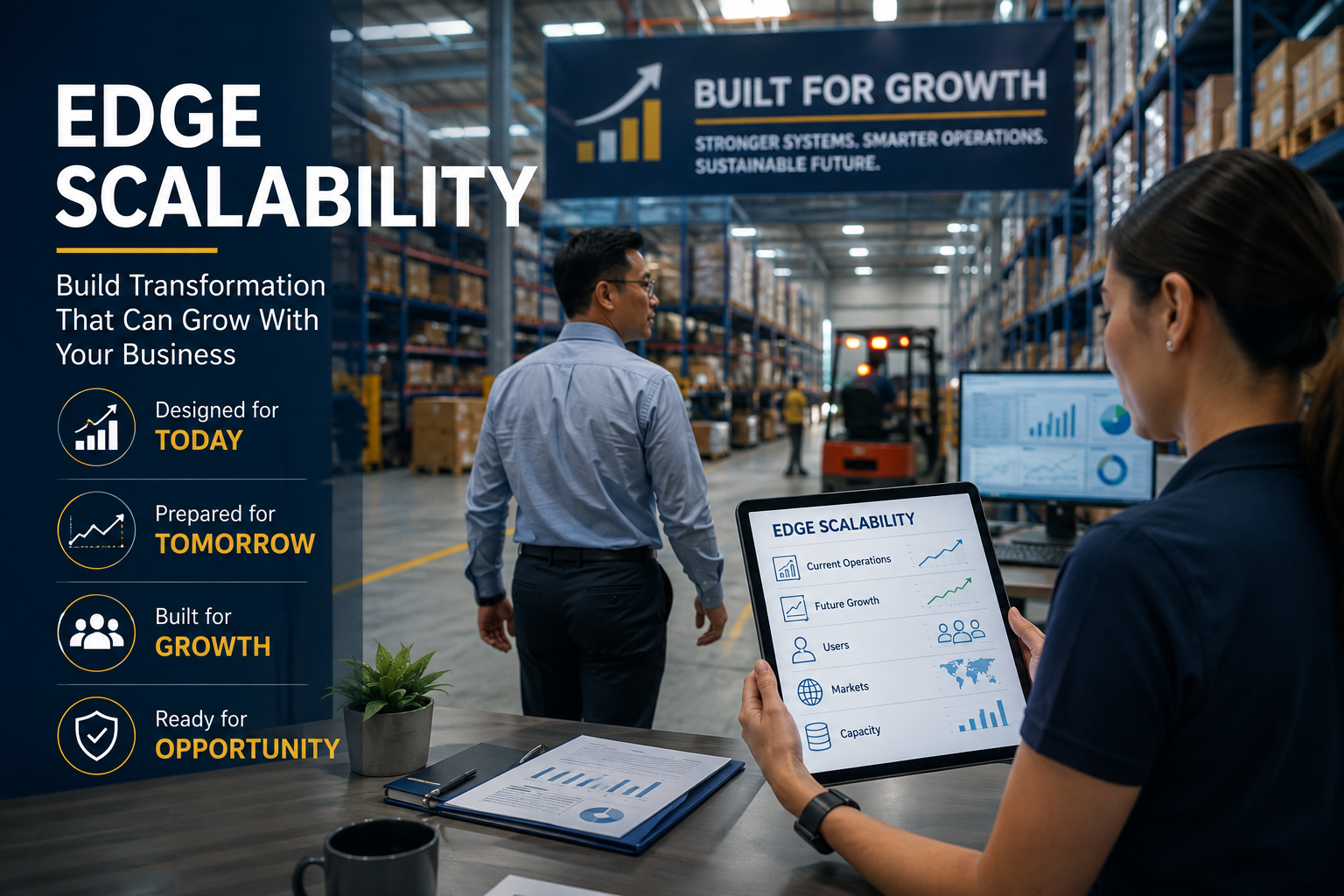
A business transformation project can succeed today and still create problems tomorrow.
A company may implement a system that works for 10 employees but becomes difficult to manage at 50.
A workflow may solve current transaction volumes but collapse when sales double.
A reporting process may work while the founder personally reviews every number but become ineffective once several departments are involved.
A market-entry process may work for one country but provide no repeatable method for entering the next.
This is the difference between implementation and scalability.
Implementation asks:
“Does this work now?”
Scalability asks:
“Will this continue to work when the business becomes more complex?”
That second question is increasingly important when planning an EDGE transformation project.
Singapore's Business Refresh Package positions EDGE as a way to streamline access to support currently provided through EDG, MRA and PSG, while helping businesses improve productivity, efficiency and growth.
For businesses, the strategic opportunity is not simply to solve one operational problem.
It is to build capabilities that can support the next stage of growth.
EDGE project scalability means designing a transformation so that it can accommodate reasonable future increases in:
Revenue
Customers
Employees
Transactions
Products
Business locations
Markets
Data
Management complexity
Scalability does not mean building an unnecessarily expensive enterprise system from day one.
It means avoiding solutions that are so narrow that they immediately become obsolete when the company grows.
The objective is proportionate design.
Build for today's needs.
But understand tomorrow's requirements.
A grant-supported project may represent a significant management investment even when grant support is available.
Management time is required.
Employees need to learn new processes.
Vendors need to be coordinated.
Data may need to be migrated.
Systems may need to be integrated.
Processes may need to change.
If the company has to repeat the entire transformation shortly afterwards because the original solution could not scale, much of that effort is wasted.
Good transformation planning therefore considers the company's growth trajectory before implementation begins.
Businesses sometimes evaluate transformation projects almost entirely on initial cost.
That can be misleading.
Consider two options.
Option A is inexpensive but requires manual workarounds as transaction volume increases.
Option B costs more to implement but provides better integration, controls and scalability.
Option A may look cheaper initially.
But if the company has to replace it in 18 months, the total cost may be significantly higher.
This does not mean businesses should automatically choose the most sophisticated technology.
It means total business value should be considered.
Businesses often make one of two mistakes.
The company tells the vendor:
“We only need this for our current operations.”
The vendor builds around today's structure.
Six months later:
A new department is added.
New products are launched.
More customers arrive.
The workflow becomes difficult to manage.
The opposite problem is buying an unnecessarily complex solution.
The business pays for capabilities it does not need.
Employees struggle to adopt it.
Implementation takes too long.
Management becomes frustrated.
The system becomes underutilised.
Both approaches are poor transformation strategy.
The right question is:
“What level of capability do we need now, and what reasonable growth should the solution accommodate?”
Technology should not determine the growth strategy.
The business strategy should determine the transformation requirements.
Before designing a project, management should consider:
Where do we expect growth?
Which products will expand?
Which markets are important?
Which processes will become bottlenecks?
Which departments will become more complex?
Where is management currently dependent on individuals?
Which activities should become standardised?
Which capabilities must be built internally?
These questions help determine what the transformation actually needs to support.
Businesses can assess scalability across five dimensions:
People
Processes
Technology
Data
Markets
Each dimension can create a bottleneck.
For example:
A system may scale technically, but employees may not understand it.
Employees may be capable, but processes may remain inconsistent.
Processes may be standardised, but data may be fragmented.
Data may be structured, but the system may not support overseas operations.
Scalability requires these elements to work together.
A solution should not depend on one employee knowing how everything works.
This creates key-person risk.
Ask:
Can a new employee be trained quickly?
Are responsibilities clearly defined?
Are processes documented?
Can another manager take over?
Are approvals structured?
Is knowledge stored centrally?
A scalable business gradually reduces dependence on individual memory.
Process scalability is often overlooked.
A workflow may work perfectly when there are 20 orders per day.
But what happens at 100?
What happens when three people need to approve something?
What happens when customers request exceptions?
What happens when multiple markets use the same process?
Good process design identifies bottlenecks before they become operational problems.
Technology scalability depends on more than software capacity.
Businesses should consider:
User expansion
Integration capability
Data structure
Reporting requirements
Security controls
Workflow flexibility
Automation capability
Configuration options
Vendor support
Migration requirements
Future compatibility
The objective is not to predict every future requirement.
That is impossible.
The objective is to avoid obvious limitations.
Growth creates more data.
More transactions.
More customers.
More products.
More markets.
More employees.
More reporting requirements.
A scalable transformation should therefore consider how data is captured, stored, structured and reviewed.
If every department maintains its own spreadsheet, management visibility becomes increasingly difficult as the company grows.
A stronger approach creates consistent data definitions and reporting structures.
For companies pursuing overseas expansion, scalability also means geographic adaptability.
Ask:
Can the process support multiple currencies?
Can reporting accommodate different markets?
Can customer information be segmented by country?
Can pricing structures be adapted?
Can the sales pipeline distinguish markets?
Can local partners be managed consistently?
Can the company replicate its market-entry process?
A successful first overseas market should ideally become a learning platform for the next one.
One of the strongest indicators of scalability is repeatability.
Can the company repeat the process?
For example:
Can the sales process be replicated across teams?
Can a new branch adopt the same operating framework?
Can a new country use the same market-entry methodology?
Can new employees follow the same workflow?
Can management generate the same reports without depending on one person?
Repeatability turns transformation into organisational capability.
Digital transformation is particularly vulnerable to poor scalability decisions.
A company may adopt several disconnected tools because each solves one immediate problem.
One system for sales.
Another for accounting.
Another for inventory.
Another for project management.
Another for HR.
Another for reporting.
Each tool may work individually.
But the organisation becomes increasingly fragmented.
The next challenge becomes integration.
This is why digital transformation should be assessed at the workflow level, not only at the software level.
Before adopting a new system, ask:
What information enters this system?
Where does it go next?
Who uses it?
Does another department need the same information?
Will information have to be re-entered manually?
Can systems exchange data?
What happens if transaction volume doubles?
These questions expose scalability problems early.
AI projects should also be designed with scale in mind.
A company might begin with one use case.
For example:
Document summarisation.
Customer enquiry assistance.
Internal knowledge search.
Sales analysis.
The next question should be:
If this works, can the organisation deploy the capability across other workflows?
That requires consideration of:
Data quality
User access
Human review
Governance
Security
Training
Workflow integration
Performance measurement
AI should not become a collection of disconnected experiments.
The strongest projects create a foundation for broader adoption.
Productivity projects should examine whether efficiency improvements can survive growth.
For example:
A company automates one administrative task.
The task becomes faster.
But another manual bottleneck appears elsewhere.
This is why businesses should examine the entire process.
Ask:
Where does the work start?
Where does it end?
Where are approvals required?
Where is data re-entered?
Where are delays created?
Where does work move between departments?
Improving one step may simply move the bottleneck.
Internal capability also needs to scale.
Training one manager is not enough if the business expects to grow significantly.
Businesses should consider:
Training materials
SOPs
Internal champions
Onboarding processes
Knowledge repositories
Management routines
Refresher training
New employee induction
The goal is to make capability transferable.
Internationalisation creates a particularly strong need for repeatability.
A company should learn from its first market.
Document:
How partners were identified
How markets were assessed
How pricing was evaluated
How local requirements were researched
How customers were approached
How distributors were selected
How opportunities were qualified
This converts one market-entry project into an internal internationalisation capability.
A scalable project scope should clearly distinguish:
Current problem
Immediate solution
Expected business outcome
Future operating requirements
Potential expansion path
The scope should not include every hypothetical future requirement.
Instead, it should establish a strong foundation.
For example:
Current requirement:
Centralise sales pipeline management.
Scalable design:
Create standard customer, opportunity and reporting structures that can support additional sales teams and markets.
This is a better way to think about future readiness.
Scalability should not become an excuse for overengineering.
A company does not need to design for 1,000 employees if it currently has 30 and has no realistic path to that scale.
It does not need a multinational architecture because it might someday enter 20 countries.
The right question is:
What growth is reasonably foreseeable?
Then design accordingly.
This is strategic discipline.
A scalable transformation gives management options.
The company can:
Add users
Add products
Add markets
Add workflows
Add automation
Add reporting
Add locations
Without rebuilding the entire operating model.
Optionality has strategic value.
It allows management to respond faster when opportunities emerge.
Businesses should not assume that “scalable” automatically makes a project more attractive.
The project still needs a clear business rationale.
The important connection is:
Business problem → transformation → capability → measurable outcome → future relevance.
For current EDG applications, EnterpriseSG states that applications are assessed based on factors including project scope, project outcomes and service-provider competency.
As EDGE brings together support previously associated with EDG, MRA and PSG, businesses should continue thinking in terms of the business case rather than simply the grant category.
A strong transformation plan can document:
Current operating model
Current limitations
Expected growth
Future requirements
Process bottlenecks
System limitations
Proposed solution
Implementation roadmap
Training requirements
Adoption plan
Expected outcomes
Scalability considerations
This helps management understand why the project is necessary.
It also creates a clearer basis for evaluating vendor proposals.
When evaluating a vendor, ask:
How does the solution support additional users?
How does it support additional locations?
How does it support multiple markets?
Can workflows be changed without rebuilding the system?
What integrations are available?
How does data migrate?
What happens when transaction volume increases?
What functionality is available later?
What requires additional licensing?
What internal skills will we need?
How much ongoing vendor dependency should we expect?
These questions often reveal more than a product demonstration.
Businesses should look beyond initial implementation cost.
Consider:
Implementation
Licensing
Maintenance
Training
Integration
Upgrades
Internal manpower
Vendor support
Future expansion
Data migration
Replacement risk
A scalable solution may have a higher initial cost but lower long-term disruption.
Conversely, an expensive platform may still provide poor value if employees do not adopt it.
The decision should be based on total business value.
Before approving an EDGE transformation project, ask:
If several answers are unclear, the project may not yet be ready for implementation.
Businesses often invest in transformation only after a problem becomes painful.
Orders are missed.
Reporting becomes unreliable.
Employees are overwhelmed.
Systems stop communicating.
Management loses visibility.
Customers experience delays.
The business then spends significant time fixing the consequences.
A better approach is anticipatory transformation.
Identify the bottleneck.
Understand the growth trajectory.
Build the capability before the limitation becomes critical.
This is not about spending ahead of need.
It is about investing intelligently before complexity becomes expensive.
The deeper value of scalability is enterprise maturity.
A mature company does not simply react to growth.
It builds systems and capabilities that allow growth to happen without proportionally increasing complexity.
That means:
Better processes
Better data
Better management visibility
Better technology foundations
Better employee capability
Better governance
Better decision-making
EDGE should therefore be viewed as an opportunity to strengthen the operating platform of the business.
Not simply to fund an isolated project.
If you are considering an EDGE project and want to ensure the proposed transformation is commercially justified, scalable and aligned with your company's next stage of growth, speak with us before committing to a solution or vendor.
We help Singapore businesses structure transformation projects around business strategy, capability, implementation and measurable outcomes.
Book a 30-minute, no-obligation discussion here:
 WhatsApp us
```