A business can identify an important problem.
Management can agree that something needs to change.
Employees can recognise that current processes are inefficient.
A technology provider can demonstrate a promising solution.
A consultant can recommend a transformation strategy.
The business may even have a preliminary budget.
But there is still an important question:
Is the organisation actually ready to start?
Many transformation problems do not occur because the original idea was poor.
They occur because implementation began before the business was ready.
The company may have:
An unclear business problem.
No accountable project owner.
Insufficient internal resources.
Poor-quality data.
Unresolved process decisions.
Unrealistic timelines.
Weak employee readiness.
Dependencies that have not been addressed.
A provider ready to begin.
But an organisation that is not.
This distinction matters.
Project desirability and project readiness are not the same thing.
A project may be strategically important and still require further preparation before implementation should begin.
As Singapore businesses prepare for the transition towards EDGE, this becomes an increasingly useful discipline. EnterpriseSG has announced that EDGE will streamline the existing Enterprise Development Grant (EDG), Market Readiness Assistance (MRA) and Productivity Solutions Grant (PSG) into a single scheme, with EDGE scheduled to launch in 2H 2026. The existing grants remain accessible until the launch of EDGE.
The strategic question should therefore not simply be:
What support can the business apply for?
It should also be:
Are we organisationally ready to execute the transformation we are proposing?
Consider two companies.
Both want to implement a major digital transformation initiative.
The company has:
A clearly identified business problem.
A defined project scope.
An accountable business owner.
Management sponsorship.
Relevant employees available.
Documented processes.
Reasonably prepared data.
A realistic implementation timeline.
Defined success measures.
The company has:
A software demonstration.
An enthusiastic provider.
A preliminary quotation.
A broad ambition to “digitalise the business”.
No agreed process design.
No clear project owner.
No internal implementation team.
No baseline measurements.
No agreement on what success means.
Both companies may want the same technology.
But they are not equally ready.
Company A is preparing to manage a transformation.
Company B may simply be preparing to purchase something.
Businesses sometimes treat readiness as a temporary administrative stage.
It is more important than that.
Readiness reflects whether the organisation has developed the ability to:
Make decisions.
Commit resources.
Coordinate employees.
Manage providers.
Control change.
Solve implementation problems.
Adopt new capabilities.
Measure outcomes.
These are transformation capabilities.
A business that repeatedly develops strong project readiness can execute future initiatives more effectively.
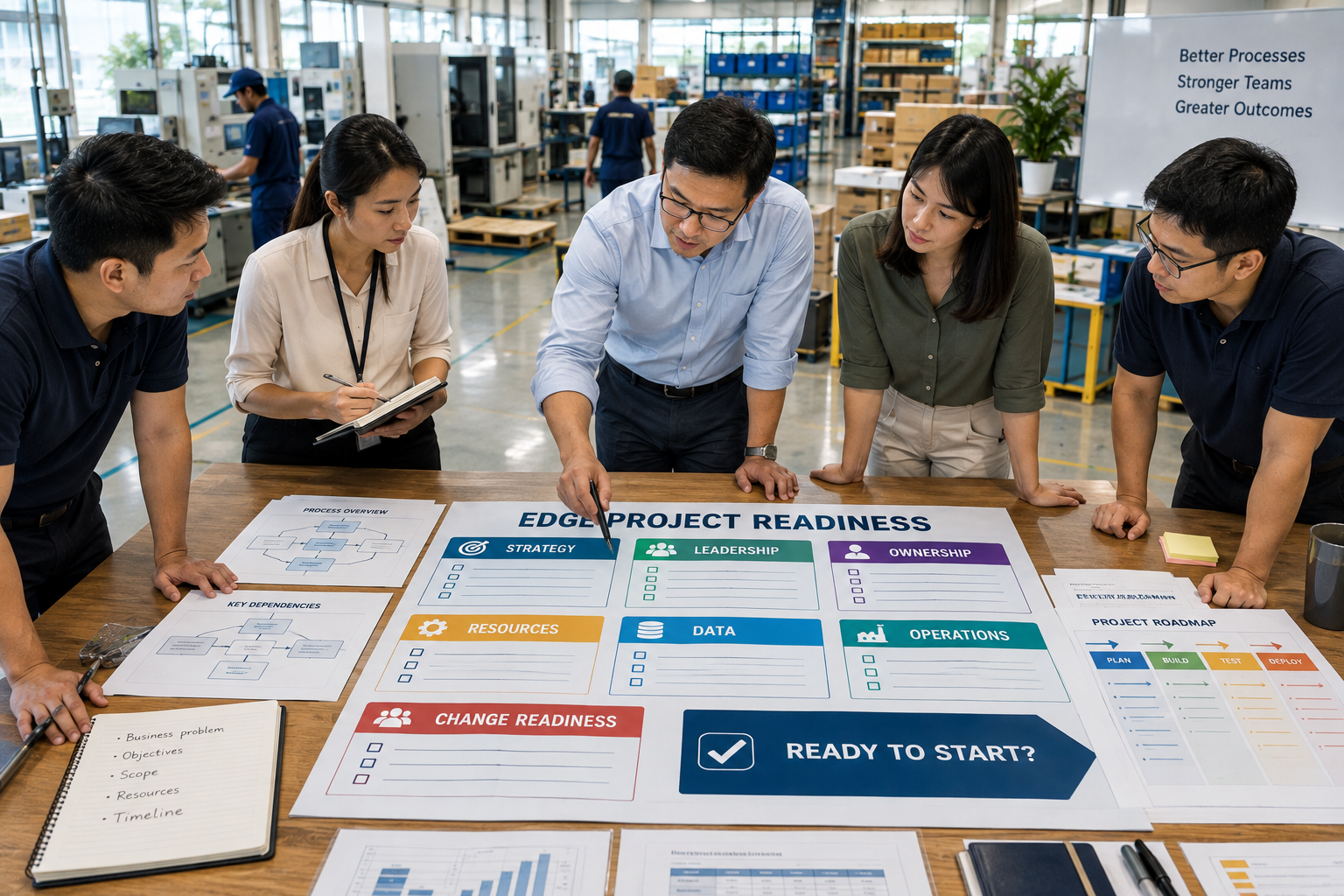
A practical readiness assessment can examine eight areas:
A weakness in one area does not necessarily mean the project should be abandoned.
But it may mean the project should not begin yet.
The first question is simple:
Why is this project necessary?
A business should be able to explain the problem in practical terms.
For example:
Manual work is limiting operating capacity.
Management lacks timely performance information.
The business cannot scale an existing process efficiently.
Employees lack capabilities required for future growth.
Customer service is inconsistent.
The company lacks readiness for overseas expansion.
Data is fragmented across multiple systems.
The business is facing increasing cost or productivity pressure.
EnterpriseSG's broader enterprise capability approach emphasises transformation across areas including productivity, digitalisation, talent and business growth. This reinforces the importance of linking a proposed activity to a genuine enterprise need rather than treating transformation as technology acquisition alone.
A business sees:
AI.
Automation.
Analytics.
A new platform.
A consultant's framework.
And immediately asks:
“How can we implement this?”
A stronger approach begins with:
“What problem are we trying to solve?”
The solution should follow the business need.
Not the other way around.
Before starting, management should be able to answer:
If these answers remain vague, the project may still be an idea rather than a ready initiative.
Management support is frequently described as important.
But “support” can mean many things.
A senior executive may approve the budget.
That does not necessarily mean they are prepared to:
Resolve disagreements.
Prioritise resources.
Make difficult decisions.
Support process changes.
Hold people accountable.
Maintain attention when implementation becomes difficult.
Real leadership readiness requires more than approval.
It requires commitment to the organisational consequences of transformation.
A transformation project can require management to decide:
Which department must change.
Which process should be redesigned.
Which employees need additional training.
Which legacy practices should stop.
Which investment priorities should change.
These decisions may create resistance.
A project without leadership readiness can therefore become technically active but organisationally stalled.
An executive sponsor should understand:
Why the project matters.
What business outcome is expected.
What major decisions may be required.
What organisational barriers could emerge.
Who should be accountable.
The sponsor does not need to manage every task.
But they should be prepared to lead when leadership is required.
This is closely connected to clear project ownership.
EDGE Project Ownership: Who Should Be Accountable for Business Transformation?
A company may be ready to transform.
But not ready to begin a particular project.
This often happens when the scope remains unclear.
For example:
“We want to improve productivity.”
“We need to use AI.”
“We want to digitalise operations.”
“We need to expand internationally.”
These statements describe ambitions.
They do not yet define implementation work.
A ready project should have reasonable clarity around:
The business problem.
The intended objective.
The activities involved.
The project boundaries.
The expected deliverables.
The major dependencies.
The people responsible.
The expected outcomes.
External providers can provide valuable expertise.
But the business should not expect the provider to discover every internal requirement without management participation.
The provider may understand the solution.
The business understands its own operations.
Both forms of knowledge are required.
A strong business enters implementation with enough internal clarity to evaluate whether the proposed solution actually addresses the problem.
One of the most underestimated transformation risks is internal capacity.
Businesses often budget for:
Software.
Consulting.
Equipment.
External implementation.
But underestimate the internal work required.
Employees may need to:
Attend workshops.
Provide information.
Review requirements.
Prepare data.
Test new processes.
Approve decisions.
Participate in training.
Support colleagues.
Manage implementation alongside normal responsibilities.
The provider may be ready.
But the business may not have enough internal capacity.
A company cannot completely outsource its own participation in transformation.
If employees are unavailable, decisions can be delayed.
If managers are overloaded, requirements may remain unresolved.
If key users cannot test the solution, implementation quality may suffer.
If nobody has time to prepare data, the project can stall before technical work is complete.
A company may have sufficient funds to appoint an excellent provider.
That does not automatically create:
Management attention.
Employee availability.
Decision-making capacity.
Process knowledge.
Internal project capability.
These resources must be planned separately.
Instead of asking only:
Can we afford this project?
Ask:
Can we participate in this project properly?
That question can reveal readiness problems before implementation begins.
Businesses sometimes attempt to transform processes that they have never clearly documented.
Different employees may perform the same activity differently.
Managers may believe the process works one way.
Employees may actually use informal workarounds.
Spreadsheets may exist outside official systems.
Important knowledge may exist only in individual employees' experience.
This creates a problem.
How can the business design the future state if it does not understand the current state?
Automation can make a process faster.
It does not automatically make the process better.
If the existing workflow contains:
Unnecessary steps.
Duplicate approvals.
Poor controls.
Unclear responsibilities.
Manual workarounds.
The business may simply automate the existing inefficiency.
Before major implementation, businesses should understand:
What happens today.
Who performs each activity.
Where information comes from.
Where delays occur.
Where errors occur.
Which controls are necessary.
Which activities no longer add value.
This creates a stronger basis for transformation.
Digital and AI projects often depend on conditions that are not immediately visible.
For example:
Data may be incomplete.
Information may be stored in multiple systems.
Different departments may use inconsistent definitions.
Historical records may be unreliable.
Existing systems may not integrate easily.
Access controls may not be ready.
Cybersecurity requirements may need review.
An AI initiative may sound simple at the strategy level but depend on significant data preparation.
Technology projects frequently encounter a difficult reality:
The solution works.
The data does not.
Or:
The system is ready.
The integration is not.
Or:
The AI capability is available.
But employees do not have reliable information to use with it.
A readiness assessment should therefore identify technical dependencies before implementation begins.
Businesses frequently ask:
“Which technology should we choose?”
An equally important question is:
“Is our information environment ready for the technology?”
This is particularly important as EnterpriseSG and other agencies increasingly support business adoption of AI-enabled and digitally integrated operations across sectors. Recent EnterpriseSG initiatives have highlighted the move from standalone tools towards more integrated, AI-enabled business operations.
A provider can be highly capable and still be unsuitable for a specific project.
Businesses should consider:
Does the provider understand the required capability?
Have they worked with comparable business problems?
Do they understand the industry context?
Is their proposed scope aligned with the business objective?
Who will actually perform the work?
How will knowledge be transferred?
What internal responsibilities are expected?
How will quality be reviewed?
If a business chooses a provider first, the provider may naturally frame the project around its own services.
That is not necessarily inappropriate.
But management should remain capable of asking:
Does this proposal solve our actual business problem?
A strong provider selection process begins with a reasonably clear understanding of what the business needs.
The business should be ready to manage the provider relationship.
This includes:
Providing timely information.
Making decisions.
Reviewing deliverables.
Managing changes.
Escalating problems.
Retaining knowledge.
A provider relationship is strongest when both sides understand their responsibilities.
A technically successful project can still fail if employees do not adopt the new way of working.
This is why readiness must include people.
Before implementation, businesses should ask:
Who will be affected?
Which behaviours must change?
Which employees need training?
Who may resist the change?
Which managers must reinforce adoption?
What existing habits need to stop?
How will employees receive support after implementation?
A new system can go live.
Employees can still avoid using it.
A new process can be officially introduced.
Teams can still use the old process.
An AI tool can be deployed.
Employees can still lack confidence in using it.
Readiness therefore includes preparing the organisation for behavioural change.
EDGE Change Management: Why Employee Adoption Will Determine Whether Transformation Actually Works
A practical readiness review can classify each area as:
The business has sufficient clarity and capability to proceed.
The project can proceed after specific preparation work is completed.
A significant issue should be resolved before implementation begins.
For example:
Readiness AreaKey QuestionStrategyIs there a clear business problem?LeadershipIs there active executive sponsorship?OwnershipIs one person accountable for the outcome?ScopeAre activities and boundaries sufficiently clear?ResourcesCan employees participate properly?OperationsIs the current state understood?DataIs the required information available and reliable?TechnologyAre systems and dependencies understood?ProviderIs the required external capability available?ChangeAre employees prepared for adoption?GovernanceAre decisions and escalation routes clear?MeasurementDoes the business know how success will be measured?
The objective is not to achieve perfection.
Few transformation projects begin with every uncertainty resolved.
The objective is to identify major readiness gaps before those gaps become implementation problems.
Some businesses worry that further preparation will delay transformation.
But beginning an unready project can create much larger delays later.
A few weeks spent clarifying:
Requirements.
Data.
Ownership.
Processes.
Dependencies.
May prevent months of rework.
Preparation is part of transformation.
It is not separate from transformation.
Businesses may have several potential EDGE initiatives.
For example:
An AI project.
A productivity project.
A market expansion initiative.
A capability-building programme.
A major digital transformation.
The most strategically attractive project is not always the one that should start first.
A business should also consider readiness.
A useful question is:
Which project has both strategic importance and sufficient readiness to begin?
A highly important project with major unresolved dependencies may require preparation.
A slightly smaller project may be ready now and create capability for larger transformation later.
Sometimes management believes:
“If the project is not starting immediately, we are losing momentum.”
But a delay can be strategically useful if it is used to resolve a genuine readiness issue.
For example:
A company may postpone implementation to:
Clean critical data.
Clarify processes.
Appoint a project owner.
Complete a requirements assessment.
Prepare employees.
Resolve a system dependency.
These activities may improve the probability of success.
Starting early is not always the same as progressing quickly.
A project that begins prematurely may later experience:
Rework.
Scope changes.
Provider disputes.
Budget increases.
Employee resistance.
Technical problems.
A disciplined preparation stage can reduce these risks.
Readiness should influence budgeting.
If the company has not assessed the current state, the initial budget may exclude important work.
For example:
The provider quotation covers implementation.
But not:
Data preparation.
Process redesign.
Employee training.
Change management.
Internal project resources.
Integration.
Testing.
The project can then appear to exceed budget even though the original budget was incomplete.
Instead of asking:
What does the provider charge?
Ask:
What does the complete transformation require?
This includes internal and external requirements.
EDGE Project Budgeting: How Singapore Businesses Should Build a Credible Transformation Budget
AI initiatives require particular discipline.
A business should assess:
Is there a specific use case?
Is relevant information available?
Is the workflow sufficiently understood?
Are there appropriate controls and human oversight?
Do users understand how the tool should be used?
How will the business determine whether AI created value?
A broad ambition to “adopt AI” is rarely sufficient preparation.
The strongest initiatives begin with a specific business workflow.
Productivity projects should identify the actual constraint.
The business should understand:
Where time is being lost.
Which work is repetitive.
Where bottlenecks occur.
Which errors consume resources.
What limits operating capacity.
The project should not simply automate an activity because automation is available.
It should address a meaningful productivity problem.
Internationalisation also requires readiness.
The business may need clarity around:
The target market.
The commercial opportunity.
The product or service proposition.
Internal capacity.
Market-entry requirements.
Financial commitment.
Operational capability.
The next decision after market research or business development activity.
The existing MRA framework remains useful context during the transition period because it continues to support qualifying overseas market development activities until EDGE launches.
Not every project begins with technology.
A business may need to develop:
Leadership capability.
Management capability.
Technical expertise.
Process capability.
Strategic planning capability.
Employee skills.
The readiness question becomes:
Is the organisation prepared to convert external learning into internal capability?
Training attendance alone is not necessarily capability development.
The business should consider:
How will learning be applied?
Who will own the new capability?
How will employees use it?
How will management reinforce it?
A readiness assessment can improve the quality of project planning before a business formally commits to implementation.
It can help management identify:
Unclear assumptions.
Missing information.
Internal dependencies.
Resource gaps.
Provider requirements.
Governance weaknesses.
Potential risks.
This can produce a stronger and more coherent project narrative.
EnterpriseSG's current information on EDGE emphasises a streamlined approach intended to help businesses access enterprise support more seamlessly, while the existing EDG, MRA and PSG schemes remain available during the transition.
Businesses should therefore continue to focus on the underlying quality of the transformation project itself.
A company may have enough information to prepare an application.
That does not necessarily mean the organisation is ready to implement immediately.
These are different questions.
Can the business clearly describe the project?
Can the business successfully execute the project?
A strong organisation considers both.
Before starting a transformation project, ask:
If several major questions remain unanswered, the business may need a preparation phase before implementation.
Project readiness is not simply something a business either has or does not have.
It can be developed.
For example:
Preparation action: Appoint an accountable business owner.
Preparation action: Conduct a current-state assessment.
Preparation action: Complete data mapping and preparation.
Preparation action: Develop a change-management plan.
Preparation action: Break the transformation into manageable phases.
Preparation action: Define business requirements before procurement.
This creates an important management principle:
A readiness gap is not necessarily a reason to abandon a project.
It is a reason to prepare properly.
The results of a readiness assessment can help businesses build a more realistic transformation roadmap.
For example:
Clarify the business problem, current state and project scope.
Resolve ownership, data, process and resource gaps.
Begin the main transformation activity.
Support employees and embed new ways of working.
Measure whether the intended business value was achieved.
This approach treats transformation as a managed journey rather than a single implementation event.
Before a company changes its systems, processes or markets, it may first need to improve its ability to manage change.
That can include:
Clearer governance.
Better management information.
Defined ownership.
Stronger processes.
Improved internal coordination.
More disciplined decision-making.
In this sense, readiness work can itself be capability building.
A project that begins without a clear definition of success may struggle to demonstrate value later.
Readiness should therefore include outcome planning.
Before implementation begins, the business should consider:
What should improve?
What is the current baseline?
How will improvement be measured?
Who will own the benefit?
When should management review results?
This creates a direct connection between preparation and benefits realisation.
Every transformation project contains uncertainty.
The objective is not to eliminate every risk before beginning.
That would be unrealistic.
The objective is to identify the most important readiness gaps while they are still relatively easy to address.
Once:
Contracts are signed.
Budgets are committed.
Providers are mobilised.
Employees are allocated.
Implementation has started.
A previously hidden problem can become significantly more expensive.
The strongest Singapore businesses should therefore treat readiness as a formal management stage.
Before asking:
When can we start?
Ask:
What must be true for us to start well?
That question can improve:
Project governance.
Provider selection.
Budget discipline.
Employee adoption.
Implementation quality.
Business outcomes.
As EDGE brings EDG, MRA and PSG into a more streamlined enterprise-support framework, businesses should continue to focus on the quality and readiness of the underlying transformation initiative.
Because the objective should not simply be to start a project.
The objective should be to build the organisational conditions required to finish it successfully—and create lasting enterprise value.
If your business is considering an EDGE transformation initiative but is unsure whether it is ready to begin, speak with us.
We help Singapore businesses assess transformation readiness, identify capability gaps, clarify project scope, establish ownership, review dependencies and prepare more disciplined implementation plans.
 WhatsApp us
```