
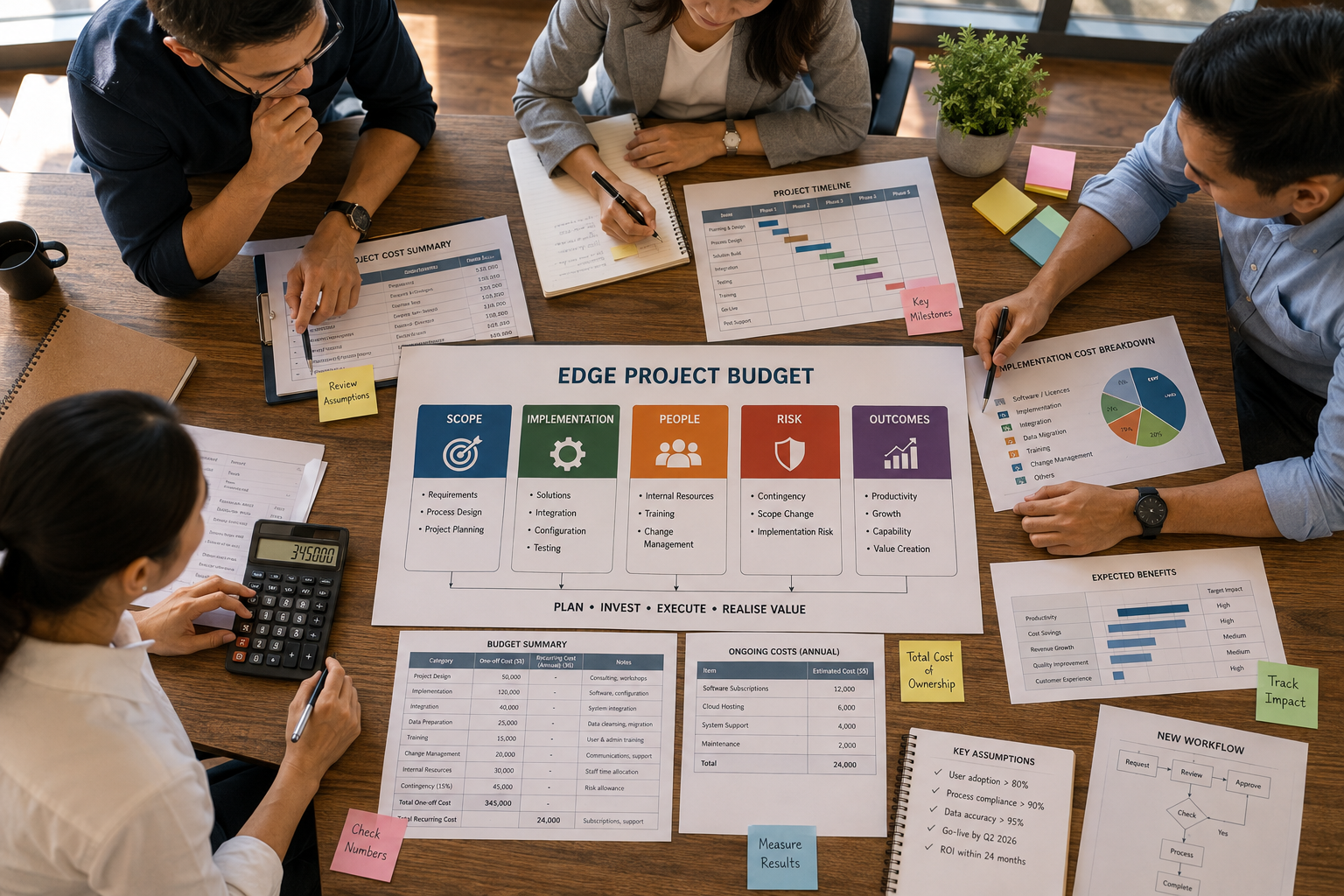
One of the most common weaknesses in business transformation is underestimating the real cost of execution.
A company receives a quotation.
The quotation fits the available budget.
Management approves the project.
The project begins.
Then additional requirements emerge.
Data needs to be cleaned.
Systems need to be integrated.
Employees need more training.
A process needs to be redesigned.
Internal employees need to spend more time on implementation than expected.
Additional licences are required.
Post-implementation support becomes necessary.
The original quotation was accurate for the vendor's scope.
But it was never the full transformation budget.
This distinction matters for EDGE projects.
As Singapore's enterprise support landscape transitions towards the Enterprise Development & Growth Enabler, or EDGE, businesses should approach projects as enterprise investments with defined scope, outcomes and execution requirements—not simply as grant-supported purchases. Existing EDG guidance similarly places emphasis on project scope and outcomes, while the broader Business Refresh Package is intended to support business upgrading, productivity and growth. Enterprise Development Grant EnterpriseSG Business Refresh Package
A technology quotation answers:
“How much does the supplier charge?”
A transformation budget should answer:
“How much will it cost the business to achieve the intended outcome?”
Those are different questions.
A complete budget may include:
External consulting.
Software or technology.
Implementation.
Configuration.
Integration.
Data preparation.
Internal project resources.
Training.
Change management.
Testing.
Cybersecurity or governance requirements.
Post-implementation support.
Ongoing subscriptions or maintenance.
Contingency.
The right budget structure depends on the project.
But management should understand the full cost before deciding whether the expected outcome justifies the investment.
A project can appear commercially attractive when evaluated only against the initial vendor proposal.
It may become significantly less attractive once additional costs are included.
For example, a business may plan to implement a new operating platform for $100,000.
But the full transformation may also require:
$20,000 of integration work.
$15,000 of data preparation.
$10,000 of additional training.
Internal employee time equivalent to $30,000.
Annual recurring costs of $24,000.
A contingency for implementation changes.
The real investment decision should consider the entire economic commitment.
A grant may reduce the company's eligible cost burden.
It does not eliminate:
Implementation risk.
Cash-flow requirements.
Internal resource requirements.
Operating costs.
Scope changes.
Post-project commitments.
Management should therefore ask:
Would this still be a sensible business investment if we evaluated the complete project economics?
The answer should guide the transformation decision.
A practical transformation budget can be organised into six layers.
These are costs associated with understanding the problem and designing the solution.
They may include:
Business diagnosis.
Process mapping.
Requirements definition.
Technical assessment.
Transformation planning.
Specialist advisory work.
These activities are sometimes overlooked because businesses want to move quickly into implementation.
However, weak design can create expensive problems later.
These are the direct costs of delivering the agreed project.
They may include:
Software.
Consulting.
Implementation.
Configuration.
Equipment where relevant.
System development.
Integration.
Testing.
The key question is whether the quotation clearly defines what is included and excluded.
These are often the most underestimated costs.
Employees may need to:
Attend workshops.
Provide operational information.
Clean data.
Test new systems.
Redesign processes.
Prepare documents.
Train colleagues.
Manage implementation.
Support adoption.
Their time has value.
Even if these costs do not appear as a supplier invoice, they are part of the project's resource requirement.
A technically successful project may still require investment in:
Training.
Change management.
User support.
Management communication.
Process documentation.
Capability transfer.
These activities are especially important when the project changes how employees work.
Management should understand what happens after implementation.
Possible recurring costs include:
Software subscriptions.
Cloud services.
Maintenance.
Managed services.
Technical support.
Cybersecurity.
Additional licences.
Future upgrades.
A project with a modest implementation cost may create a substantial recurring commitment.
Not every risk can be predicted.
A contingency provides room for:
Unexpected technical issues.
Additional testing.
Data problems.
Minor scope adjustments.
Implementation delays.
The objective is not to create a vague reserve that can fund uncontrolled expansion.
The objective is to recognise that transformation involves uncertainty.
The quotation may be entirely legitimate.
The problem is assuming it includes everything required for success.
Before approving a project, ask:
What must the company provide?
What work is excluded?
What assumptions must remain true?
What happens if the scope changes?
What costs begin after go-live?
A transformation may require significant employee involvement.
If key employees are already operating at full capacity, management faces a practical problem.
Either:
The transformation work will be delayed.
Existing operational work will suffer.
Employees will work excessive hours.
Additional resources will be required.
Or the project scope will need to change.
Internal capacity should therefore be part of the budget and implementation plan.
Management may approve a project based on first-year affordability without understanding the long-term cost structure.
A stronger business case identifies:
One-time costs.
Recurring costs.
Variable costs.
Potential future scaling costs.
Exit or replacement costs where relevant.
An unclear scope produces an unreliable budget.
Suppose management says:
“We want to use AI to improve productivity.”
That is not a budgetable project.
The business needs more detail.
Which process?
Which users?
Which data?
Which decisions?
Which systems?
Which outcome?
Without these answers, suppliers may quote different assumptions.
The quotations may then appear comparable when they are not.
A lower quotation is not automatically better value.
It may exclude:
Integration.
Training.
Data migration.
Change management.
Post-go-live support.
Documentation.
Testing.
The business should compare like with like.
A proposal comparison should therefore include:
Scope.
Deliverables.
Assumptions.
Exclusions.
Timeline.
Internal responsibilities.
Recurring costs.
Expected outcomes.
Price should be one part of the comparison.
Not the entire comparison.
A strong budget should connect expenditure to the intended result.
For example:
Budget AreaInvestmentIntended OutcomeProcess redesignDefined project costReduced duplicationWorkflow implementationDefined project costFaster processingEmployee trainingDefined project costHigher adoptionData preparationDefined project costBetter reportingPost-go-live supportDefined project costStable implementation
This creates a stronger management discussion.
Instead of asking:
“How much does this cost?”
Management can ask:
“What capability or outcome does this expenditure create?”
A project costing $50,000 may be expensive if it creates little measurable benefit.
A project costing $500,000 may be commercially attractive if it fundamentally improves a scalable business model.
The right question is not:
“Is this project cheap?”
It is:
“Is the expected value proportionate to the total investment and risk?”
Potential value may come from:
Higher productivity.
Revenue growth.
Reduced errors.
Faster turnaround.
Lower operating costs.
Better management information.
Reduced dependency on manual work.
Greater capacity for growth.
Improved customer experience.
Reduced operational risk.
The business case should identify which of these are relevant.
A credible transformation budget should be logically connected to:
The current business problem.
The proposed project scope.
The required activities.
The intended outcomes.
The implementation timeline.
The resources required.
This creates budget traceability.
If the project changes, the budget implications should be visible.
Every major budget line should answer a simple question:
What are we paying for, and why is it necessary?
For example:
“Consulting – $40,000”
is not very informative.
A more useful structure may identify:
Current-state assessment.
Process redesign.
Implementation planning.
Management workshops.
Post-project review.
Specificity improves management control.
It also makes it easier to identify whether a proposed change is inside or outside the original scope.
Scope creep occurs when additional requirements gradually enter the project.
Individually, each request may appear reasonable.
Together, they can materially change the project.
Examples include:
“Can we add one more department?”
“Can we integrate one more system?”
“Can we create another dashboard?”
“Can we automate this additional workflow?”
“Can we include another market?”
These may all create value.
But they should be treated as decisions with:
Cost implications.
Timeline implications.
Resource implications.
Risk implications.
A project can fail because it attempts too much.
Management should distinguish between:
Necessary scope.
Useful enhancements.
Future opportunities.
A transformation roadmap can capture future opportunities without forcing them into the first implementation phase.
This is particularly useful for businesses planning multiple EDGE-related transformation initiatives. EDGE Transformation Roadmap: How Singapore Businesses Should Sequence Multiple Projects
Change requests should not be handled informally.
A simple process can require each proposed change to identify:
Description.
Business reason.
Cost impact.
Timeline impact.
Resource impact.
Risk impact.
Decision required.
This does not mean every project must become bureaucratic.
It means management should know when the project is changing.
A realistic budget should consider who inside the company will perform the work.
Key roles may include:
Project sponsor.
Project manager.
Process owners.
Data owners.
Finance.
Operations.
IT.
Department representatives.
Change champions.
These employees may need dedicated time.
Management should ask:
How many hours will be required?
What operational work will be affected?
Do we need temporary support?
Who has authority to make decisions?
A project can become delayed simply because nobody has enough time to make the required decisions.
A transformation budget is not only financial.
It also consumes management attention.
Senior leaders may need to:
Review progress.
Resolve conflicts.
Approve decisions.
Remove obstacles.
Monitor outcomes.
If leadership time is not available, execution quality may suffer.
Businesses frequently underestimate data preparation.
A new system may require:
Data cleaning.
Data standardisation.
Duplicate removal.
Field mapping.
Access control.
Historical-data decisions.
Ownership definitions.
Data migration.
If data quality is weak, the business may need to invest in readiness before the intended solution can create value.
This is why data readiness should be assessed before committing to a data-intensive transformation. EDGE Data Readiness: Why Better Data Will Become a Core Business Capability
AI projects require additional financial discipline because experimentation can expand quickly.
Businesses should separate:
Initial experimentation.
Proof of concept.
Pilot deployment.
Production implementation.
Ongoing usage.
Governance and monitoring.
A useful question is:
What will the AI cost when it is used at the intended scale?
A small pilot may be inexpensive.
A company-wide implementation may involve additional:
Usage costs.
Integration.
Data preparation.
Security controls.
Human review.
Monitoring.
Training.
The business case should therefore distinguish between pilot economics and operating economics.
Digital projects should identify both visible and hidden dependencies.
For example, implementing a new platform may require:
Application licences.
Integration.
API access.
Cybersecurity review.
Identity management.
Data migration.
User devices.
Training.
Technical support.
Management reporting.
The technology budget should reflect the operating environment.
Not just the software package.
Internationalisation budgets require similar discipline.
The initial market-entry activity may be only one component of the total investment.
Businesses may also need to consider:
Market validation.
Travel.
Local expertise.
Marketing adaptation.
Partner development.
Legal or regulatory requirements.
Sales support.
Local operations.
Management time.
Existing MRA principles remain useful context during the transition towards EDGE because overseas expansion should be evaluated as a commercial capability-building activity rather than simply as a collection of supported expenses. Market Readiness Assistance Grant
Before approving an EDGE project, management should be able to answer:
Not simply the supplier quotation.
The total investment.
Not simply the implementation deliverable.
The business outcome.
Who owns it?
Who supports it?
What does it cost?
How will it improve?
These questions create stronger investment discipline.
To assess value, businesses need to understand the current position.
For example:
Current processing time.
Current error rate.
Current revenue.
Current employee workload.
Current customer response time.
Current reporting cycle.
Without a baseline, it becomes difficult to demonstrate whether the project created improvement.
Businesses should avoid creating unrealistic return projections simply to make a project appear attractive.
A stronger approach is to use reasonable assumptions.
For example:
Current monthly processing volume.
Average time per transaction.
Expected reduction.
Expected capacity improvement.
The assumptions should be explainable.
Management should be able to understand where the numbers came from.
Where uncertainty is significant, use scenarios.
For example:
Limited improvement.
Longer adoption period.
Higher implementation effort.
Target outcome achieved within the planned period.
Stronger adoption or greater commercial benefit.
This creates a more realistic discussion about risk.
Contingency should be proportionate to project uncertainty.
A well-understood, repeatable implementation may require less contingency than a complex transformation involving:
New technology.
Multiple systems.
Poor-quality data.
Process redesign.
Several business units.
External dependencies.
The contingency should not become an excuse for weak planning.
It should recognise genuine uncertainty.
The project may technically finish when the implementation provider leaves.
The business, however, may continue paying for:
Software.
Support.
Hosting.
Maintenance.
Specialist resources.
Security.
Enhancements.
Management reporting.
A five-year view may be useful for strategic projects.
Management should understand the difference between:
Initial implementation cost.
Total cost of ownership.
A transformation can create a new capability but also create a new dependency.
For example:
A business implements a sophisticated platform.
Only one external provider understands it.
Support costs increase every year.
Internal employees cannot make basic changes.
This may create operational risk.
The project design should therefore consider:
Knowledge transfer.
Documentation.
Internal ownership.
Support arrangements.
Exit options.
The original budget should not disappear after project approval.
Management should monitor:
Approved budget.
Committed expenditure.
Actual expenditure.
Forecast remaining cost.
Approved changes.
Contingency used.
Expected outcome.
A simple monthly dashboard can be sufficient for many SME projects.
The important point is visibility.
Management may track:
MetricQuestionApproved budgetWhat was authorised?Committed costWhat contracts have been entered into?Actual spendWhat has been paid?Forecast to completeWhat is the latest expected total cost?VarianceAre we above or below budget?Scope changesWhat has changed?Outcome statusAre expected benefits still achievable?
The final line is critical.
A project can remain within budget and still fail to deliver value.
Budget discipline and project governance are closely connected.
Governance determines:
Who can approve expenditure.
Who can change scope.
Who monitors delivery.
Who owns outcomes.
Who escalates risks.
A project without clear governance can drift financially and operationally.
This becomes increasingly important as businesses undertake larger and more integrated transformation initiatives. EDGE Governance & Compliance: Why Execution Discipline Will Become Even More Important
The lowest quotation does not necessarily create the lowest project cost.
A provider with weak implementation capability may create:
Rework.
Delays.
Additional internal workload.
More external support.
A second implementation.
Provider selection should therefore consider total project economics, not only initial fees. EDGE Service Provider Selection: How Singapore Businesses Should Choose the Right Partner
Change management should not be treated as a free activity.
It may require:
Communication.
Training materials.
Workshops.
User testing.
Pilot programmes.
Post-go-live support.
Additional management time.
If these activities are not budgeted, they may be reduced when the project faces financial pressure.
That can undermine adoption and ultimately weaken the value of the entire investment. EDGE Change Management: Why Employee Adoption Will Determine Whether Transformation Actually Works
Before finalising a transformation budget, ask:
If these questions cannot be answered, the budget may be incomplete.
The purpose of a transformation budget is not simply to control spending.
Its deeper purpose is to connect:
Strategy.
Scope.
Resources.
Execution.
Risk.
Outcomes.
A strong budget helps management understand what the company is committing to and why.
As businesses prepare for EDGE, the strongest projects are unlikely to be those with the lowest budgets or the highest grant ambitions.
They will be the projects where the investment is proportionate to the business problem, the scope is disciplined, the implementation requirements are understood and the expected outcomes are measurable.
That is what turns project expenditure into enterprise investment.
If you are planning an EDGE transformation project and want to assess whether the proposed budget reflects the full implementation requirement, speak with us before finalising the scope or appointing a provider.
We help Singapore businesses review project scope, cost assumptions, implementation dependencies, governance and expected business outcomes.
Book a 30-minute, no-obligation discussion here:
 WhatsApp us
```