
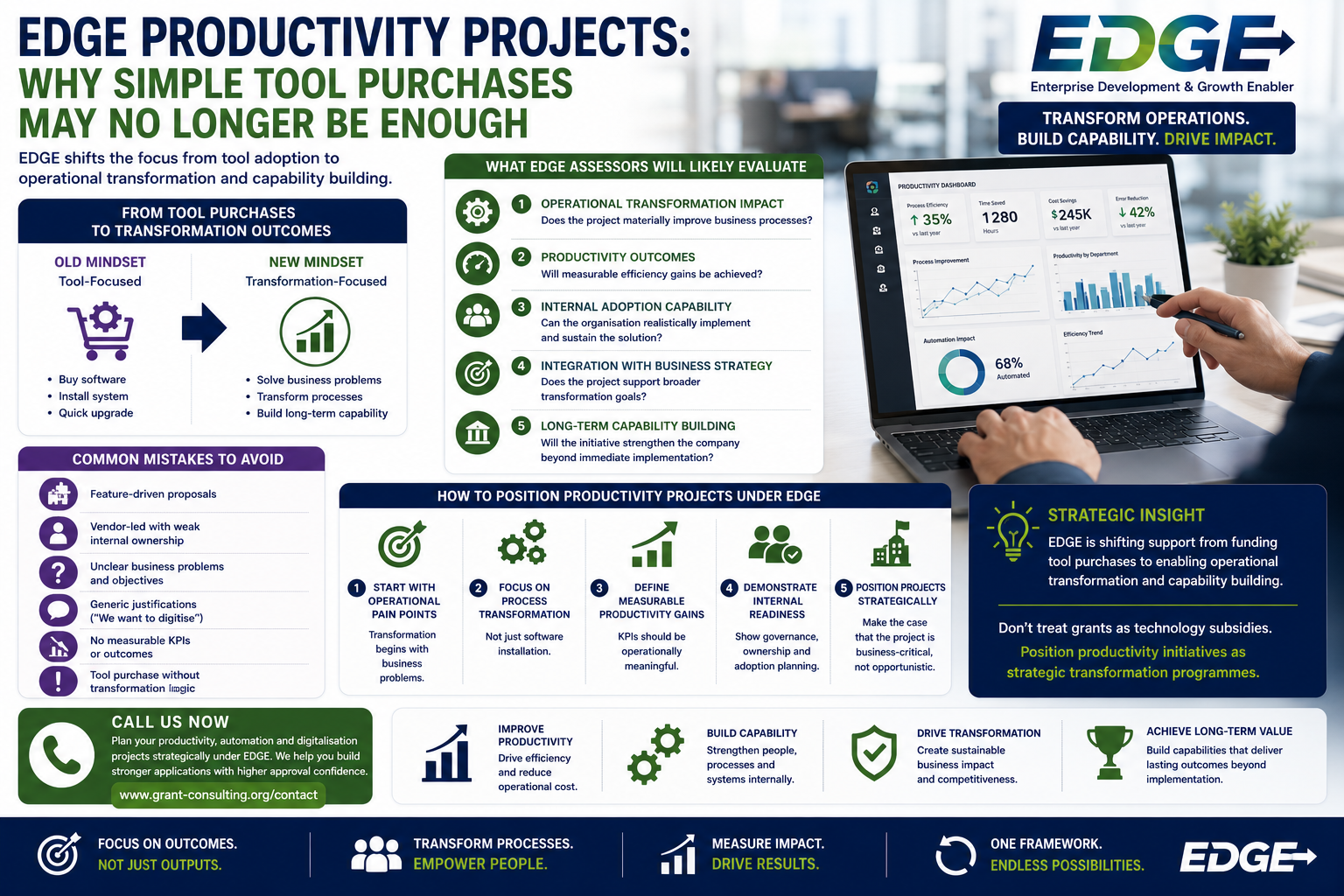
Under previous schemes like PSG, many businesses approached grants as:
EDGE may change this significantly.
Because the new framework appears to move toward evaluating:
broader business transformation outcomes—not just tool adoption.
This is an important shift.
Historically, businesses could often position projects around:
But under EDGE, assessors may increasingly ask:
“How does this initiative transform the business operationally?”
—not simply:
“What tool is being purchased?”
This means productivity projects may need:
Many productivity applications remain overly tool-focused:
These alone may no longer be sufficiently compelling.
Because software adoption by itself does not necessarily equal:
Businesses should expect scrutiny around:
1. Operational transformation impact
Does the project materially improve business processes?
2. Productivity outcomes
Will measurable efficiency gains be achieved?
3. Internal adoption capability
Can the organisation realistically implement and sustain the solution?
4. Integration with business strategy
Does the project support broader transformation goals?
5. Long-term capability building
Will the initiative strengthen the company beyond immediate implementation?
Common weak positioning includes:
These create weak transformation narratives.
To improve approval confidence:
1. Start with operational pain points
Transformation begins with business problems.
2. Focus on process transformation
Not just software installation.
3. Define measurable productivity gains
KPIs should be operationally meaningful.
4. Demonstrate internal readiness
Show governance, ownership, and adoption planning.
5. Position projects strategically
The strongest projects will likely feel business-critical—not opportunistic.
EDGE likely reflects an important evolution in Singapore’s productivity support philosophy:
The focus is shifting from:
toward:
Businesses that continue treating grants as:
may struggle.
Businesses that position productivity initiatives as:
will likely perform much better.
If you are planning productivity, automation, software, or digitalisation initiatives under the upcoming EDGE framework, it is important to position them strategically from the start.
We help companies structure productivity projects around operational transformation, measurable outcomes, governance readiness, and approval confidence.
https://www.grant-consulting.org/contact
 WhatsApp us
```
WhatsApp us
```