Many Singapore businesses have ideas for new products.
A manufacturer may want to develop a specialised component.
A technology company may want to introduce a new software solution.
An engineering firm may be exploring a proprietary system.
A business may also want to transform an existing service into a technology-enabled offering.
However, having a new idea does not automatically establish that the project meets EDGE Product Development requirements.
The important distinction is between developing a commercially meaningful innovation and simply introducing something new to the company.
EnterpriseSG's Product Development activity supports the development of new products, services and solutions through technological innovation, with the objective of bringing them to market.

Enterprise Singapore
+1
For businesses considering this activity, the central question is:
What is technically or functionally advancing, and how will that advancement create business value?
This question should shape the project before a vendor is appointed or an application is submitted.
EDGE Product Development is an innovation-focused activity under Singapore's Enterprise Development and Growth Enabler (EDGE) Grant.
It is designed to support qualifying development projects involving technological innovation and commercial growth.
EnterpriseSG currently indicates the following support levels for this activity:
Business category
Published support level
SMEs
Up to 50%
Non-SMEs
Up to 30%
These are activity-specific headline support levels, subject to eligibility, qualifying costs and approval conditions.
Enterprise Singapore
The activity is intended for businesses that want to move beyond existing capabilities by developing new offerings or creating meaningful technological or functional advancement.
It is not simply a funding route for purchasing standard equipment or launching a conventional product.
Product development can involve substantial uncertainty.
A company may need to invest in:
These activities may require specialist expertise and significant management commitment.
A structured grant application can help a business articulate the proposed development, expected outcomes and commercial rationale.
However, the company must still demonstrate that the project satisfies the applicable activity requirements.
Potential project examples include:
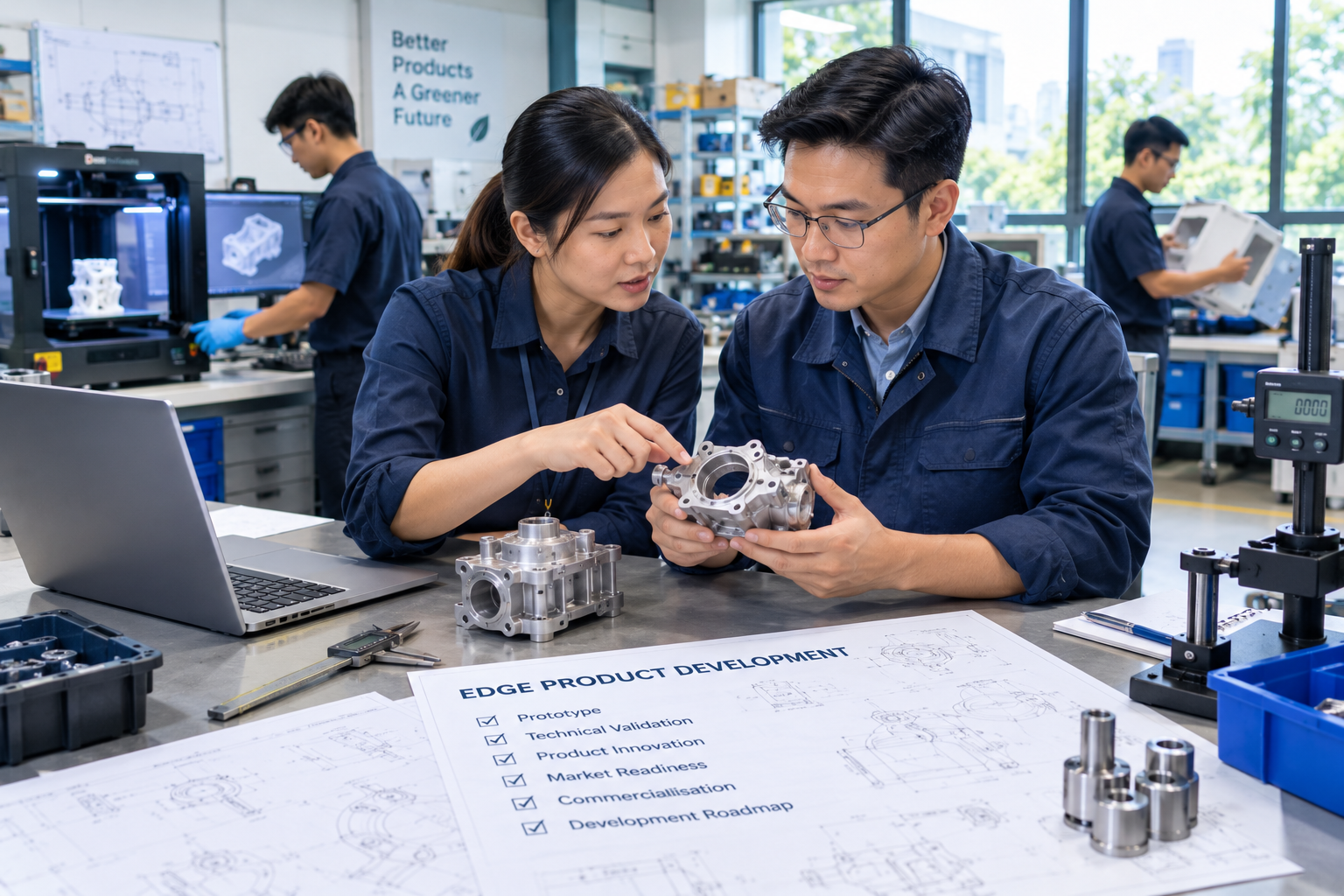
A Singapore manufacturer develops a component with improved technical functionality for a specific industrial application.
The project involves engineering design, prototype fabrication and technical testing.
A technology company develops a new software product involving meaningful technical advancement beyond routine configuration or implementation.
The development may involve a new architecture, specialised functionality or technically advanced capabilities.
An engineering business develops a new system that combines hardware, software and technical integration to address an existing market problem.
A business develops a new product based on existing commercial capabilities, involving prototype development, testing and a defined route to market.
These examples are illustrative. Eligibility depends on the actual project scope and EnterpriseSG's assessment.
This is one of the most important distinctions in product development planning.
A business may consider a project innovative because it is new to its organisation.
However, EnterpriseSG's published conditions require clear technological or functional advancement beyond current market standards. Routine replacements, standard implementations and incremental upgrades are generally not supported unless they form part of a larger integrated system with clear advancement.
Enterprise Singapore
Consider the following examples.
Proposed project
Key consideration
Replacing an old standard machine
Routine replacement alone is not sufficient
Installing standard business software
Standard implementation alone is not sufficient
Developing a technically advanced proprietary solution
Potentially relevant, subject to assessment
Improving an existing product through meaningful technical advancement
Requires clear evidence of advancement
Developing a first-ever company product
Not supported under the published activity conditions
Building a prototype for a new commercial offering
Relevant where all activity requirements are satisfied
The business should be able to explain precisely what is new, what is technically different and why the development matters.
EnterpriseSG explicitly identifies development of a company's first product as a non-supported project category.
Enterprise Singapore
This requires careful interpretation during project planning.
A business may have operated for several years but still be developing its first commercial product.
The company's age alone does not establish that a proposed project qualifies.
Management should therefore clarify:
This distinction should be examined before significant development expenditure is committed.
A strong product development strategy generally starts with a business that understands its market and existing operations.
It then identifies an opportunity to develop something beyond its current offering.
For example:
A manufacturer already supplies industrial components.
Its customers increasingly require a component with a specialised technical function.
The business proposes developing a new design, validating the engineering requirements, building prototypes and testing performance.
The project is not simply about introducing another product catalogue item.
It involves developing a new technical capability that can support commercial growth.
This is the type of business logic that should be articulated clearly.
EnterpriseSG states that Product Development projects should demonstrate clear business growth objectives, building on existing commercial operations and capabilities. Desired outcomes may include new revenue streams, market expansion or new capabilities.
Enterprise Singapore
A business should therefore explain:
A technical project without a credible commercial rationale may have difficulty demonstrating the required business value.
The proposed development must go beyond incremental improvement and demonstrate clear advancement relative to current market standards.
Enterprise Singapore
This is where technical explanation becomes important.
Businesses should identify:
Avoid relying on broad claims such as "industry-leading", "revolutionary" or "innovative" without supporting explanations.
EnterpriseSG identifies prototype development and/or small-batch production as examples of tangible development activities. Strategy work may be supported as a lead-in to actual prototype development.
Enterprise Singapore
This means a project should not be limited to producing recommendations or a conceptual roadmap.
The proposed work should lead towards a tangible product or solution.
A structured development roadmap helps the company explain how the project will progress from technical concept to commercial readiness.
Stage 1
Market and Technical Feasibility
Identify the market need, existing alternatives, technical limitations and development requirements.
Stage 2
Product Design and Engineering
Develop specifications, architecture, engineering concepts and technical design.
Stage 3
Prototype Development
Build the prototype or initial technical implementation.
Stage 4
Testing and Validation
Assess functionality, technical feasibility, performance and user requirements.
Stage 5
Commercialisation Preparation
Prepare the product roadmap, manufacturing or deployment requirements and market-entry approach.
The roadmap should identify the work to be performed, who is responsible and what evidence will demonstrate completion.
A practical business case should address six areas.
Explain what the company currently does.
This may include:
The purpose is to establish the foundation from which the new development will emerge.
Identify the customer problem or market requirement.
For example:
Existing products may not meet a particular technical specification.
Customers may require greater performance or functionality.
A specific market segment may be underserved.
A business may identify an opportunity to develop a differentiated solution.
The market opportunity should be supported by reasonable evidence rather than unsupported assumptions.
Explain what existing market solutions cannot adequately achieve.
This is particularly important where technological advancement is central to the project.
A useful comparison may include:
Dimension
Existing market solution
Proposed development
Functionality
Current capabilities
Intended additional capability
Performance
Existing limitations
Target performance
Technical design
Current architecture
Proposed advancement
Customer application
Existing use cases
New or improved use case
Commercial potential
Current offering
New opportunity
These are planning dimensions, not official assessment scores.
Clearly identify the work that will be undertaken.
Examples include:
Each activity should connect to a tangible output.
EnterpriseSG requires relevant projections of expected revenue growth, cost savings and overseas sales, where applicable, for three years after project completion.
Enterprise Singapore
Businesses should prepare reasonable forecasts and explain their assumptions.
For example:
Avoid presenting speculative commercial projections as guaranteed results.
The published application requirements also include projections of new jobs created, overall and Singaporean employees, with gross monthly salary above S$5,000, for one year after project completion.
Enterprise Singapore
Businesses should prepare this information carefully and ensure projections are internally consistent with their growth plans.
EnterpriseSG identifies several application documents and information requirements for Product Development.
Enterprise Singapore
Preparation item
Purpose
Project proposal
Explain project scope and rationale
Vendor proposal
Define proposed development work
Vendor quotation
Establish project costs
Latest financial statements
Support financial assessment
Three-year business projections
Explain anticipated commercial impact
Employment projections
Document anticipated job creation
Development roadmap
Clarify project stages and outputs
Technical information
Explain innovation and advancement
The company should ensure the information is consistent across its proposal, quotation, timeline and financial projections.
A project described as prototype development should not have a quotation that only covers general consultancy recommendations.
A business may commission a consultant to prepare:
These activities may be useful.
However, EnterpriseSG states that strategy development activities are supportable as a lead-in to actual prototype development, rather than as an isolated substitute for tangible product development.
Enterprise Singapore
The distinction matters.
A business should establish how the strategic work connects to the technical development that follows.
The project should have a coherent path towards an actual product, prototype or solution.
Product development often requires capabilities that the company does not possess internally.
Depending on the project, external expertise may be required for:
However, vendor selection should be based on the actual technical requirements.
Businesses should assess:
A vendor's ability to prepare a polished proposal is not the same as its ability to deliver the proposed technical advancement.
Product development may create intellectual property or commercially sensitive technical information.
Businesses should consider:
EnterpriseSG identifies IP-related considerations, including IP strategy and Freedom to Operate analysis, among examples of strategic work that may lead into actual product development.
Enterprise Singapore
The company should clarify these matters with relevant technical and legal advisers where appropriate.
One of the most important published conditions is that the company must not have started work or made any payment or deposit to a supplier, vendor or third party before application submission.
Enterprise Singapore
Businesses should therefore avoid assuming that they can commence development first and seek grant support retrospectively.
Before committing, management should verify:
The official activity conditions should be checked before signing contracts, paying deposits or beginning work.
EnterpriseSG describes the following general process for the Product Development activity.
Enterprise Singapore
Approval should not be assumed before the Letter of Offer is issued.
EnterpriseSG identifies the following Product Development deliverables, where applicable:
Enterprise Singapore
This reinforces an important point.
The project should be designed around demonstrable development outputs, not simply activities completed or consultant meetings conducted.
A prototype may demonstrate technical feasibility.
But the company still needs to determine whether the product can become commercially viable.
Management should consider:
A successful development project should therefore connect technical progress with commercial planning.
EDGE provides up to S$100,000 in total grant support per year across all activities, with the annual cap refreshed on 1 April. Support levels differ by activity.
Enterprise Singapore
For product development projects, businesses should consider the funding implications alongside their technical roadmap.
This includes:
The funding cap is not an automatic grant award.
A company should ensure that its product development investment remains commercially viable even after accounting for its own funding contribution.
Before submitting an application, management should confirm:
The company has existing commercial operations and capabilities.
The project is not the company's first product development.
The proposed offering has a clear business growth objective.
The technical or functional advancement is clearly explained.
The project goes beyond routine replacement or standard implementation.
Tangible development activities are defined.
Prototype or small-batch development is appropriately scoped.
The vendor has relevant technical expertise.
Project deliverables are measurable.
Commercial projections have been prepared.
Employment projections have been considered.
IP and ownership issues have been reviewed.
The company has not commenced work or made prohibited pre-application payments.
The business can fund its project commitments.
If these areas remain unclear, further project development may be required before application submission.
Avoid:
The purpose is to establish a credible product development project with a defensible technical and commercial rationale.
The long-term value of product development extends beyond the first commercial offering.
A company that successfully builds product development capability may strengthen its ability to:
This is particularly relevant for Singapore businesses seeking to move from conventional service or manufacturing activities towards differentiated offerings.
The strategic objective is not merely to launch one new product.
It is to build a repeatable capability for innovation and commercial growth.
If your company is exploring a new product, proprietary solution or technically advanced offering, we can help assess project readiness, structure the business case, review the proposed scope and identify important application considerations.
Our focus is on helping Singapore businesses develop credible, commercially grounded grant-supported transformation projects.
Book a 30-minute, no-obligation discussion here:
 WhatsApp us
```