
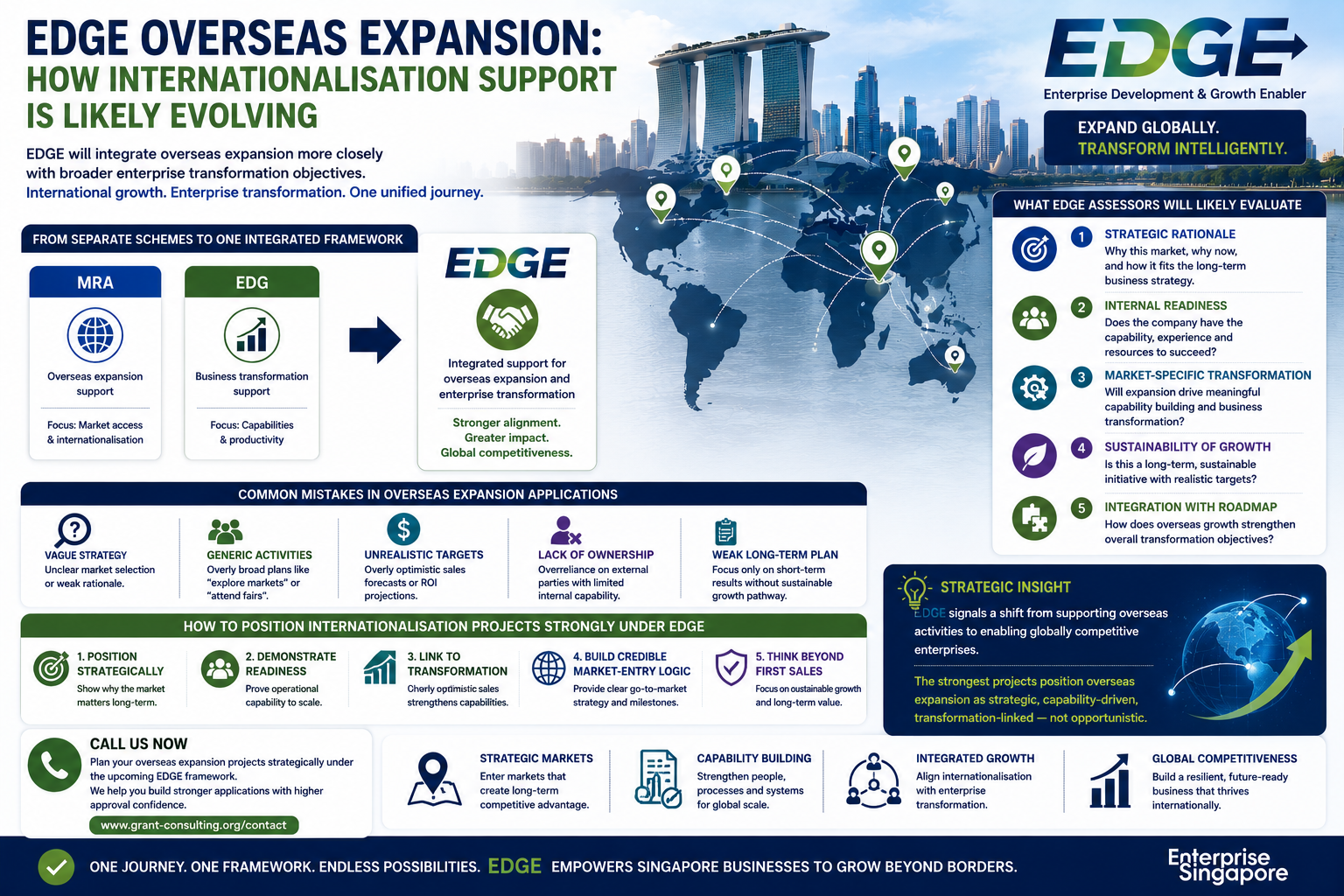
Under the previous grant landscape, internationalisation support was often viewed separately through:
EDGE appears to change this dynamic significantly.
Instead of treating overseas expansion as an isolated activity, the new framework may increasingly evaluate:
how international growth fits into broader enterprise transformation.
This is an important strategic shift.
Historically, some companies approached overseas expansion as:
EDGE may push businesses toward positioning internationalisation more strategically:
This likely increases both:
Many companies still position expansion projects too narrowly:
These statements are often insufficient strategically.
Assessors will likely increasingly ask:
“How does this expansion strengthen the company long-term?”
Businesses should expect stronger focus on:
1. Strategic rationale for expansion
Why this market? Why now?
2. Internal readiness
Does the company have operational capability to scale internationally?
3. Market-specific transformation
Will expansion require meaningful business capability enhancement?
4. Sustainability of overseas growth
Is this a long-term strategic initiative or short-term opportunism?
5. Integration with broader business roadmap
Does overseas growth align with transformation objectives?
Common weaknesses include:
These increase perceived execution risk significantly.
To strengthen approval confidence:
1. Position expansion strategically
Show why the market matters long-term.
2. Demonstrate operational readiness
Internationalisation requires execution maturity.
3. Link expansion to transformation
Show how overseas growth strengthens capabilities.
4. Build credible market-entry logic
Avoid generic “market exploration” positioning.
5. Think beyond first sales
Assessors will likely focus increasingly on sustainable growth pathways.
EDGE likely signals an important evolution in Singapore’s internationalisation philosophy:
The focus is shifting from:
toward:
The strongest projects under EDGE will likely be those that position overseas expansion as:
If you are planning overseas expansion initiatives under the upcoming EDGE framework, it is important to position them strategically from the start.
We help companies structure internationalisation projects around long-term competitiveness, capability building, market-entry logic, and approval readiness.
https://www.grant-consulting.org/contact
 WhatsApp us
```
WhatsApp us
```