Many Singapore businesses approach grants one project at a time.
They identify a business need, obtain a vendor quotation, prepare an application and proceed with implementation.
That approach may work for a single project.
However, businesses planning several transformation initiatives need a broader perspective.
A company may simultaneously want to:
Under Singapore's new EDGE Grant, these activities sit within a consolidated business grant framework.
EnterpriseSG provides for up to S$100,000 in total grant support per year across EDGE activities, with the annual cap refreshed on 1 April. Support levels differ by activity.

Enterprise Singapore
This changes the planning conversation.
Instead of looking at each project independently, management should consider how its investments fit together.
The objective is not to maximise grant utilisation.
It is to maximise the business value of transformation while managing available funding, cash flow and execution capacity.
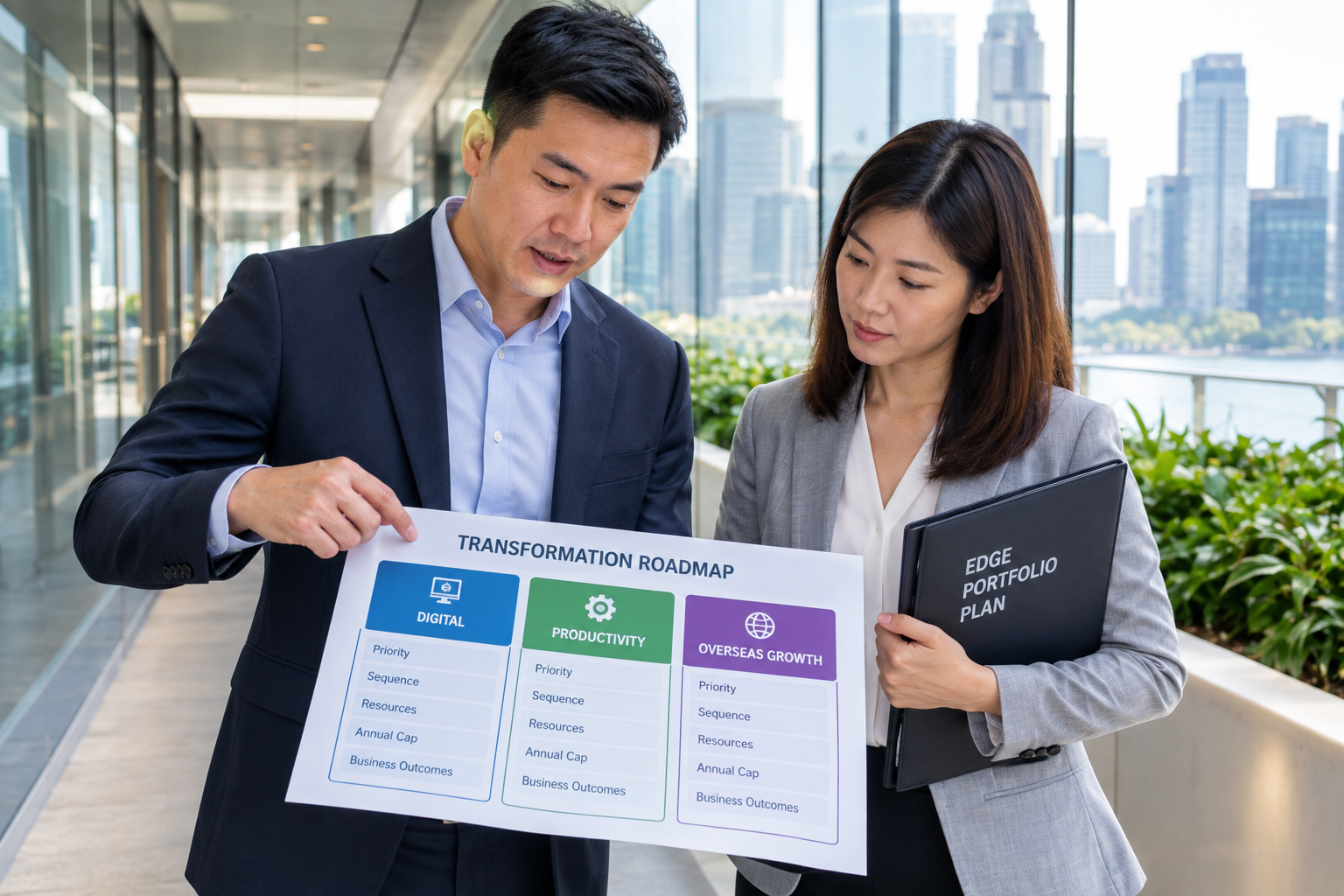
EDGE portfolio planning refers to the process of identifying, prioritising and sequencing multiple business improvement projects under the EDGE framework.
It involves deciding:
A portfolio approach is particularly relevant for growing SMEs.
As businesses become more complex, individual improvement initiatives increasingly affect one another.
A new CRM system may depend on sales process redesign.
An AI project may depend on data quality.
Overseas expansion may require stronger financial reporting and management controls.
The projects should therefore be planned as connected investments rather than unrelated grant applications.
EnterpriseSG's EDGE information provides the following headline structure:
Item
Published position
SME support
Up to 70%
Non-SME support
Up to 50%
Annual grant support cap
S$100,000
Cap application
Across all EDGE activities
Annual refresh
1 April
Disbursement
Reimbursement basis
These are headline limits, not automatic entitlements. Actual support levels and conditions depend on the selected activity.
Enterprise Singapore
The distinction matters.
A company should not assume that every project receives the maximum support rate or that every expenditure qualifies.
The appropriate activity page and current application conditions remain the reference point.
Consider a company with three transformation priorities:
Each project may have a legitimate business rationale.
However, management must consider the combined impact.
The company may face:
A portfolio strategy helps management decide how to proceed without overcommitting the organisation.
A common mistake is to prioritise projects based primarily on how much grant support may be available.
This can reverse the proper decision-making sequence.
The company should first identify its business priorities.
Then determine which activities align with those priorities.
Then assess eligibility, support levels, project costs and implementation requirements.
The correct sequence is:
Business problem → Strategic priority → Project design → EDGE activity → Funding assessment → Execution.
Not:
Grant availability → Vendor package → Project justification.
The first approach is business-led.
The second risks creating projects that are financially attractive but strategically weak.
Businesses frequently make five portfolio planning mistakes.
A company may approve several projects without considering their combined impact on staff, cash flow and management attention.
The result can be implementation fatigue.
The annual cap is a maximum support limit, not a recommended spending amount.
Businesses should not create unnecessary projects simply to use available support.
Implementing advanced analytics before fixing data quality may produce limited value.
Likewise, purchasing technology before redesigning the workflow may preserve existing inefficiencies.
Three projects running simultaneously may require more management time than the company can realistically provide.
EDGE operates on a reimbursement basis. Businesses must complete the relevant activity and make full payment before submitting claims.
Enterprise Singapore
A company therefore needs sufficient working capital to fund project commitments.
Begin with the business, not the grant.
Management should identify the three to five most important improvement priorities for the coming 12 months.
These may include:
Each priority should address a genuine business requirement.
For each proposed project, identify the intended outcome.
Business priority
Potential project outcome
Sales transformation
Better pipeline visibility
Operations improvement
Reduced manual processing
Digitalisation
More consistent workflows
Overseas expansion
Qualified market opportunities
Financial management
Improved management reporting
Innovation
New product or solution capability
This helps management compare projects using business value rather than grant percentage alone.
Some projects should happen before others.
For example:
Phase 1
Process and Data Foundation
Map existing workflows, identify data gaps and standardise processes.
Phase 2
Digital Implementation
Introduce systems, reporting tools and appropriate automation.
Phase 3
Advanced Capability Development
Build analytics, AI applications or new growth capabilities on the improved foundation.
The objective is to prevent businesses from investing in advanced solutions before the underlying processes are ready.
Management should prepare a consolidated project forecast.
It should include:
The company should distinguish between potential support and confirmed approved support.
Do not treat an estimated grant amount as cash already available.
Not every project needs to start immediately.
A project may be strategically important but not yet ready because:
Management should distinguish between:
Priority: How important is the project?
Readiness: Can the company execute it now?
A high-priority project with low readiness may need preparation before formal commencement.
Consider a hypothetical Singapore SME planning three projects.
Illustrative figures only. These are not official EDGE quotations, support rates or approval amounts.
Project A: Digital Sales System
Phase 1
Illustrative project cost
Objective: Establish centralised customer and sales pipeline management.
Project B: Operations Improvement
Phase 2
Illustrative project cost
Objective: Redesign fulfilment processes and improve operational visibility.
Project C: Overseas Market Development
Phase 3
Illustrative project cost
Objective: Validate overseas demand and develop qualified commercial opportunities.
Combined illustrative project cost
The company should not automatically commence all three projects together.
Instead, it may decide to establish the sales and operational foundation first, then proceed with overseas market development once management has sufficient internal capacity.
The annual grant cap should be modelled alongside this sequencing decision.
EnterpriseSG states that the S$100,000 annual cap refreshes on 1 April.
Enterprise Singapore
This creates a planning consideration for companies with multiple initiatives.
However, businesses should not treat the refresh date as a reason to rush applications or artificially divide projects.
Management should focus on:
A timing decision should support business execution, not override it.
Businesses with limited management resources may need to focus on foundational improvements.
Typical priorities include:
The priority is to build operational discipline before expanding the number of initiatives.
Businesses experiencing rising complexity may need to connect several projects.
For example:
These initiatives should reinforce one another.
Larger companies may have several departments proposing projects simultaneously.
Management should establish portfolio governance so that project selection aligns with corporate priorities, internal capacity and financial planning.
A portfolio approach gives management a consolidated view of transformation commitments.
It helps answer:
Which projects are active?
Which projects are delayed?
Which departments are overloaded?
Where are vendor dependencies?
How much internal funding is committed?
Which projects are generating measurable value?
Which initiatives should be paused or redesigned?
This is particularly important when several grant-supported projects are running concurrently.
Businesses sometimes assume that earlier applications are always preferable.
But a project should not proceed simply because funding is available.
If the company lacks the internal capacity to implement it, delaying the project may be commercially more sensible.
For example:
A company may want to implement AI automation but has not yet standardised its processes.
The immediate priority may be process redesign and data preparation.
Once those foundations are established, the AI project may have a clearer business case.
This is not a missed opportunity.
It is disciplined investment sequencing.
Management can conduct a quarterly review using the following questions:
Review area
Management question
Strategic alignment
Does each project support a real business priority?
Funding
Are projected support amounts and own contributions understood?
Capacity
Can our teams execute the projects concurrently?
Dependencies
Which projects must happen first?
Vendor readiness
Are scopes and responsibilities clear?
Timing
Is the implementation sequence realistic?
Outcomes
What measurable improvement should each project deliver?
Governance
Who monitors the overall portfolio?
This can be incorporated into an existing management meeting.
A separate grant committee is not necessarily required for a smaller business.
Avoid:
The objective is disciplined project selection, not grant maximisation.
Before committing to multiple EDGE projects, management should confirm:
The company's transformation priorities are documented.
Each project addresses a specific business problem.
The intended outcomes are clear.
The appropriate EDGE activity has been identified.
Current activity-specific support conditions have been reviewed.
The annual funding cap has been considered.
Internal project owners are available.
Project dependencies have been mapped.
Cash flow has been forecast.
Vendor scopes are sufficiently defined.
Implementation timelines are realistic.
Management has a consolidated review process.
The introduction of EDGE provides an opportunity for Singapore businesses to rethink how they approach enterprise development.
Instead of treating each grant application as an isolated administrative task, companies can use the framework to examine their wider investment priorities.
This encourages management to consider:
What capabilities are missing?
Which processes limit growth?
Which investments should happen first?
Where is the company over-reliant on manual work?
What capabilities will support future expansion?
Which initiatives should be measured together?
The value is not simply accessing support for individual projects.
It is building a more coherent transformation roadmap.
If your business is considering several EDGE projects and needs help assessing priorities, sequencing initiatives, reviewing activity alignment or preparing a coordinated grant strategy, speak with us.
We help Singapore businesses structure grant-supported transformation around commercial objectives, project readiness, funding considerations and execution discipline.
Book a 30-minute, no-obligation discussion here:
 WhatsApp us
```