One of the most underestimated shifts under EDGE may not be:
It may be:
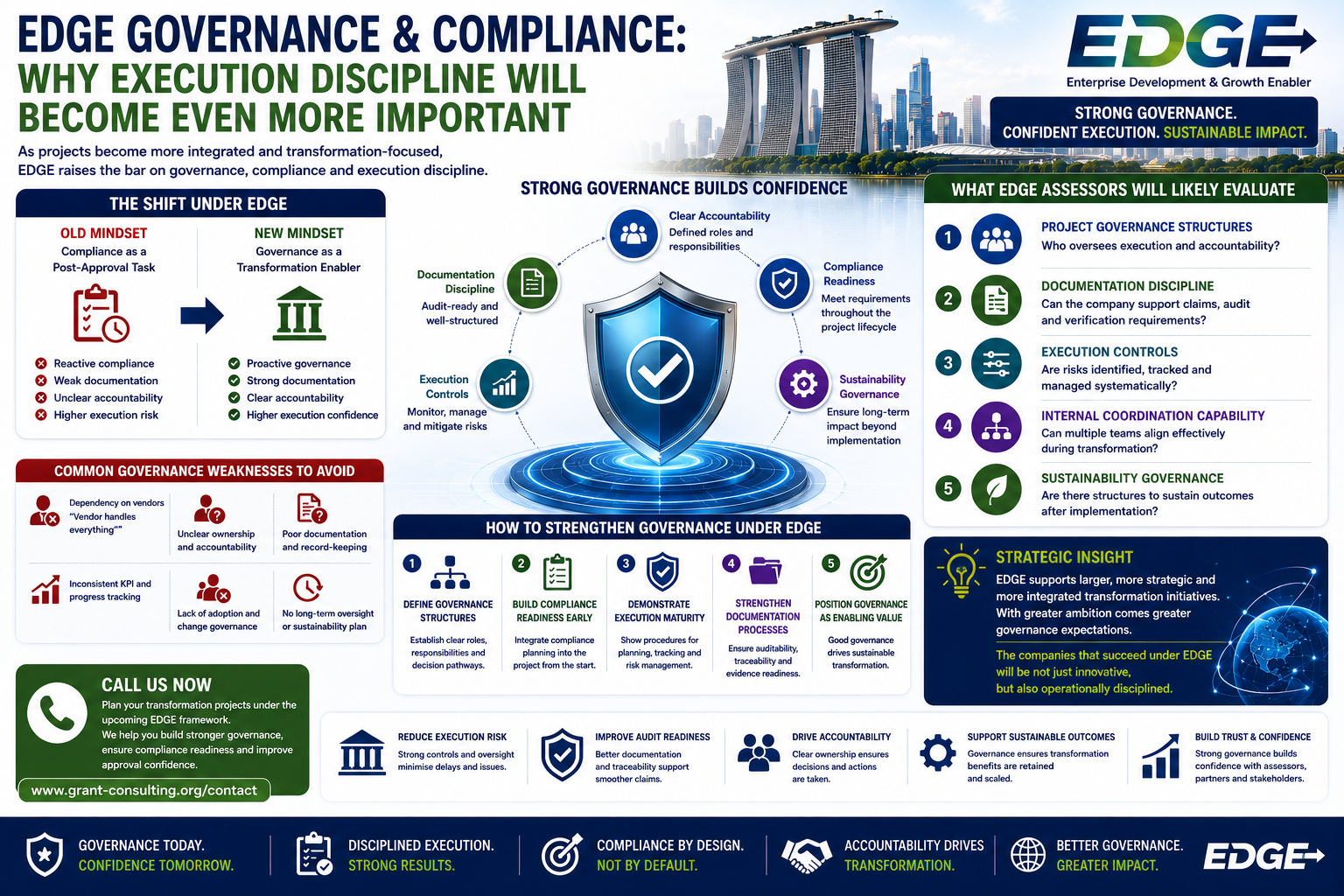
As projects become increasingly integrated and transformation-focused, assessors will likely place greater emphasis on:
Because larger transformation ambitions naturally increase implementation risk.
Under earlier grant structures, businesses sometimes viewed compliance as:
EDGE may change this significantly.
Because integrated transformation projects often involve:
This means weak governance can undermine:
Many companies still:
Common weaknesses include:
These create significant perceived risk.
Businesses should expect increasing scrutiny around:
1. Project governance structures
Who oversees execution and accountability?
2. Documentation discipline
Can the company support claims, audit, and verification requirements properly?
3. Execution controls
Are risks managed systematically?
4. Internal coordination capability
Can multiple teams align effectively during transformation?
5. Sustainability governance
Are there structures to sustain outcomes after implementation?
Common weak signals include:
These raise questions around:
To improve approval confidence:
1. Define governance structures clearly
Strong accountability matters.
2. Build compliance readiness early
Do not treat compliance as an afterthought.
3. Demonstrate execution maturity
Assessors want confidence that projects can be delivered systematically.
4. Strengthen documentation processes
Auditability and traceability remain critical.
5. Position governance as transformation enablement
Good governance accelerates sustainable outcomes.
EDGE likely reflects an important evolution in transformation philosophy:
Singapore is increasingly supporting:
But with greater transformation ambition comes:
The companies that succeed under EDGE will likely not just be:
They will also be:
If you are preparing transformation initiatives under the upcoming EDGE framework, it is important to strengthen governance, compliance, and execution readiness early.
We help companies structure projects around operational discipline, audit readiness, sustainable execution, and stronger approval confidence.
https://www.grant-consulting.org/contact
 WhatsApp us
```
WhatsApp us
```