
Businesses are increasingly investing in digital systems, automation and artificial intelligence.
But there is a problem that technology alone cannot solve.
Poor data.
A company can buy a sophisticated system and still produce unreliable reports.
It can implement AI and still receive weak outputs.
It can automate a workflow and still automate incorrect information.
It can create dashboards and still make poor decisions.
The underlying issue is often data readiness.
For businesses preparing for EDGE transformation, this deserves serious attention.
EnterpriseSG's Budget 2026 materials describe EDGE as a single scheme intended to streamline support currently provided through EDG, MRA and PSG. The same policy direction places greater emphasis on digitalisation, AI adoption, productivity and business growth.
That means companies should increasingly think about the foundations underneath transformation.
And data is one of those foundations.
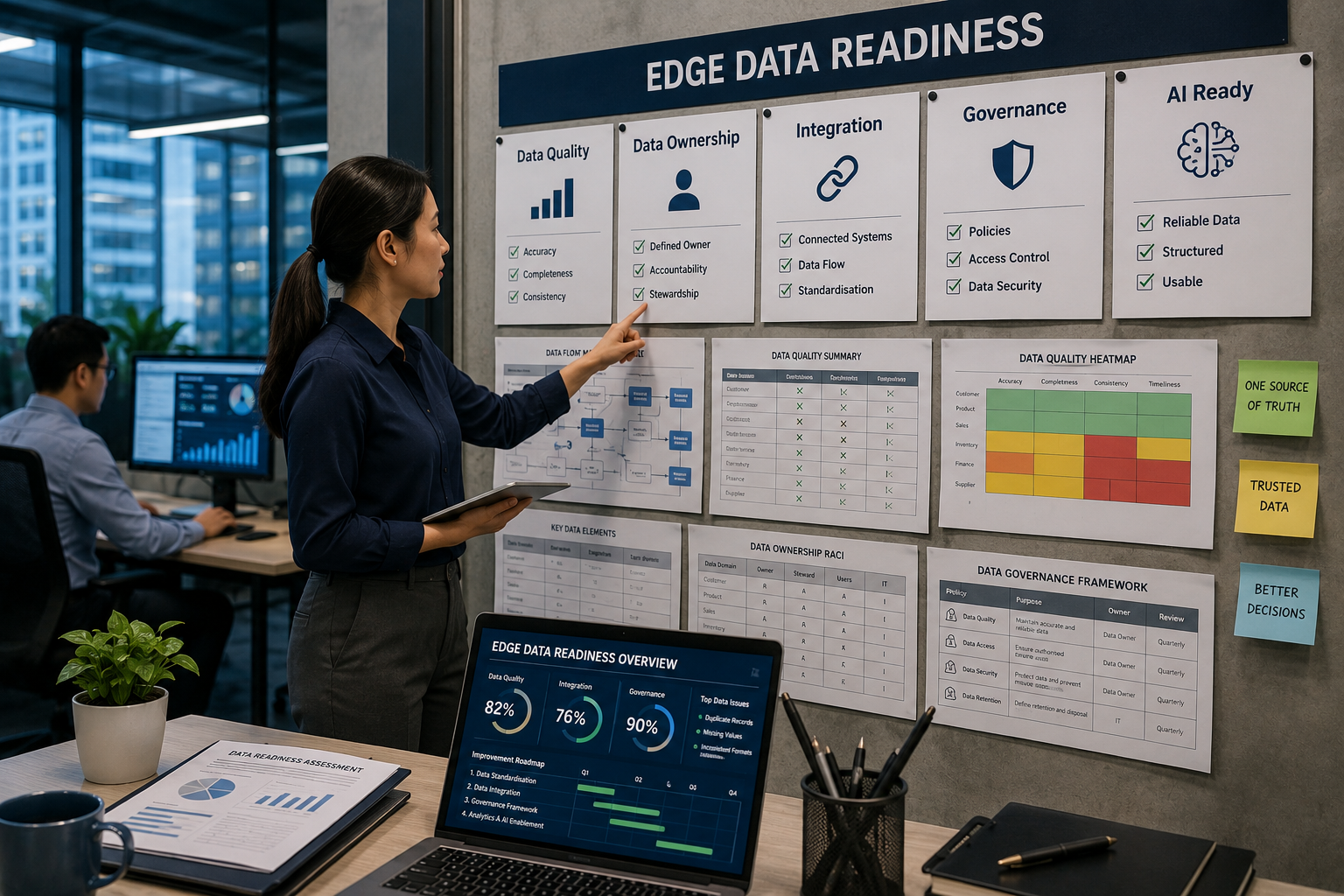
EDGE data readiness is the ability of a business to collect, structure, manage, access and use reliable information for operational and strategic purposes.
It includes:
Data accuracy
Data completeness
Data consistency
Data accessibility
Data ownership
Data security
Data integration
Reporting quality
Data governance
Management usability
The objective is not to create a perfect data environment.
The objective is to ensure that the company's information is good enough to support the transformation being proposed.
Many transformation projects begin with technology.
Businesses ask:
Which software should we buy?
Which AI tool should we use?
Which dashboard should we implement?
Which automation platform should we adopt?
A stronger starting point is:
What information do we need?
Where does that information currently exist?
Is it reliable?
Who owns it?
How is it currently used?
What happens when it is wrong?
These questions often reveal that the real problem is not the absence of technology.
It is the absence of structured information.
AI can process information quickly.
It cannot automatically make bad information reliable.
If historical customer records contain duplicates, an AI system may inherit those inconsistencies.
If product information is incomplete, automated recommendations may be weak.
If management reports use different definitions for revenue, margins or customers, AI-generated analysis may produce misleading conclusions.
This is why AI readiness begins with data readiness.
Businesses frequently underestimate their data problems.
They assume:
“Our ERP already has the data.”
“Our spreadsheets are accurate.”
“Our staff know which numbers to use.”
“The system can clean everything automatically.”
“We can fix the data after implementation.”
These assumptions can create expensive problems.
A transformation project may expose inconsistencies that have existed for years.
For example:
Two departments may use different customer codes.
Sales may define an active customer differently from finance.
Inventory records may contain duplicate product descriptions.
Management reports may use different reporting periods.
Historical records may be incomplete.
These issues become more visible as businesses integrate systems.
Businesses can assess data readiness across five areas.
Is the information correct?
Examples:
Customer contact details
Product pricing
Inventory quantities
Sales records
Supplier information
Financial data
Incorrect information creates downstream problems.
Is enough information available?
A customer database may contain names but not:
Industry
Location
Purchase history
Account owner
Customer segment
Contact role
Incomplete data limits analysis.
Are the same definitions used across the company?
For example:
What is a customer?
What counts as a qualified lead?
What is an active account?
What is a completed order?
What is monthly revenue?
If different departments answer differently, management reporting becomes unreliable.
Can authorised employees access the information they need?
Data may exist but still be difficult to use.
It may sit inside:
Personal spreadsheets
Email inboxes
Individual computers
Separate software platforms
Paper documents
Informal messaging channels
This creates operational dependency.
Does someone own the data?
Businesses should know:
Who creates it?
Who updates it?
Who approves changes?
Who can access it?
Who checks quality?
Who resolves errors?
Without ownership, data quality deteriorates over time.
Digitalisation often creates more data.
A CRM creates customer information.
An inventory system creates stock information.
An ERP creates financial and operational information.
A workflow platform creates process information.
A customer-service platform creates interaction data.
The more systems a business operates, the more important consistency becomes.
This is why digital transformation should not be treated as simply adding software.
It is also an information architecture challenge.
Businesses sometimes believe integration automatically creates efficiency.
It does not.
Connecting two systems can simply make bad information move faster.
The important question is:
What business decision does the integrated information improve?
For example:
Sales data connected to inventory can improve fulfilment planning.
Customer data connected to service history can improve account management.
Operational data connected to finance can improve margin analysis.
Production data connected to demand forecasts can improve planning.
Integration should have a business purpose.
AI transformation requires particularly careful preparation.
Before deploying an AI solution, businesses should ask:
What data will the AI use?
Is the data structured?
Is it current?
Who owns it?
Is there sensitive information?
How will access be controlled?
How will outputs be checked?
What happens when the AI is wrong?
How will employees use the output?
These questions should be answered before focusing on the AI interface.
Businesses should not wait for perfect data before beginning transformation.
That can become another form of inaction.
Instead, assess whether the data is:
Good enough for the intended use
Reliable enough for the required decision
Structured enough for the proposed solution
Controlled enough for the associated risk
For example, an internal knowledge-search application may require different data preparation from a financial forecasting system.
Data requirements should therefore be tied to the use case.
Automation also depends on consistent information.
Consider an automated approval workflow.
If requests arrive in ten different formats, automation becomes difficult.
If customer names are inconsistent, matching records becomes difficult.
If product codes are missing, downstream processing may fail.
Automation works best when inputs and rules are sufficiently structured.
This means process standardisation and data standardisation often need to happen together.
Management dashboards are only as useful as the information behind them.
A dashboard can look impressive while providing poor decision support.
Before building one, management should define:
What decisions need to be made?
Which metrics matter?
How often should they be reviewed?
Who owns each metric?
Where does the data come from?
What is the definition of each KPI?
How quickly should information be available?
This avoids building dashboards simply because dashboards are available.
A practical data-readiness exercise may identify the need to standardise:
Customer names
Customer IDs
Product codes
Supplier records
Employee identifiers
Sales categories
Revenue definitions
Cost categories
Market classifications
Lead stages
Order statuses
Reporting periods
Standardisation may appear administrative.
But it creates the foundation for reliable analysis.
Spreadsheets are not inherently bad.
They can be useful and flexible.
The problem arises when critical business information depends entirely on uncontrolled spreadsheets.
Typical warning signs include:
Multiple versions of the same file
Different formulas across departments
Manual copying between files
Unknown data owners
Broken links
Unclear reporting definitions
Files stored on individual computers
Heavy dependence on one employee
At a certain level of complexity, these practices become operational risks.
Technology vendors can help configure systems.
Consultants can help design data structures.
But the business should retain ownership.
Management needs to determine:
Which information matters
Which definitions are correct
Which data is sensitive
Which reports are authoritative
Who can change records
How quality is monitored
This prevents data governance from becoming a purely technical exercise.
A data dictionary can help businesses establish common definitions.
It might define:
Customer
Lead
Opportunity
Order
Revenue
Gross margin
Product
Active account
Cancelled order
Completed project
The dictionary does not need to be complicated.
Even a simple shared document can reduce confusion.
For larger projects, these definitions can become part of the system design.
Some SMEs avoid data governance because they associate it with large corporate processes.
It does not need to be complicated.
A practical SME data governance model can simply establish:
Data owner
Data source
Definition
Update frequency
Access permissions
Quality check
Escalation process
This can often be enough to create significant improvement.
Better data management also supports security.
Businesses should understand:
Who can access information
Where sensitive data is stored
Which systems exchange data
How access is removed when employees leave
Which external providers can access information
How data is backed up
How unusual access is identified
Transformation should not increase data exposure unnecessarily.
Security requirements should be considered during project design rather than after implementation.
Moving information from an old system to a new one can be more difficult than expected.
Historical data may contain:
Duplicates
Missing fields
Inconsistent formats
Old customer records
Incorrect codes
Obsolete information
Businesses should decide:
What data needs to move
What data can be archived
What data should be cleaned
What data can be discarded
What historical information must remain accessible
Migration is a business decision, not simply a technical exercise.
A common assumption is:
“We will migrate everything.”
That may not be the best approach.
Moving every historical record can:
Increase project cost
Increase implementation time
Create unnecessary complexity
Carry old errors into the new system
A better principle is:
Migrate what the business needs.
Archive what it must retain.
Remove what has no useful purpose.
Internationalisation adds another layer of complexity.
Businesses may need to manage:
Multiple currencies
Different customer structures
Different tax requirements
Different product information
Different market classifications
Different sales channels
Different partner types
Data structures should therefore be capable of distinguishing markets without creating unnecessary duplication.
This becomes particularly important when management wants to compare performance across countries.
Data can help identify productivity problems.
For example:
Where are delays occurring?
Which process takes the most time?
Which tasks require repeated manual entry?
Which products generate the most rework?
Which customers create unusual administrative workload?
Which activities depend on one employee?
Good data allows management to identify bottlenecks rather than relying entirely on anecdotal feedback.
Businesses can score themselves from low to high across the following areas:
Low:
Frequent errors and duplicates.
Medium:
Major records are generally reliable.
High:
Quality is monitored consistently.
Low:
Nobody clearly owns information.
Medium:
Departmental ownership exists.
High:
Responsibilities are clearly defined.
Low:
Information is scattered.
Medium:
Most information can be retrieved with effort.
High:
Authorised users can access reliable information efficiently.
Low:
Systems operate independently.
Medium:
Some information is exchanged manually.
High:
Critical workflows are integrated appropriately.
Low:
Rules are informal.
Medium:
Some procedures exist.
High:
Definitions, ownership, access and quality controls are established.
This simple assessment can reveal where transformation should begin.
A data assessment may reveal that the original project is too ambitious.
For example:
A company wants to deploy advanced AI forecasting.
But its historical sales data is inconsistent.
The appropriate first phase may therefore be:
Data standardisation
System integration
Data ownership
Reporting discipline
Then AI.
This is not a failure.
It is better transformation sequencing.
For many businesses, a logical sequence is:
Business problem
↓
Process definition
↓
Data assessment
↓
Data standardisation
↓
Technology implementation
↓
User adoption
↓
Measurement
↓
Continuous improvement
This prevents technology from becoming the starting point for every transformation decision.
A strong project proposal can explain:
The current information problem
Why it affects business performance
What data improvements are required
How technology will address the problem
How employees will use the new capability
What business outcomes are expected
How management will measure improvement
This creates a stronger connection between technology expenditure and enterprise transformation.
A transformation proposal should make the logic easy to follow.
For example:
Current problem:
Management spends several days consolidating sales information from multiple spreadsheets.
Root cause:
Customer and sales data are stored in inconsistent formats across teams.
Transformation:
Implement a centralised sales management workflow with standard data fields and reporting.
Capability:
Train sales and management teams on the new process.
Outcome:
Reduce reporting effort and improve management visibility.
This is more compelling than simply saying:
“We want a new CRM.”
During the transition period, businesses may still encounter projects that look like traditional PSG-style digital adoption, such as adopting a specific productivity solution.
EnterpriseSG currently states that existing EDG, MRA and PSG support remains accessible until EDGE launches in 2H 2026.
The strategic lesson remains relevant:
Do not start with the grant category.
Start with the business problem.
Then determine the appropriate transformation.
Businesses sometimes work backwards.
They ask:
“What can we claim?”
Then design a project around the answer.
A stronger approach is:
“What does the business need to become better at?”
Then:
“What transformation will achieve that?”
Then:
“What support pathway is appropriate?”
This keeps the business case in control.
Before starting a digital, AI or automation project, ask:
If these questions cannot be answered, the technology decision may be premature.
A mature business does not necessarily have an expensive data platform.
It has something more important:
Management trusts the information.
Employees know where information comes from.
Departments use consistent definitions.
Important records have clear owners.
Systems exchange information appropriately.
Errors are identified and corrected.
Management can access the information required to make decisions.
That is data maturity.
Singapore's current enterprise policy direction is increasingly focused on helping businesses adopt and benefit from AI and digital technologies. Budget 2026 specifically identifies AI adoption and digital transformation as areas of emphasis.
EnterpriseSG has also recently highlighted the move from standalone digital systems towards integrated, AI-enabled operations in the F&B sector.
This reinforces a broader strategic point.
The future competitive advantage may not come simply from having access to AI.
It may come from having better business information with which to use AI.
Companies that build strong data foundations will generally be better positioned to:
Automate intelligently
Analyse performance
Forecast demand
Personalise customer interactions
Improve operational control
Integrate systems
Scale digital capabilities
The data foundation therefore becomes a strategic asset.
A business does not become data-driven by buying a dashboard.
It becomes data-driven when information is:
Reliable
Structured
Owned
Accessible
Used
Reviewed
Acted upon
This is why data readiness deserves attention before major EDGE transformation projects begin.
The strongest businesses will not simply ask:
“What technology can we adopt?”
They will ask:
“What information do we need to operate better, and what capability must we build around it?”
That is a much more strategic transformation question.
If you are planning an EDGE digitalisation, AI, automation or business transformation project and want to assess whether your data foundation is strong enough to support the proposed solution, speak with us before committing to the project scope.
We help Singapore businesses structure transformation projects around business needs, data readiness, implementation discipline and measurable outcomes.
Book a 30-minute, no-obligation discussion here:
 WhatsApp us
```