A transformation project is not successful simply because it is implemented.
A new system can go live.
An automation workflow can be activated.
An AI tool can be deployed.
A redesigned process can be documented.
And the business can still continue operating almost exactly as before.
Why?
Because employees may not adopt the change.
This is one of the most underestimated risks in enterprise transformation.
Businesses often focus heavily on selecting technology, preparing grant applications, appointing service providers and defining project deliverables.
But after implementation begins, a different question becomes critical:
Will the people expected to use the new capability actually change how they work?
This is where change management becomes strategically important.
Singapore's enterprise support landscape is moving towards EDGE, which is intended to streamline support previously provided through EDG, MRA and PSG into a more seamless framework. The underlying policy direction remains focused on helping businesses build capabilities, improve productivity, digitalise and grow.
For businesses, that means transformation should not be understood as a procurement exercise.
It is an organisational change exercise.
Change management is the structured process of helping people move from the current way of working to a new one.
Depending on the project, this may involve changes to:
Processes
Responsibilities
Technology
Decision-making
Reporting
Management structures
Customer interactions
Job roles
Performance expectations
Skills
Data ownership
Approval procedures
The objective is not simply to tell employees that a change is happening.
The objective is to help the organisation understand:
Why the change is necessary.
What will change.
Who will be affected.
What employees need to do differently.
What support will be available.
How management will measure adoption.
What happens when the new process does not work as intended.
Consider a company implementing a new CRM.
The technology may be correctly configured.
The data may be migrated.
The employees may receive training.
But six months later, sales staff may still maintain their own spreadsheets.
Why?
Perhaps the CRM requires too many manual updates.
Perhaps management does not use the CRM data.
Perhaps employees do not understand why the information matters.
Perhaps the new workflow creates additional work.
Perhaps the sales manager continues accepting reports from spreadsheets.
The system is technically implemented.
The transformation is not.
This distinction matters.
Businesses should separate three milestones.
The solution has been delivered.
Employees are actively using the solution.
The organisation can consistently operate and improve the new way of working.
These are not the same thing.
A project should not be considered complete simply because the implementation milestone has been reached.
The more strategic question is:
Has the business actually changed its capability?
Resistance is often misunderstood.
Management may assume employees dislike change because they are unwilling to improve.
Sometimes that is true.
More often, the reasons are more practical.
Employees may be concerned about:
Additional workload
Loss of familiarity
Reduced control
New performance expectations
Unclear responsibilities
Job security
Lack of confidence
Technology complexity
Previous failed projects
Insufficient training
Conflicting instructions
Poorly designed processes
The first step in managing resistance is therefore understanding it.
Do not assume.
Ask.
Employees are sometimes informed only after management has selected the solution.
By that point, the project may already be committed.
Employees then feel that the change has been imposed on them.
Where appropriate, involving affected employees earlier can improve the quality of the project design.
They often understand operational problems that management cannot see from reports alone.
Training is important.
But training answers only one question:
“How do I use this?”
Change management addresses additional questions:
“Why are we doing this?”
“What changes in my role?”
“What happens to my existing work?”
“Who can help me?”
“What happens if the new process fails?”
“How will success be measured?”
A business can provide excellent training and still experience poor adoption.
Management may believe that employees will naturally adopt a new system because it is objectively better.
But employees experience change through their own daily work.
If the new process adds ten minutes to every transaction, employees will notice.
If the benefit appears only in management reporting, employees may not see the value.
The implementation design should therefore consider the user experience as well as the management objective.
This is one of the most common adoption failures.
The company introduces:
A new system.
A new workflow.
A new reporting process.
But management continues accepting the old version.
Employees quickly learn:
“The new process is optional.”
That creates parallel operations.
Over time, the business may have:
The official system.
The unofficial spreadsheet.
The management dashboard.
The manually adjusted report.
The automated workflow.
The workaround.
Complexity increases instead of decreasing.
Employees pay attention to what management actually does.
If senior management says:
“We are now using the new system.”
But continues asking for manual reports, the message is inconsistent.
If management says:
“Data quality matters.”
But never reviews inaccurate records, employees notice.
If management says:
“AI will improve productivity.”
But does not redesign workloads or expectations, adoption may remain superficial.
Change management therefore begins with leadership behaviour.
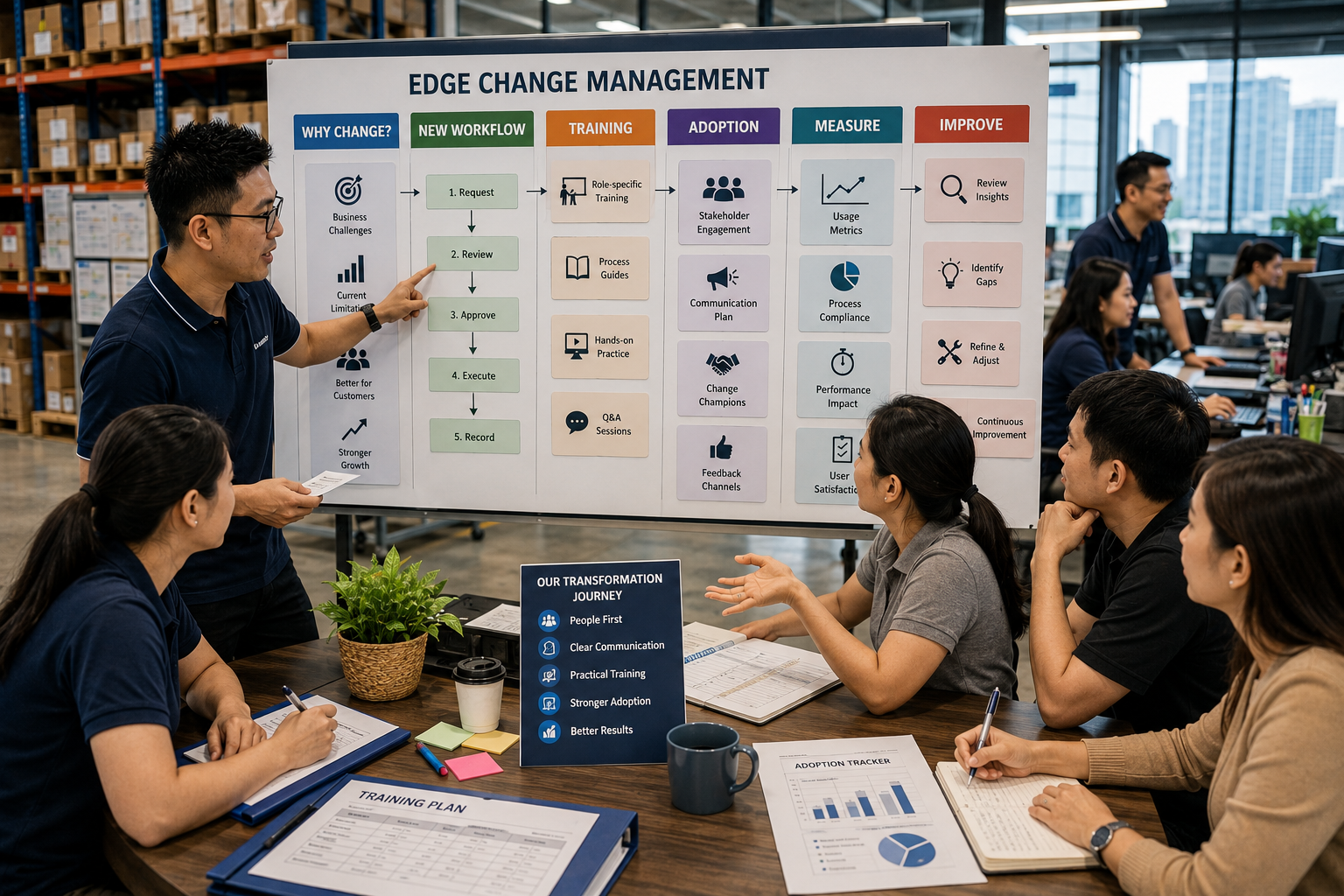
A practical transformation project can organise change management around six stages.
Employees should understand why the business cannot continue operating in the current way.
For example:
Manual reporting is consuming too much management time.
Customer information is fragmented.
Errors are increasing.
Demand is growing faster than the existing process can handle.
The company needs stronger visibility before expanding.
The current operating model depends too heavily on individual employees.
The explanation should be specific.
“Digital transformation” is too abstract.
“We currently spend three days every month manually consolidating information from five departments” is easier to understand.
Employees need clarity.
Explain:
Which process is changing.
Which systems are changing.
Which responsibilities are changing.
What will remain the same.
When the change will occur.
What employees need to learn.
What support will be available.
Uncertainty creates unnecessary resistance.
Not every employee experiences transformation in the same way.
A new system may affect:
Frontline employees.
Managers.
Finance.
Operations.
Sales.
IT.
External partners.
Customers.
Each group may require a different communication and training approach.
Readiness may involve:
Process testing.
User testing.
Training.
Data preparation.
Role clarification.
Access management.
Frequently asked questions.
Support arrangements.
Management communication.
A rushed go-live can damage confidence in the project.
The project does not end on launch day.
Employees may need:
Additional training.
Process clarification.
Technical support.
Refresher sessions.
Management guidance.
Peer support.
Problem escalation.
Businesses should expect a period of adjustment.
Do not rely entirely on employee feedback.
Measure behaviour.
For example:
System login rates.
Transaction completion.
Workflow usage.
Data completeness.
Process compliance.
Error rates.
Manual workarounds.
Reporting turnaround time.
Training completion.
Productivity changes.
The business should know whether the intended behaviour is actually occurring.
The official EDGE direction is designed around enterprise needs and activities rather than requiring businesses to navigate separate grant categories for different transformation objectives. EnterpriseSG's published materials describe activities such as digitalisation, enterprise efficiency and overseas growth as examples of the broader business needs the streamlined framework is intended to support.
That makes organisational readiness increasingly important.
A business may undertake a digitalisation project.
But digitalisation can affect:
Job roles.
Management processes.
Data responsibilities.
Performance measurement.
Decision-making.
Customer interactions.
The project should therefore consider the people dimension from the beginning.
Digital projects often fail because businesses focus on software features rather than workflow changes.
Before implementation, ask:
What will employees stop doing?
What will employees start doing?
What tasks will become automated?
What decisions will change?
What information will become available?
What exceptions will require human intervention?
Who owns the new workflow?
These questions are often more important than the software demonstration.
A system does not create value on its own.
People must perform certain behaviours consistently.
For a CRM, this may mean:
Updating customer records.
Logging opportunities.
Recording interactions.
Following standard sales stages.
For an automation platform, this may mean:
Using the correct input fields.
Following standard exception procedures.
Avoiding manual workarounds.
For AI, this may mean:
Knowing when to trust the output.
Knowing when to challenge it.
Reviewing important recommendations.
Protecting sensitive information.
Technology adoption is therefore behaviour change.
AI requires particularly careful change management.
Employees may have concerns about:
Job security.
Accuracy.
Privacy.
Accountability.
Performance expectations.
The reliability of AI-generated output.
Businesses should address these concerns directly.
A useful AI change-management programme should explain:
What the AI is intended to do.
What it is not intended to do.
Which decisions remain human decisions.
How outputs should be checked.
What data can and cannot be used.
How errors should be reported.
How employees will be trained.
EnterpriseSG's current AI transformation initiatives explicitly include organisational change management and workforce training as part of holistic transformation, reinforcing the importance of preparing people alongside technology.
The common approach is:
Buy an AI tool.
Give employees access.
Send an announcement.
Wait for productivity to improve.
This often produces uneven adoption.
Some employees experiment.
Some ignore the tool.
Some use it incorrectly.
Some become highly dependent on it.
Some create unofficial workflows outside management oversight.
A better approach defines:
Approved use cases.
Employee responsibilities.
Review requirements.
Data controls.
Performance expectations.
Training.
Governance.
AI should be incorporated into the operating model.
Not simply added to the software list.
Automation can also create employee anxiety.
Employees may ask:
Will my job disappear?
Will my workload increase?
Who handles exceptions?
What happens when the automation fails?
Will I be responsible for mistakes?
Management should answer these questions before implementation.
Where automation changes job responsibilities, businesses may need to consider job redesign, training and redeployment into higher-value activities.
EnterpriseSG currently highlights job redesign as a means of improving processes, workers' tasks and responsibilities, while its broader enterprise capability resources also emphasise investment in employee capability.
Businesses often describe automation only in terms of manpower reduction.
That can create unnecessary fear.
A more strategic objective may be to reduce:
Repetitive work.
Manual errors.
Administrative burden.
Processing time.
Dependency on individual employees.
This can allow employees to focus on:
Customer relationships.
Problem-solving.
Analysis.
Quality improvement.
Business development.
Management.
The transformation narrative should reflect the actual business objective.
Leadership support should be visible.
Employees should know:
Who sponsors the project.
Why management considers it important.
How decisions will be made.
Who can resolve issues.
What happens when implementation problems occur.
A transformation without visible sponsorship can become an IT project.
That is risky when the project affects the entire business.
Businesses should consider appointing internal champions.
A champion does not necessarily need to be the most senior employee.
The person should:
Understand the business.
Be respected by colleagues.
Understand the project.
Communicate clearly.
Identify adoption problems.
Provide practical feedback.
Help connect employees with management.
For larger projects, different departments may have their own champions.
This creates a more effective feedback network.
Businesses sometimes appoint a project champion and assume the change-management responsibility has been delegated.
That is not enough.
The champion can support adoption.
But management must still:
Make decisions.
Remove obstacles.
Allocate resources.
Set expectations.
Resolve conflicts.
Reinforce the new operating model.
Change management requires leadership ownership.
One announcement is rarely enough.
A practical communication plan may include:
Project launch.
Business rationale.
Progress updates.
Upcoming changes.
Training reminders.
Go-live information.
Frequently asked questions.
Success stories.
Post-implementation updates.
The purpose is not to overwhelm employees.
It is to reduce uncertainty.
A useful employee communication framework answers five questions.
Why does the business need to change?
What is changing?
When will the change happen?
How will employees work differently?
Where can employees get help?
If employees cannot answer these questions, communication may not yet be sufficient.
Generic training often produces poor results.
A sales employee may need different training from:
A finance employee.
An operations manager.
A system administrator.
A senior executive.
Training should focus on the tasks employees actually need to perform.
For example, management may need training on:
Reading dashboards.
Using new reports.
Making decisions with new data.
Employees may need training on:
Completing transactions.
Handling exceptions.
Updating records.
Following the new workflow.
Different roles require different capabilities.
Employees should ideally practise before a major transition.
Useful approaches may include:
Sandbox environments.
Pilot programmes.
Test cases.
Role-play.
Simulated transactions.
Guided workshops.
Small-group sessions.
The objective is to identify problems before they become operational failures.
For higher-risk changes, a pilot may be more effective than a company-wide launch.
For example:
One department.
One product category.
One customer segment.
One branch.
One market.
The business can learn:
What employees struggle with.
Which processes are unclear.
Where data problems occur.
Which training is missing.
What technical changes are required.
The pilot creates evidence before the project scales.
A pilot should test:
Technology.
Process.
Employee behaviour.
Management reporting.
Exception handling.
Training.
Governance.
Support requirements.
A technically successful pilot can still reveal major adoption problems.
That information is valuable.
Businesses should define adoption indicators before implementation.
Possible measures include:
Percentage of employees trained.
Percentage actively using the system.
Percentage of required records completed.
Reduction in manual workarounds.
Reduction in processing time.
Error rates.
Workflow completion rates.
User-support requests.
Management usage.
Employee confidence.
Business outcomes.
The most useful metrics will depend on the project.
A login does not necessarily mean adoption.
An employee may log in once and never use the system again.
A better question is:
Is the intended business behaviour occurring?
For example, if the project objective is to improve sales management, measure:
Percentage of opportunities recorded.
Forecast accuracy.
Follow-up completion.
Sales-cycle visibility.
Management usage of CRM data.
The adoption metric should connect to the transformation objective.
After implementation, management should conduct a structured review.
Ask:
What changed?
What did not change?
Which employees adopted the new process?
Where are workarounds occurring?
What problems remain?
What training gaps exist?
What should be improved?
Has the expected business outcome been achieved?
This prevents the project from disappearing after go-live.
If employees consistently avoid a process, management should not immediately assume that employees are the problem.
Ask:
Is the process unnecessarily complicated?
Does it duplicate work?
Are the instructions unclear?
Does the system match actual operations?
Are responsibilities properly defined?
Does management reinforce the process?
A repeated workaround may be evidence of a design issue.
Good governance should distinguish between:
Employee non-compliance.
Process failure.
System failure.
Training gaps.
Unclear management expectations.
These problems require different responses.
Businesses should not treat adoption as an optional activity at the end of the project.
The project scope should consider:
Stakeholder identification.
Communication.
Training.
Pilot testing.
User feedback.
Go-live support.
Adoption measurement.
Post-implementation review.
Capability transfer.
This makes change management part of project execution.
A stronger transformation proposal can demonstrate:
The current operating problem.
The proposed capability.
The employees affected.
The changes required.
The implementation approach.
The training plan.
The adoption measures.
The expected business outcome.
This creates a more complete transformation logic.
For example:
Current problem:
Customer service requests are manually routed through email, resulting in inconsistent response times.
Transformation:
Implement a centralised workflow with automated routing and standard service categories.
People impact:
Service employees must use a new request-management process.
Change management:
Role-specific training, pilot testing and departmental champions.
Adoption measure:
Percentage of requests processed through the new workflow.
Business outcome:
Reduced manual coordination and improved response visibility.
This is more complete than:
“We are buying workflow software.”
A credible transformation project should make it clear that the company has considered execution beyond procurement.
The questions include:
Who will use the capability?
What will change?
How will employees be prepared?
Who owns the new process?
How will adoption be monitored?
How will problems be resolved?
How will the company know whether the transformation created value?
These questions matter because a grant-supported project still needs to create a genuine business outcome.
Before implementing a major transformation project, ask:
If these questions do not have clear answers, the project may be technically ready but organisationally unprepared.
Change management is not separate from governance.
They reinforce each other.
Governance determines:
Who owns decisions.
Who approves changes.
Who monitors outcomes.
Who resolves problems.
Change management determines:
How the organisation adopts those decisions and new ways of working.
Together, they create execution discipline.
Without governance, employees may receive inconsistent instructions.
Without change management, governance decisions may never translate into operational behaviour.
Management may decide:
“We will become more data-driven.”
But employees continue maintaining separate spreadsheets.
Management may decide:
“We will automate approvals.”
But managers continue approving requests through informal messages.
Management may decide:
“We will use AI.”
But employees do not know which outputs require human review.
The gap is between the decision and the behaviour.
Change management closes that gap.
The strongest transformation does not leave behind only:
A new system.
A consultant's report.
A set of training slides.
A completed implementation milestone.
It leaves behind a stronger organisation.
Employees understand the new process.
Managers use better information.
Responsibilities are clearer.
Data is more reliable.
Workflows are more consistent.
The business can continue improving without constant external intervention.
That is capability building.
Businesses often follow this sequence:
Choose technology.
Appoint vendor.
Implement solution.
Then think about employees.
A stronger sequence is:
Understand the business problem.
Understand the people and processes affected.
Design the transformation.
Prepare employees.
Implement.
Support adoption.
Measure outcomes.
Improve.
People should not be treated as the final implementation step.
They are part of the transformation design from the beginning.
As Singapore businesses move towards more integrated digital, AI and capability-building initiatives under EDGE, the organisations that achieve the strongest results are unlikely to be those that simply buy the most advanced technology.
They will be the businesses that can successfully change how people work.
That is where transformation becomes operational capability.
If you are planning an EDGE digitalisation, AI, automation or enterprise transformation project and want to strengthen employee adoption, implementation readiness and post-project capability, speak with us before finalising the project scope.
We help Singapore businesses structure transformation projects around people, processes, governance, implementation discipline and measurable business outcomes.
Book a 30-minute, no-obligation discussion here:
https://www.grant-consulting.org/contact
 WhatsApp us
```