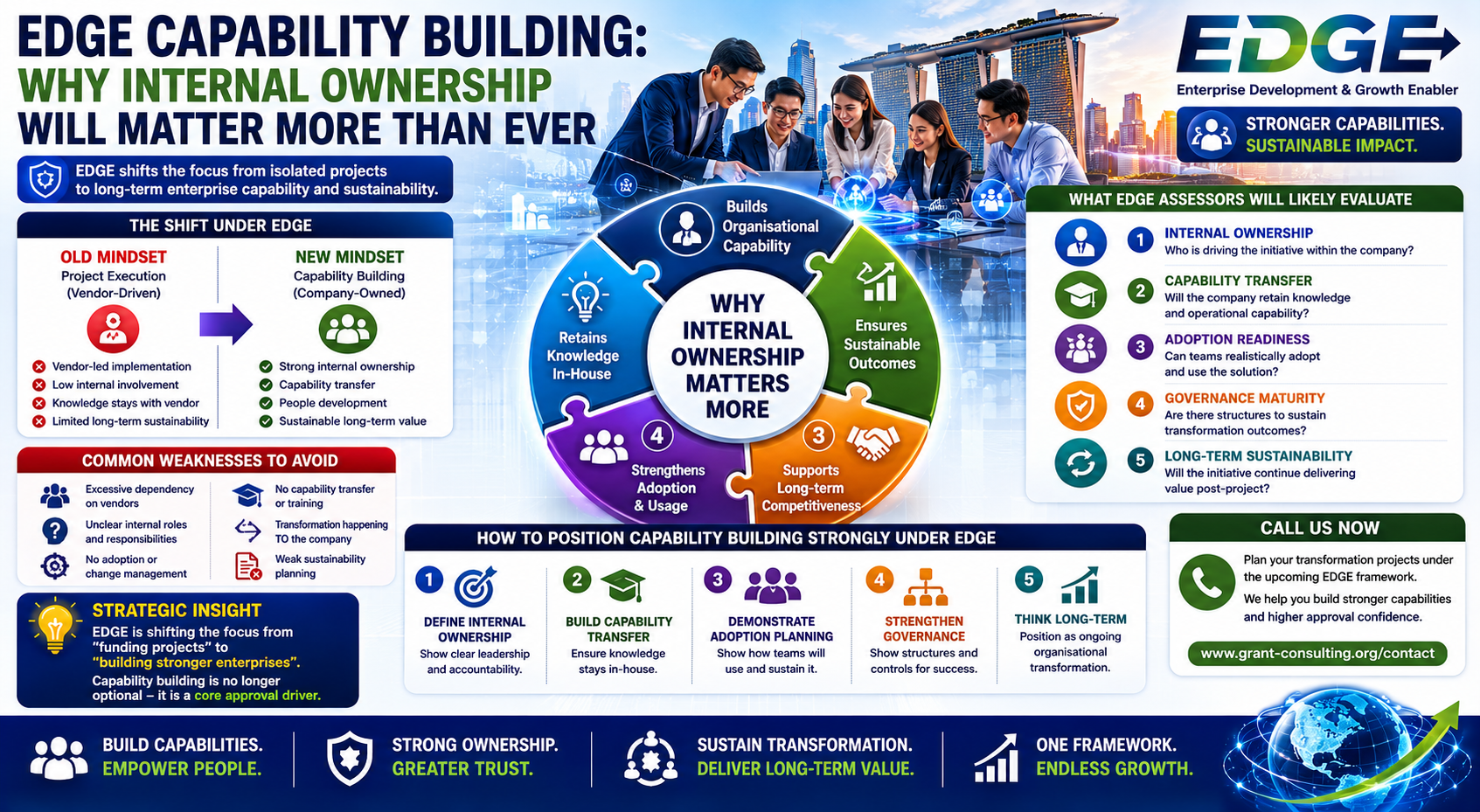
One of the biggest shifts likely emerging under EDGE is this:
Singapore appears to be moving away from:
toward:
This changes how businesses should think about grant positioning entirely.
Because under EDGE, the key question may increasingly become:
“What capability does the company retain after the project ends?”
—not simply:
“Was the project implemented?”
Historically, some businesses approached grants as:
EDGE may significantly increase scrutiny around:
This means companies that rely entirely on external parties may face greater approval risk.
Many applications still position projects like this:
while the company remains largely passive.
This creates a major concern:
“What happens when the vendor engagement ends?”
If the answer is unclear, sustainability risk rises significantly.
Businesses should expect increasing scrutiny around:
1. Internal ownership
Who inside the company is driving the initiative?
2. Capability transfer
Will the organisation retain knowledge and operational capability?
3. Adoption readiness
Can teams realistically absorb and utilise the changes?
4. Governance maturity
Are there structures to sustain transformation outcomes?
5. Long-term sustainability
Will the initiative continue delivering value post-project?
Common weaknesses include:
These significantly increase perceived risk.
To improve approval confidence:
1. Define internal project ownership clearly
Assessors want to see accountable leadership.
2. Build capability transfer into the project
Knowledge retention matters.
3. Demonstrate adoption planning
Transformation only matters if people actually use it.
4. Position projects as organisational transformation
Not outsourced implementation.
5. Think beyond project completion
The strongest projects show sustainable operational evolution.
EDGE likely reflects an important evolution in enterprise support philosophy:
The focus is shifting from:
toward:
This means capability building may increasingly become:
Businesses that internalise this early will likely position themselves much more effectively.
If you are planning transformation initiatives under the upcoming EDGE framework, it is important to demonstrate strong internal ownership and capability-building strategy from the start.
We help companies structure projects around sustainable transformation, adoption readiness, governance, and long-term operational capability.
https://www.grant-consulting.org/contact
 WhatsApp us
```
WhatsApp us
```