
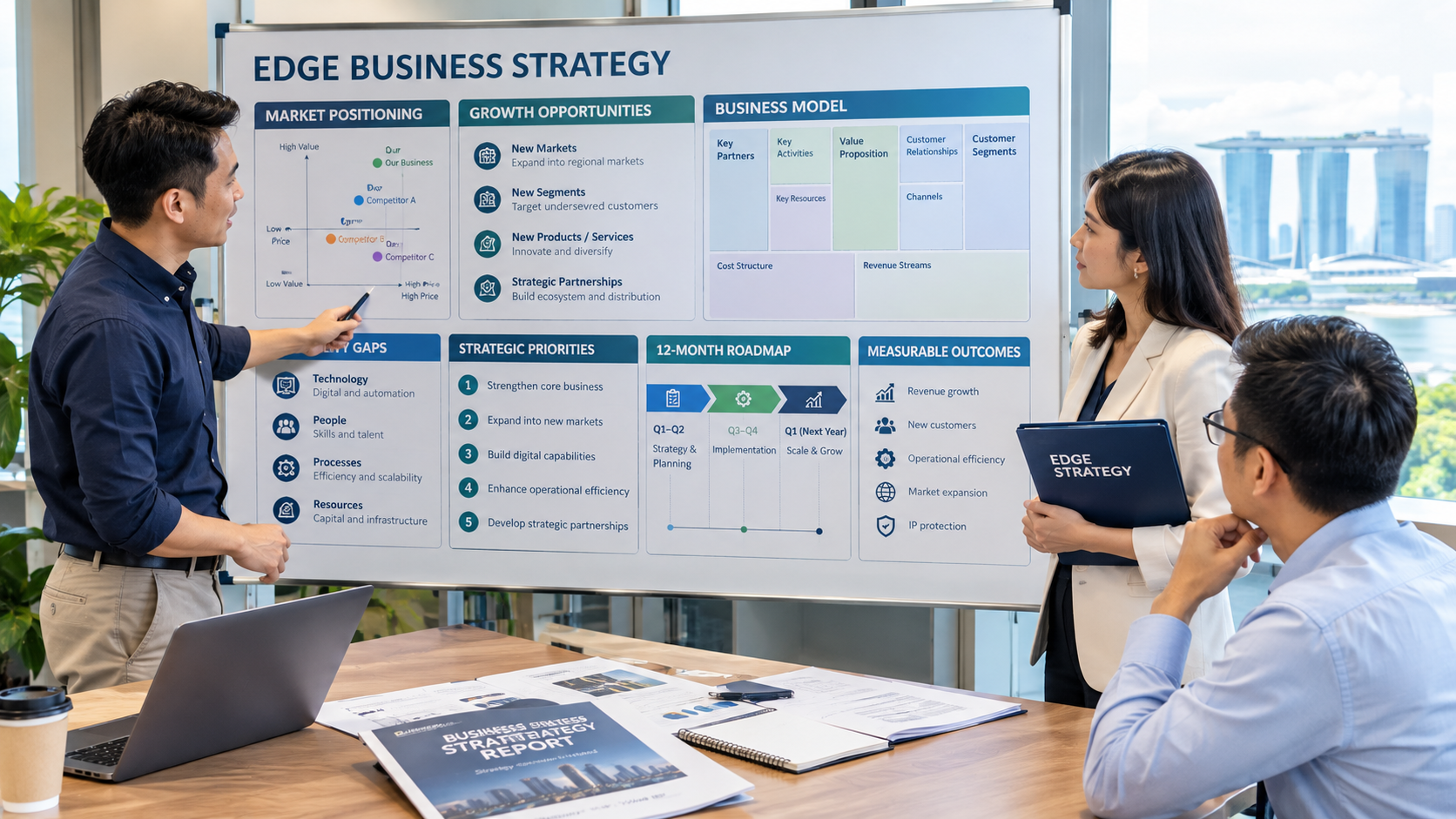
Many Singapore SMEs have clear ambitions.
They want to increase revenue, enter new markets, introduce new services, improve profitability or build stronger competitive positioning.
However, ambition does not automatically translate into a coherent business strategy.
A company may pursue several initiatives simultaneously without understanding which opportunities offer the greatest commercial value.
Another business may invest in new capabilities without establishing how those capabilities support its long-term direction.
Some organisations remain heavily dependent on founder decisions, informal planning and historical business practices.
These challenges become more significant as the business expands.
The EDGE Business Strategic Planning activity provides support for eligible businesses seeking to formulate strategies and processes that improve business development, manage intellectual property assets and optimise operations.

Enterprise Singapore
+1
The central objective is to establish a clearer relationship between:
A useful strategy is not simply a report describing what the company wants to achieve.
It is a structured decision-making framework that guides management action.
EDGE Business Strategic Planning is an activity under the Business Strategy category of Singapore's EDGE Grant.
It supports professional services to help businesses formulate strategies and processes for business development, intellectual property management and operational optimisation.
EnterpriseSG publishes the following headline support levels:
Business category
Support level
SMEs
Up to 50%
Non-SMEs
Up to 30%
The published application outcome is 10 weeks, and the project must be completed within 12 months from approval. The support received counts towards the company's overall annual EDGE grant cap of S$100,000.
Enterprise Singapore
Actual support is subject to eligibility, approved project scope and the Letter of Offer.
Singapore businesses operate in an environment where commercial conditions, customer expectations and competitive pressures can change.
A business that relies entirely on its existing revenue model may find it difficult to respond when:
Strategic planning provides a structured way to examine these conditions before making significant commitments.
For SMEs, the value lies in improving the quality of business decisions.
Rather than asking only, "How can we grow?", management should ask:
Which growth opportunities fit our capabilities, market position and available resources?
EnterpriseSG identifies several core components of the required business strategy report.
Enterprise Singapore
These include:
Each component serves a different purpose.
01 — Internal Analysis
Understand the business
Existing business drivers, challenges, strengths, weaknesses and operating model.
02 — External Analysis
Understand the market
Market size, trends, competitive conditions and external opportunities.
03 — Growth Strategies
Determine where to compete
Business models, strategic priorities and proposed growth initiatives.
04 — Implementation Roadmap
Translate strategy into action
Implementation timeline, measurable outcomes and management responsibilities.
A strategic planning engagement should connect these four components into one coherent business direction.

Before deciding where to grow, a business must understand its current position.
This requires more than reviewing revenue figures.
A meaningful internal analysis may examine:
What currently generates the company's revenue?
Which customers, products or services contribute most significantly to business performance?
Are there dependencies on a small number of customers or key employees?
Potential strengths include:
Potential weaknesses include:
Management should understand how the company creates and delivers value.
This includes examining:
The purpose is to identify where the current business model supports growth and where structural limitations exist.
A company may have operated successfully for 15 years.
However, its historical success does not automatically establish that its current business model remains suitable for the next five years.
Past revenue may reflect relationships, market conditions or operating practices that are changing.
Strategic planning should therefore examine both existing performance and future relevance.
The question is not simply whether the company has been successful.
It is whether its current capabilities can support its intended future direction.

External analysis examines the commercial environment surrounding the business.
EnterpriseSG identifies market size and trend analysis, together with competitor analysis, as components of the required business strategy report.
Enterprise Singapore
Management should understand the potential scale of the opportunity.
A large market does not automatically represent an attractive opportunity for every SME.
The business must consider whether it can realistically reach and serve the relevant customer segment.
Relevant trends may include:
A competitor assessment should examine more than competitor names.
It should consider:
Dimension
Strategic question
Market positioning
How do competitors differentiate themselves?
Pricing
Where does the company sit in the market?
Customer segments
Which customers do competitors serve?
Product or service offering
What capabilities do competitors provide?
Distribution
How do competitors reach customers?
Differentiation
Where might an underserved opportunity exist?
The objective is to establish a defensible understanding of the competitive landscape.
A market may be commercially attractive but operationally unsuitable.
For example, a Singapore engineering company may identify an opportunity to serve larger regional customers.
However, the company may lack:
The strategy should identify these gaps before management commits to expansion.
A market opportunity becomes more actionable when the company understands what it must build to pursue it.
This is where analysis becomes strategic decision-making.
A company may identify several possible growth directions:
However, attempting every opportunity simultaneously can dilute management attention.
A business strategy should establish priorities.
Consider a professional services company that generates most of its revenue through project-based engagements.
Management identifies three potential directions:
Opportunity
Strategic consideration
Expand existing project services
Builds on established expertise
Introduce recurring service packages
May improve revenue predictability
Develop proprietary digital offerings
Requires additional technical capabilities
The strategic planning process should assess the market potential, investment requirements, commercial risks and capability gaps associated with each option.
The result should be a reasoned strategic direction rather than an unprioritised list of ideas.
A strategy containing 20 major initiatives may appear comprehensive.
But if the business lacks the resources to execute them, the plan becomes difficult to operationalise.
A more practical approach is to identify a manageable number of priorities.
Each priority should have:
Strategic discipline is often demonstrated through what management chooses not to pursue.

A business model explains how an organisation creates, delivers and captures value.
Strategic planning may reveal that the existing model requires adjustment.
For example:
A manufacturer may rely on one-off equipment sales.
It may explore maintenance packages, technical support contracts or recurring service arrangements.
A B2B service provider may rely heavily on customised projects.
It may examine whether selected services can be standardised into repeatable packages.
A distributor may explore additional value-added services rather than competing only on product pricing.
These are strategic questions rather than automatic recommendations.
The company should assess customer demand, delivery feasibility, pricing and financial implications before adopting a new model.
The answers help establish whether the business should refine its existing model or pursue a more substantial strategic shift.
Business Strategic Planning also covers the management of intellectual property assets.
Enterprise Singapore
For some Singapore SMEs, intellectual property is an important but underdeveloped business asset.
Relevant considerations may include:
A company may possess valuable technical knowledge without having a structured approach to protecting or commercialising it.
Strategic planning can help management understand how intellectual property relates to its competitive positioning and growth objectives.
This is not the same as treating every business idea as patentable or commercially protectable.
The relevant protection approach depends on the nature of the asset and applicable legal considerations.
Growth can expose weaknesses in the way a business operates.
For example, a company may have a strong sales pipeline but lack sufficient delivery capacity.
Another may have profitable products but inefficient fulfilment processes.
A third may rely on manual coordination between departments.
Strategic planning should examine whether the operating model can support the intended direction.
Potential areas of examination include:
The purpose is to establish which operating changes are strategically important.
This should not be confused with a standalone routine SOP update, which EnterpriseSG lists among non-supported costs for the Business Strategic Planning activity.
Enterprise Singapore
A business strategy becomes useful when it establishes what happens next.
Months 1–3
Strategic Foundation
Months 4–6
Business Model and Capability Development
Months 7–9
Execution Planning
Months 10–12
Management Review
The roadmap should contain measurable outcomes and a realistic timeline, consistent with the official project deliverable requirements.
Enterprise Singapore
EnterpriseSG specifies four broad areas for the final report.
Enterprise Singapore
Report section
Key information
Internal analysis
Business drivers, challenges, strengths, weaknesses and operating model
External analysis
Market size, trends and competitor analysis
Growth strategies
Business models, strategic roadmaps and action plans
Recommendations
Implementation roadmap, timeline and measurable expected outcomes
A well-structured report should allow management to understand not only the recommended strategy but also the reasoning behind it.
It should be sufficiently specific to support management decisions.
A generic report describing broad economic trends without connecting them to the company's business model would have limited practical value.
Strategic recommendations should be connected to measurable business objectives.
Possible indicators include:
Strategic objective
Illustrative measurement
Revenue diversification
Revenue contribution from new offerings
Customer development
Number of new target-segment customers
Commercial improvement
Gross margin or contribution margin
Operating efficiency
Cost per transaction or service delivery
Recurring revenue
Share of revenue from recurring contracts
Capability development
Completion of defined capability milestones
These are illustrative management indicators, not official EDGE scoring criteria.
The company should select measurements that reflect its actual strategic priorities.
EnterpriseSG identifies the following application information for Business Strategic Planning:
Enterprise Singapore
Requirement
Purpose
Vendor proposal
Defines the strategic planning scope
Vendor quotation
Establishes project cost
SS 680 certification
Required vendor documentation
One-year revenue growth projection
Documents expected commercial impact
Employment projections
Documents anticipated job creation
The employment projections cover overall and Singaporean jobs with gross monthly salary above S$5,000 for one year after project completion.
Businesses should ensure their projections are consistent with the proposed strategic direction.
For example, if the strategy focuses on introducing a new business line, the revenue projection should explain the assumptions behind that growth.
Strategic planning requires more than the ability to produce presentations.
A suitable consultant should understand how to connect:
Businesses should evaluate whether the proposed vendor can translate analysis into decisions and an actionable roadmap.
EnterpriseSG identifies SS 680 certification among the required vendor documentation for this activity.
Enterprise Singapore
The company should verify the relevant documentation before proceeding.
A strategic plan may recommend:
But recommendations alone do not establish execution.
Each major initiative should have an accountable management owner.
For example:
Strategic initiative
Illustrative owner
New customer segment development
Commercial Director
New service offering
Business Unit Head
Operating model improvement
Operations Lead
IP strategy
Management and relevant IP adviser
Financial performance monitoring
Finance Lead
This allocation should reflect the company's actual organisation.
The key principle is that strategic responsibility must remain within the business.
A consultant can provide analysis and recommendations, but management must make the decisions and execute the strategy.
EnterpriseSG publishes several conditions relevant to this activity.
Enterprise Singapore
The business entity must:
Other activity-specific eligibility conditions may apply.
The company must not have started work or made any payment or deposit to a supplier, vendor or third party before application submission.
The project must be completed within 12 months from approval.
Professional service costs are supported under this activity, subject to the approved scope.
EnterpriseSG identifies regulatory compliance expenses, SOP updates and GST among non-supported costs.
Businesses should ensure that the proposed project is genuinely focused on business strategy development rather than routine administrative work.
Third-party companies are not permitted to apply for or manage the grant on behalf of the applicant company.
Enterprise Singapore
EDGE support is disbursed on a reimbursement basis.
The business must complete the approved project and pay the approved expenses in full before claim submission.
EnterpriseSG publishes the following disbursement timelines after claim approval:
Payment method
Published timeline
PayNow Corporate
14 working days
GIRO
Up to 8 weeks
Enterprise Singapore
Management should therefore plan the cash flow required to complete the project without relying on immediate grant disbursement.
Before applying, management should confirm:
The business has a clearly identified strategic planning need.
The project examines existing business capabilities.
Market size and trends will be assessed.
Competitor analysis is included.
Growth opportunities are connected to existing capabilities.
Business model considerations are addressed where relevant.
Strategic recommendations are prioritised.
The implementation roadmap has a realistic timeline.
Measurable outcomes are defined.
The vendor meets applicable documentation requirements.
Revenue and employment projections are prepared.
The company has not commenced prohibited pre-application work or payments.
The project can be completed within the approved period.
The company can fund the project on a reimbursement basis.
The real value of strategic planning is not the length of the report.
It is whether management can make better decisions after completing the engagement.
A useful strategy should clarify:
This creates a stronger foundation for future transformation projects.
Business strategy establishes direction.
Operational execution converts that direction into action.
For example:
A strategy may identify the need to develop a new customer segment.
Execution may involve sales capability development, revised customer acquisition processes and new commercial offerings.
A strategy may identify operational inefficiency.
Execution may involve process redesign, workforce capability building or technology transformation.
These are connected but distinct stages.
Businesses should avoid treating the strategic planning report as proof that the recommended initiatives have already been implemented.
If your company is considering a strategic planning project under EDGE, we can help assess the proposed scope, identify key preparation requirements and structure a commercially grounded business case.
Our approach focuses on helping Singapore enterprises clarify their direction, strengthen organisational capabilities and establish measurable growth priorities.
Book a 30-minute, no-obligation discussion here:
 WhatsApp us
```