
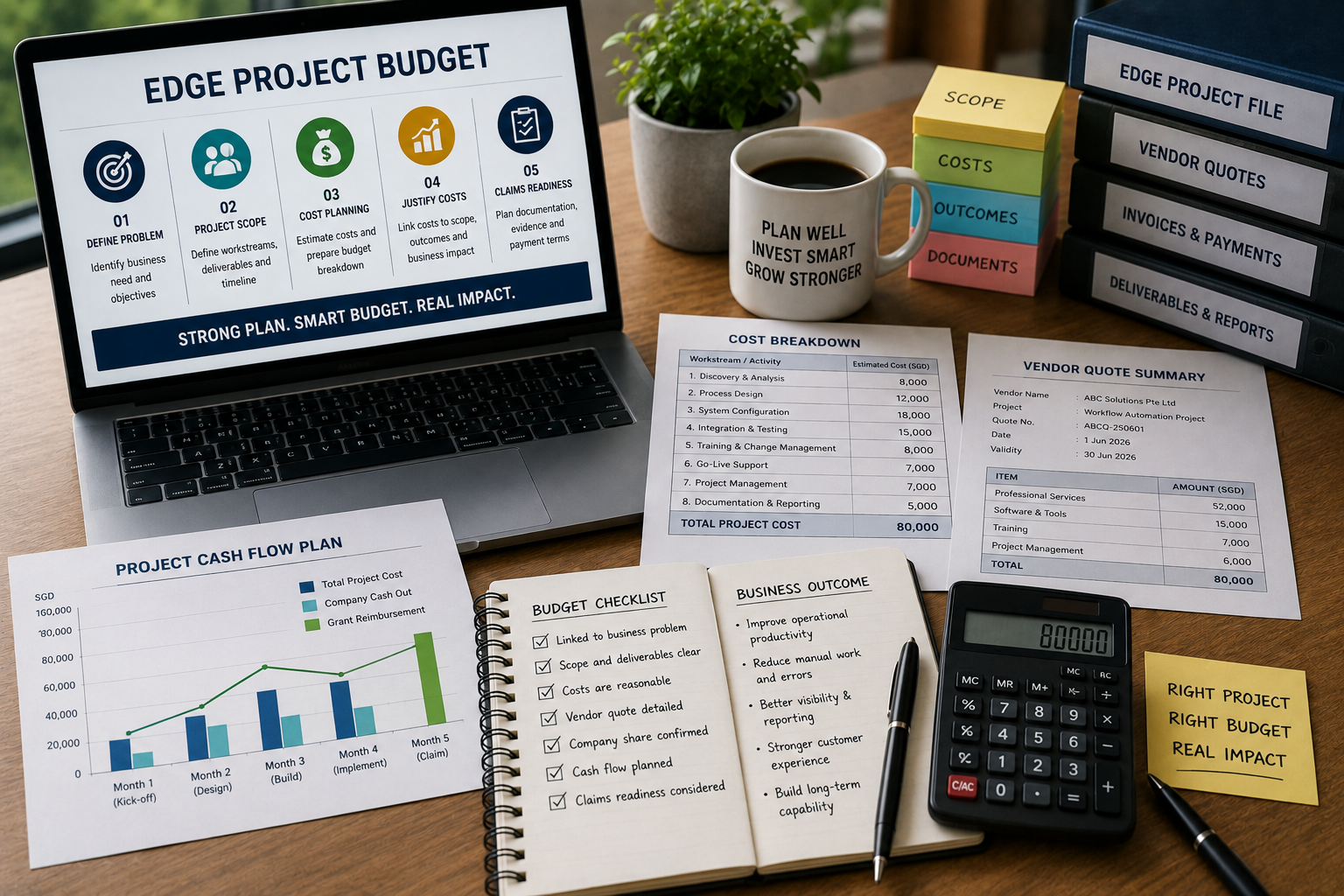
A grant project can be strategically sound but still weakened by poor budgeting.
This happens when the business problem is real, the vendor appears capable, and the project objective is sensible — but the budget is vague, inflated, poorly broken down or disconnected from the approved scope.
Under EDGE, Singapore businesses should expect budget discipline to remain important.
A unified grant scheme may make the pathway easier to understand, but it does not remove the need to justify project costs properly.
Assessors will still need to understand what the company is paying for, why the cost is reasonable, and how the spending supports enterprise development.
This is why businesses should treat budget planning as part of the business case, not an afterthought.
EDGE budget planning is the process of defining, structuring and justifying the financial cost of a grant-supported project.
It includes:
Identifying project cost items
Linking each cost to the project scope
Obtaining suitable vendor quotations
Reviewing whether costs are reasonable
Understanding company co-funding
Planning cash flow
Separating essential costs from optional costs
Preparing documentation for approval and claims
A good project budget should help an assessor understand the project.
It should not look like a number inserted at the end of the application.
EDGE is expected to consolidate EDG, MRA and PSG into one scheme.
This means businesses may increasingly apply based on intended business activities rather than first deciding which legacy scheme applies.
However, regardless of scheme design, public grant support is not meant to fund vague spending.
The business must still show that the project is credible, necessary, cost-effective and aligned with enterprise transformation.
Budget planning matters because it forces management to answer important questions:
What are we really trying to achieve?
What work is required?
Which costs are necessary?
Which costs are nice-to-have?
Are we paying for capability building or ordinary business expenses?
Can we fund the company’s share?
Can we prove completion later?
These questions improve both the application and the project itself.
A strong EDGE budget should match the project narrative.
If the project is about productivity improvement, the budget should support workflow redesign, automation, implementation, training, process documentation or measurable efficiency gains.
If the project is about overseas expansion, the budget should support market assessment, partner identification, business matching, localisation, regulatory preparation or go-to-market execution.
If the project is about digital capability, the budget should support system design, configuration, integration, user training, adoption and reporting.
If the project is about capability building, the budget should support frameworks, processes, tools, training, management systems or implementation discipline.
When the budget and scope do not align, the project becomes harder to justify.
For example, a project described as strategic overseas expansion should not have a budget that is mostly generic branding or broad marketing content.
A productivity project should not be framed mainly around buying tools without explaining process improvement.
An AI project should not be budgeted around software features without explaining business use cases, data flow, human review and adoption.
The budget should reinforce the business case.
Businesses often make the mistake of treating grant budgeting as a funding maximisation exercise.
They ask:
“How much can we claim?”
“What is the maximum grant?”
“How do we structure the project to get more support?”
These are understandable questions, but they should not be the starting point.
The better starting questions are:
What does the business actually need?
What is the right scope?
What is the reasonable cost to execute the project properly?
What capability will remain after completion?
What outcomes are worth paying for even without grant support?
A grant should improve the economics of a good project.
It should not be the reason for doing a weak project.
A strong EDGE budget should follow six principles.
The budget should begin with the problem the company is solving.
For example:
Manual order processing is creating errors and delays.
The company lacks visibility over sales pipeline conversion.
Management reporting is too slow and fragmented.
The company needs a structured overseas partner development process.
The finance team is spending excessive time on manual reconciliations.
Once the problem is clear, the company can determine what work is required.
Only then should it estimate cost.
This sequence prevents the project from looking subsidy-driven.
A vague budget weakens the application.
A weak quotation may say:
“Digital transformation services — S$90,000.”
A stronger budget breaks the cost down into project phases such as:
Discovery and requirements gathering
Current-state process review
Future-state workflow design
System configuration
Integration or implementation
Testing
Training
Documentation
Go-live support
Final report and handover
This makes the cost easier to understand.
It also makes the project easier to manage and claim.
Every meaningful cost item should support a deliverable.
For example:
Cost item: Process review
Deliverable: Current-state workflow map and pain-point assessment
Cost item: System configuration
Deliverable: Configured system workflow and user roles
Cost item: Training
Deliverable: Training materials and attendance record
Cost item: Market research
Deliverable: Target market assessment report
Cost item: Business matching
Deliverable: Partner shortlist, outreach records and meeting notes
Cost item: Management dashboard
Deliverable: Dashboard prototype, data fields and user guide
This cost-to-deliverable logic helps the budget look purposeful.
Businesses should be prepared to explain why the budget is commercially reasonable.
This does not always mean choosing the cheapest vendor.
Reasonableness depends on:
Scope complexity
Vendor expertise
Project duration
Number of workstreams
Depth of implementation
Industry requirements
Deliverable quality
Level of customisation
Training and handover support
A higher-cost proposal may be reasonable if the scope is deeper and better justified.
A lower-cost proposal may be risky if the project is under-scoped.
The key is to show fit between cost, work effort and outcome.
Not everything that is useful is essential.
A disciplined budget should distinguish between:
Must-have items
Important supporting items
Optional enhancements
Future-phase items
This helps prevent over-scoping.
For example, a CRM project may need lead capture, pipeline stages, reporting dashboards and training in Phase 1.
Advanced marketing automation, loyalty integrations or AI scoring may be better placed in a later phase.
A company that tries to include everything may weaken the project’s focus.
A sharper budget usually performs better than a bloated one.
Grant support usually does not remove the company’s need to fund the project.
Businesses may need to pay vendors first and claim reimbursement later, subject to approval conditions.
This means the company should prepare a cash flow view before committing.
The company should understand:
Total project cost
Supported cost estimate
Company co-funding
GST treatment
Deposit requirements
Milestone payments
Final payment timing
Expected claim timing
Working capital buffer
A project that looks attractive on paper may still strain cash flow if the company has not planned payment timing.
A business should not apply for a project it cannot comfortably fund.
Even if the project is approved, poor cash flow planning can lead to:
Delayed vendor payments
Implementation delays
Scope disputes
Rushed claims
Internal frustration
Incomplete deliverables
The business must be financially ready to execute.
Grant support should strengthen business transformation, not create cash pressure.
Vendor quotations are central to budget justification.
A strong quotation should include:
Vendor name and details
Project title
Scope of work
Cost breakdown
Project phases
Deliverables
Timeline
Assumptions
Exclusions
Payment terms
Validity period
GST treatment
Client responsibilities
A weak quotation may include only a lump-sum number with vague descriptions.
Businesses should ask vendors to revise unclear quotations before submission.
This is not just administrative.
A clear quotation protects the company during approval, execution and claims.
For consulting-led projects, businesses should understand what the consultant is actually doing.
Consulting costs may be more reasonable where the project involves:
Deep diagnostics
Process redesign
Market-entry strategy
Financial modelling
Organisation design
Capability building
Governance frameworks
Implementation support
Management workshops
Training and handover
Consulting costs are harder to justify when deliverables are generic, templated or unclear.
The company should ask:
What problem will the consultant solve?
What methodology will be used?
What outputs will be produced?
How much management time is required?
What capability will be transferred to the company?
What happens after the consultant leaves?
The budget should reflect real work, not just advisory branding.
For digital projects, businesses should separate different types of costs.
These may include:
Software subscription
Implementation services
Customisation
Integration
Data migration
User training
Workflow design
Dashboard setup
Support and maintenance
Not every technology-related cost may be treated the same way.
Businesses should avoid assuming that all software, subscriptions, hardware, licences or support fees are automatically supportable.
The budget should focus on the part of the project that builds capability, improves productivity or supports transformation.
A system purchase alone is rarely the full story.
The stronger narrative is usually around process improvement, adoption and measurable business impact.
AI projects are increasingly popular.
But AI budgets can become weak when they focus on novelty rather than business use.
A strong AI project budget should explain:
The specific use case
The workflow affected
The data required
The solution components
The human review process
The implementation plan
The risk controls
The training required
The expected productivity or quality improvement
Businesses should be cautious about vague AI quotations that include broad terms such as “AI automation”, “AI engine”, “AI assistant” or “machine learning module” without clear deliverables.
The budget should show what will actually be built, configured, tested and adopted.
For overseas expansion projects, the budget should be tied to market-entry work.
This may include:
Market research
Customer segmentation
Partner mapping
Distributor outreach
Business matching
In-market meetings
Localisation review
Regulatory preparation
Go-to-market recommendations
A weak overseas expansion budget may be too generic.
For example:
“Marketing services”
“Branding support”
“Business development”
“Market entry package”
A stronger budget explains the target market, target customer segments, activities, deliverables and evidence of work completed.
Overseas expansion projects should show structured market development, not broad promotional spending.
For productivity projects, the budget should show how spending leads to operational improvement.
The company should be able to explain:
Current process inefficiency
Baseline workload
Manual steps
Error points
Time spent
Proposed improvement
Expected time savings
Adoption plan
Measurement method
A productivity budget should not be framed only around buying equipment or software.
It should be framed around improving operations.
For example, a warehouse workflow project may include barcode scanning, inventory visibility, picking process redesign, staff training and dashboard reporting.
The costs should be linked to these improvements.
Businesses should be cautious if the project budget shows any of these red flags:
Large lump-sum quotation
No cost breakdown
Costs unrelated to scope
Vendor proposal appears generic
Budget includes many nice-to-have items
No clear deliverables
Payment terms are unclear
Cost appears inflated relative to company size
The company cannot explain why each item is needed
The project appears designed around grant support rather than business need
These issues should be fixed before submission.
A budget narrative explains the logic behind the numbers.
It does not need to be long, but it should be clear.
A useful structure is:
The business problem creates a need for the project.
The project requires specific workstreams.
Each workstream has defined deliverables.
The vendor quotation is based on those workstreams.
The cost is reasonable given the scope and expected outcome.
The company is prepared to co-fund and execute the project.
The project will create lasting capability or measurable improvement.
This turns the budget from a cost list into a management case.
Weak justification:
The company wants to apply for EDGE to implement a new system. The vendor quotation is S$80,000. The system will help improve productivity and streamline operations.
This is too vague.
It does not explain the current problem, cost breakdown, deliverables or outcome.
Stronger justification:
The company currently processes customer orders manually across email, spreadsheets and WhatsApp, creating duplicated data entry, order errors and limited fulfilment visibility. The proposed project will redesign the order workflow, implement a system to centralise order tracking, configure user roles, create operational dashboards, train staff and support go-live. The S$80,000 vendor quotation is broken into discovery, workflow design, system configuration, dashboard setup, testing, training and handover. Each phase produces defined deliverables, including current-state workflow maps, configured modules, training records, system screenshots and final completion documentation. The expected outcome is reduced manual processing, better order visibility and stronger operational control.
The second version is much stronger because the budget is tied to business logic.
Budget planning should not be left entirely to vendors or finance teams.
Management should review:
Whether the project is strategically necessary
Whether the scope is focused
Whether the budget is proportionate
Whether the company can co-fund
Whether expected outcomes are realistic
Whether the project should be phased
Whether internal resources are available
This is important because a grant-supported project still uses company money, management attention and staff time.
Management must be comfortable that the project is worth doing even after considering the company’s own contribution.
A well-structured budget makes claims easier.
If the budget is broken down by phases and deliverables, the company can later match:
Approved cost
Vendor invoice
Payment proof
Project deliverable
Completion evidence
Outcome record
This creates a clean claim trail.
A vague budget creates claim difficulty because the company may struggle to show what was paid for and whether it was completed.
Good budget planning therefore supports both approval and reimbursement.
Phasing can be useful when a project is large, complex or uncertain.
A phased approach may allow the company to:
Start with diagnostics
Prioritise high-impact areas
Reduce execution risk
Manage cash flow
Validate assumptions
Separate must-have scope from future enhancements
Avoid overcommitting
For example, a company may first implement core workflow digitalisation before adding advanced analytics.
Or it may first validate an overseas market before investing in a full commercial launch.
Phasing is not always required, but it often improves project discipline.
Before submitting an EDGE application, businesses should ask:
Can we explain every major cost item?
Does each cost link to the project scope?
Are vendor quotations detailed enough?
Are deliverables clearly stated?
Are payment terms clear?
Is the budget proportionate to the company and project?
Have we removed unnecessary nice-to-have items?
Can we fund our share of the project?
Do we understand GST, deposits and payment timing?
Can the budget support a clean claim later?
If the answer is no, the budget should be strengthened before submission.
A useful test is this:
Would the project still make business sense if the grant did not exist?
If the answer is yes, the budget is probably grounded in real business need.
If the answer is no, the company should pause.
Grants should accelerate serious enterprise development. They should not create artificial projects.
The strongest EDGE applications will likely be those where the business case is credible, the budget is disciplined, and the grant support clearly helps the company execute a meaningful transformation project.
If you are preparing an EDGE project and need help reviewing the budget, vendor quotation, cost breakdown, project scope or claims readiness, speak with us before submission.
We help Singapore businesses structure grant-ready budgets, prepare strong applications, respond to clarifications, and support the process through approval and claims.
Book a 30-minute, no-obligation discussion here:
https://www.grant-consulting.org/contact
 WhatsApp us
```
WhatsApp us
```