Many grant applications fail to persuade because they read like administrative forms.
The company describes what it wants to buy.
The vendor quotation is attached.
The budget is inserted.
The expected outcome is stated in generic terms.
But the application does not explain the business case clearly.
Under EDGE, this will become even more important.
EDGE is expected to streamline EDG, MRA and PSG into a single grant scheme. That may reduce confusion over which legacy grant applies. But it does not remove the need for businesses to explain why a project deserves support.
A strong EDGE application should not sound like:
“We want to apply for a grant.”
It should sound like:
“We have a clear business problem, a credible project, a disciplined execution plan, and a measurable transformation outcome.”
That is the application narrative.
An EDGE application narrative is the business story behind the grant project.
It explains:
Where the company is today
What constraint or opportunity it faces
Why the project is needed now
What the project will do
How the project will be executed
Why the cost is reasonable
How the vendor supports the project
What outcomes the company expects
How the project strengthens long-term capability
This narrative should connect the company’s business context to the proposed project.
It should help an assessor understand the logic of the application quickly.
EDGE is designed to simplify the grant journey by allowing businesses to apply based on intended activities.
That does not mean the assessment will become purely procedural.
A business still needs to show that its project is serious, relevant and properly structured.
The application narrative matters because it ties everything together.
The problem statement, vendor quotation, project scope, budget, timeline and expected outcomes should all tell one coherent story.
If they do not, the application may appear weak even if the underlying project has merit.
Many businesses over-focus on what they are doing.
For example:
Implementing software
Hiring a consultant
Entering a new market
Developing a digital platform
Automating a workflow
Building an AI tool
These descriptions are incomplete.
The stronger question is:
Why is this project necessary for the company at this stage of growth?
For example:
The company has outgrown manual processes.
Management lacks visibility over operational performance.
Existing systems cannot support the next phase of revenue growth.
The overseas market opportunity is real, but the company lacks structured market-entry capability.
The company needs to reduce reliance on manual labour to scale profitably.
The business has customer demand but lacks internal systems to execute reliably.
The “why” is what turns a project into a business case.
Businesses often write grant applications in a way that is technically complete but strategically weak.
Common mistakes include:
Starting with the grant instead of the business problem.
Using generic phrases like “improve productivity” without evidence.
Describing vendor features instead of business outcomes.
Overstating revenue impact without supporting assumptions.
Failing to explain why the timing matters.
Treating the project as a purchase rather than capability building.
Using the same wording across different applications.
Not linking the budget to deliverables.
Not explaining internal ownership.
These mistakes make the application feel shallow.
A strong application should feel company-specific, project-specific and outcome-specific.
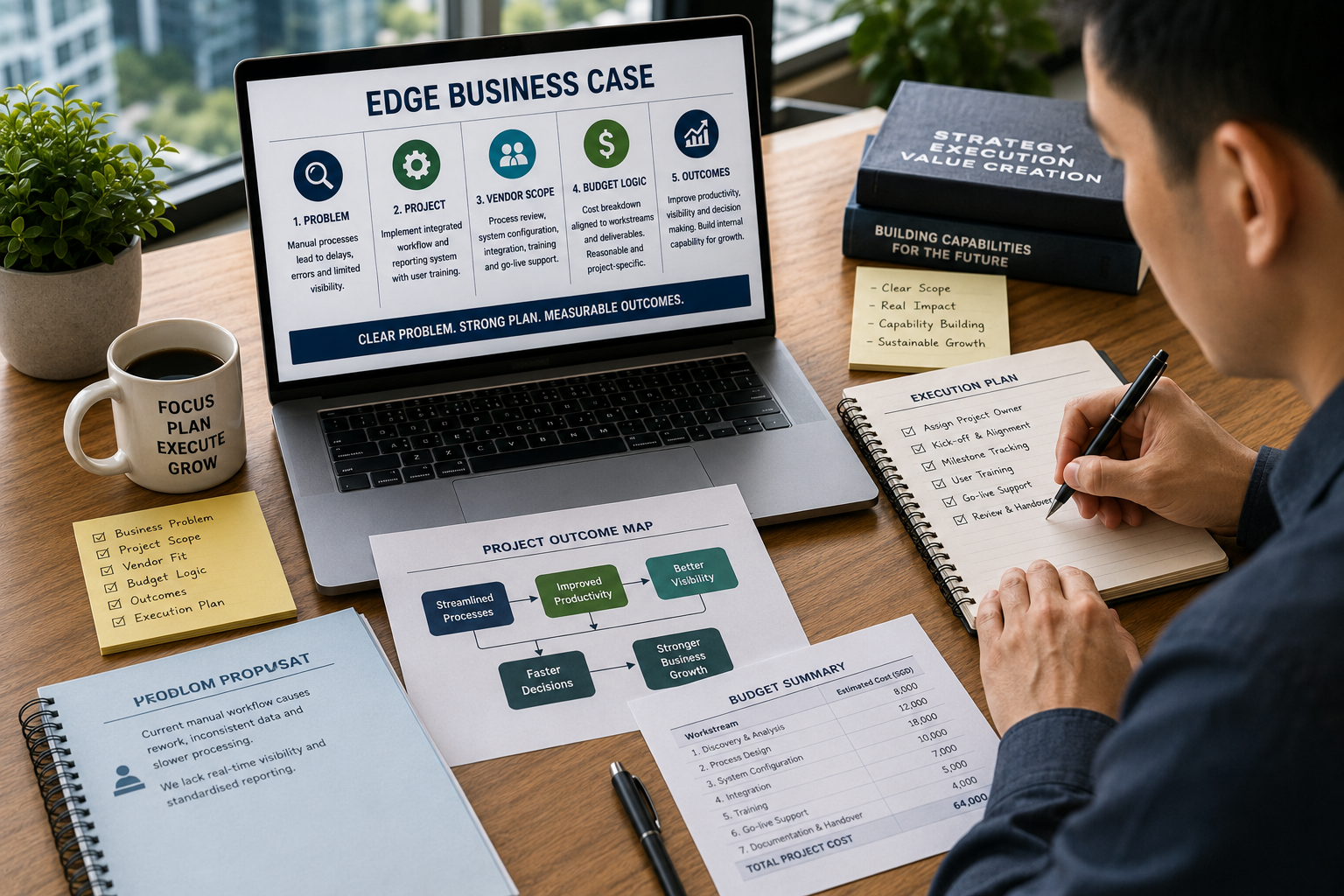
A clear EDGE application narrative can be built around five parts.
Start by explaining the company’s current position.
This may include:
Business model
Revenue stage
Customer base
Operating model
Current constraints
Growth plans
Competitive pressures
Internal capability gaps
The purpose is not to describe everything about the company.
The purpose is to give enough context for the project to make sense.
For example:
A company with rising order volume may need operational workflow improvement.
A company expanding regionally may need market-entry support.
A company growing its sales team may need CRM discipline.
A company handling more complex projects may need management reporting systems.
The business context should lead naturally into the problem statement.
The problem statement is the heart of the narrative.
It should describe the business issue clearly and specifically.
Weak problem statement:
“Our company wants to digitalise and improve efficiency.”
Stronger problem statement:
“Our company currently manages customer enquiries, quotations and follow-ups manually across WhatsApp, email and spreadsheets. This creates inconsistent follow-up, weak pipeline visibility, duplicated administrative work and limited management oversight of sales conversion.”
Weak problem statement:
“We want to expand overseas.”
Stronger problem statement:
“Our company has received recurring interest from distributors in Vietnam, but we do not yet have a structured partner qualification process, market-entry plan, pricing localisation approach or in-market business development evidence.”
A strong problem statement makes the project feel necessary.
After defining the problem, explain how the project will respond.
This should include:
Project objective
Scope of work
Key workstreams
Vendor role
Internal role
Deliverables
Timeline
Implementation approach
This section should be practical.
Avoid vague phrases such as:
“End-to-end transformation”
“Full digitalisation”
“Complete market expansion”
“AI-powered business optimisation”
Instead, describe what will actually happen.
For example:
The project will map the current sales workflow, design a future-state CRM process, configure the system, train users, implement pipeline dashboards and support go-live.
Or:
The project will assess the target market, identify customer segments, shortlist potential distributors, conduct outreach, arrange business meetings and prepare market-entry recommendations.
The project response should show that the company knows what it is doing.
The application should then explain what will improve.
Outcomes may include:
Reduced manual work
Improved productivity
Better sales visibility
Faster reporting
Stronger management control
New overseas partner pipeline
Improved customer response time
Better workflow consistency
Enhanced internal capability
More scalable operations
The outcome should be credible and proportionate.
Businesses should avoid unrealistic claims such as:
“This project will double revenue within one year.”
“This system will eliminate all manual work.”
“This overseas expansion will guarantee market entry success.”
A strong outcome is specific, measurable where possible, and linked to the project.
Finally, explain how the company will execute and govern the project.
This includes:
Internal project owner
Management sponsor
Vendor management process
Milestone review
Deliverable acceptance
Staff training
Documentation
Claims readiness
Outcome tracking
This is important because grant-supported projects are not just ideas. They must be executed.
A business that can show execution discipline is more credible.
A strong EDGE narrative should follow a simple logic:
Because we face this business problem,
we need this project,
which will deliver these outputs,
through this vendor and internal team,
at this cost,
within this timeline,
to achieve these business outcomes.
If any part of this chain is weak, the application becomes harder to defend.
A common risk is that the application sounds like it exists because funding is available.
This weakens the business case.
Avoid language such as:
“We want to tap the grant.”
“We are applying because support is available.”
“We want to maximise the funding.”
“This project is attractive because it is subsidised.”
Instead, use business-first language:
“The project addresses a current operating constraint.”
“The project supports the company’s next stage of growth.”
“The project will strengthen internal capability.”
“The project will improve workflow discipline.”
“The project will prepare the company for overseas expansion.”
“The project will create better management visibility.”
The grant should support the project. It should not be the project’s reason for existence.
A good business problem should include three elements.
First, describe the current state.
Second, explain why it is a problem.
Third, show the business consequence.
Example:
Current state: Sales leads are tracked manually across multiple channels.
Problem: There is no consistent qualification process or central pipeline.
Consequence: Management cannot track conversion properly, and follow-up quality varies across staff.
This is stronger than simply saying:
“The company needs a CRM.”
The application should focus on the business problem before naming the solution.
Businesses should explain why the project is needed now.
Urgency may come from:
Revenue growth
Rising order volume
Manpower constraints
New market opportunity
Customer expectations
Operational complexity
Competition
Compliance requirements
Management visibility gaps
Technology obsolescence
For example:
The company’s order volume has grown, but the fulfilment process remains manual. Without workflow redesign, the company will struggle to scale without adding more administrative headcount.
Or:
The company has identified distributor interest in a target market, but without structured validation and partner qualification, it risks entering the market through unsuitable partners.
Urgency should be grounded in business reality.
The vendor proposal should support the application narrative.
If the application says the problem is weak workflow discipline, the vendor scope should include process review, workflow design, implementation and training.
If the application says the problem is overseas market uncertainty, the vendor scope should include market assessment, partner mapping and business development support.
If the application says the problem is poor management reporting, the vendor scope should include data structure, dashboard design, reporting cadence and user training.
The vendor quotation should not feel detached from the business case.
The budget should be explained as a logical cost of executing the project.
For example:
The project budget covers discovery, workflow design, system configuration, training, go-live support and documentation. These workstreams are necessary because the company is not merely purchasing software; it is redesigning the sales operating process and building internal adoption capability.
This is stronger than:
“The vendor quoted S$80,000 for implementation.”
The application should show why the budget supports the project’s intended outcome.
Outcomes should be meaningful but realistic.
A useful structure is:
Operational outcome
Management outcome
Commercial outcome
Capability outcome
For example:
Operational outcome: Reduced manual tracking and duplicated data entry.
Management outcome: Improved pipeline visibility and sales reporting.
Commercial outcome: Better lead follow-up discipline and improved conversion tracking.
Capability outcome: Internal sales team trained on a repeatable CRM process.
This avoids relying only on revenue projections.
Revenue is important, but many projects create value first through capability, discipline and visibility.
A credible narrative is:
Specific to the company
Linked to current business constraints
Clear about what will be done
Supported by vendor scope
Aligned with the budget
Realistic about outcomes
Practical about execution
Consistent with claims evidence
It does not use inflated language.
It does not overpromise.
It does not sound like a generic template.
It shows that management understands the project.
Weak narrative:
The company wants to improve productivity and digitalise its operations. It intends to implement a new system that will streamline workflows and improve efficiency. The project will help the company grow and become more competitive.
This narrative is weak because it is generic.
It does not explain the current problem, specific workflow, deliverables, implementation plan or measurable outcome.
Strong narrative:
The company currently processes customer orders manually through email, WhatsApp and spreadsheets. As order volume has increased, this has created duplicated data entry, fulfilment delays, inconsistent order status tracking and limited management visibility. The proposed project will redesign the order management workflow, configure a centralised system, train operations staff, implement status dashboards and support go-live. The project is expected to reduce manual coordination, improve fulfilment visibility, standardise order handling and strengthen operational scalability. The vendor’s scope is broken into process review, workflow design, system configuration, testing, training and handover, with clear deliverables at each phase.
This narrative is stronger because it connects problem, project, vendor scope and outcome.
A strong business case should be supported by evidence where possible.
Evidence may include:
Revenue growth
Order volume
Lead volume
Manpower hours
Error rates
Customer enquiries
Market demand
Distributor interest
Existing workflow screenshots
Current reports
Manual process records
Management observations
Businesses do not always need perfect data.
But some evidence is better than purely general statements.
For example:
“Our operations team processes approximately 300 orders per week manually” is stronger than “we have many orders”.
“Our sales team manages leads across five channels without central tracking” is stronger than “our sales process is inefficient”.
Evidence makes the narrative more credible.
An EDGE application should show that the business is not outsourcing responsibility entirely.
The company should identify:
Project sponsor
Project owner
Departments involved
Users involved
Finance support
Management review process
This signals that the company is ready to execute.
For example:
The Operations Manager will serve as project owner, with support from the Finance Manager and Sales Lead. Management will review milestone deliverables monthly and approve the final workflow before go-live.
This is more credible than simply relying on the vendor.
The best EDGE applications should feel like management has thought through the project properly.
They should read like a serious internal decision paper, not a form filled in to obtain subsidy.
That means the application should answer:
What is the problem?
Why does it matter?
What are we doing about it?
Why is this the right scope?
Why is the vendor suitable?
Why is the cost reasonable?
How will we execute?
What will improve?
How will we prove completion?
This is the standard businesses should aim for.
Before submitting, review whether the application narrative answers:
Can the business problem be understood clearly?
Is the project objective specific?
Does the scope solve the problem?
Are deliverables concrete?
Does the vendor proposal support the narrative?
Is the budget linked to workstreams?
Are outcomes realistic?
Is internal ownership clear?
Is the timeline practical?
Does the project build lasting capability?
Does the claim evidence align with the approved scope?
If the answer is no, the narrative should be strengthened.
If you are preparing an EDGE application and need help framing the business case, writing the project narrative, aligning vendor scope, justifying the budget or preparing for claims, speak with us before submission.
We help Singapore businesses develop clear, assessor-ready grant narratives that support approval, execution and reimbursement.
Book a 30-minute, no-obligation discussion here:
https://www.grant-consulting.org/contact
 WhatsApp us
```
WhatsApp us
```