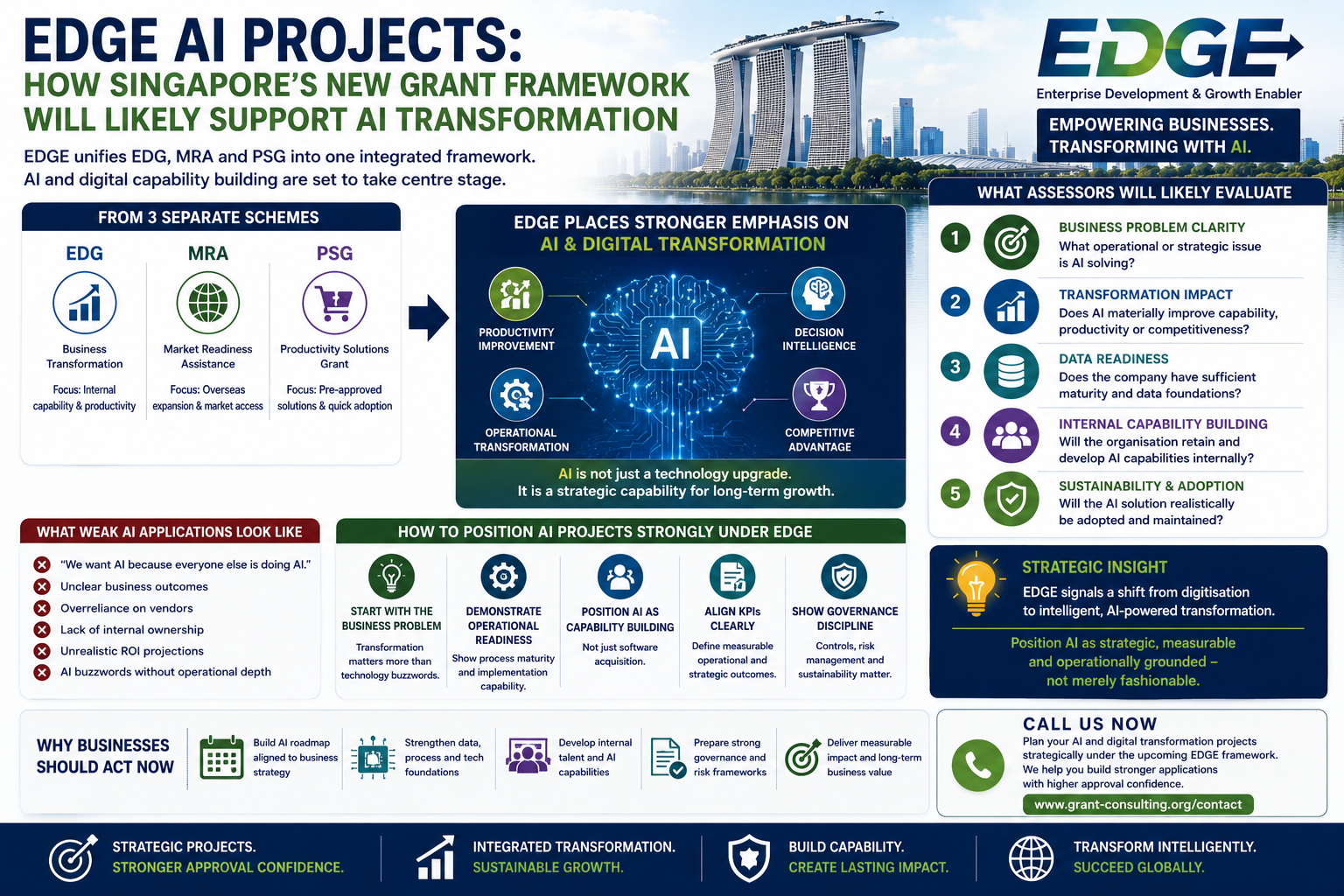
One of the clearest signals emerging from the transition into EDGE is this:
Singapore is placing increasing emphasis on:
This means businesses pursuing AI projects under EDGE will likely face:
Under previous schemes:
EDGE appears to move toward a more integrated transformation model.
And AI increasingly sits at the centre of:
This makes AI highly aligned with Singapore’s broader economic direction.
Many companies still approach AI projects as:
This is risky.
Because assessors are unlikely to evaluate AI based purely on novelty.
Instead, they will likely ask:
“Does this AI initiative create meaningful business transformation?”
Although detailed operational criteria are still evolving, businesses should expect scrutiny around:
1. Business problem clarity
What operational or strategic issue is AI solving?
2. Transformation impact
Does AI materially improve capability, productivity, or competitiveness?
3. Data readiness
Does the company have sufficient operational maturity and data foundations?
4. Internal capability building
Will the organisation retain and develop AI capabilities internally?
5. Sustainability and adoption
Will the AI solution realistically be adopted and maintained?
Common weak positioning includes:
These increase perceived execution and governance risk immediately.
To improve approval confidence:
1. Start with the business problem
Transformation matters more than technology buzzwords.
2. Demonstrate operational readiness
Show process maturity and implementation capability.
3. Position AI as capability building
Not just software acquisition.
4. Align KPIs clearly
Define measurable operational and strategic outcomes.
5. Show governance discipline
AI projects often increase scrutiny around controls, risk, and sustainability.
EDGE likely signals an important evolution:
Singapore is no longer simply encouraging businesses to:
It is increasingly encouraging businesses to:
The companies that succeed under EDGE will likely be those that position AI as:
If you are planning AI, automation, analytics, or digital transformation initiatives under the upcoming EDGE framework, it is important to position them strategically from the start.
We help companies structure AI transformation projects around business outcomes, capability building, governance, and approval readiness.
https://www.grant-consulting.org/contact
 WhatsApp us
```
WhatsApp us
```