
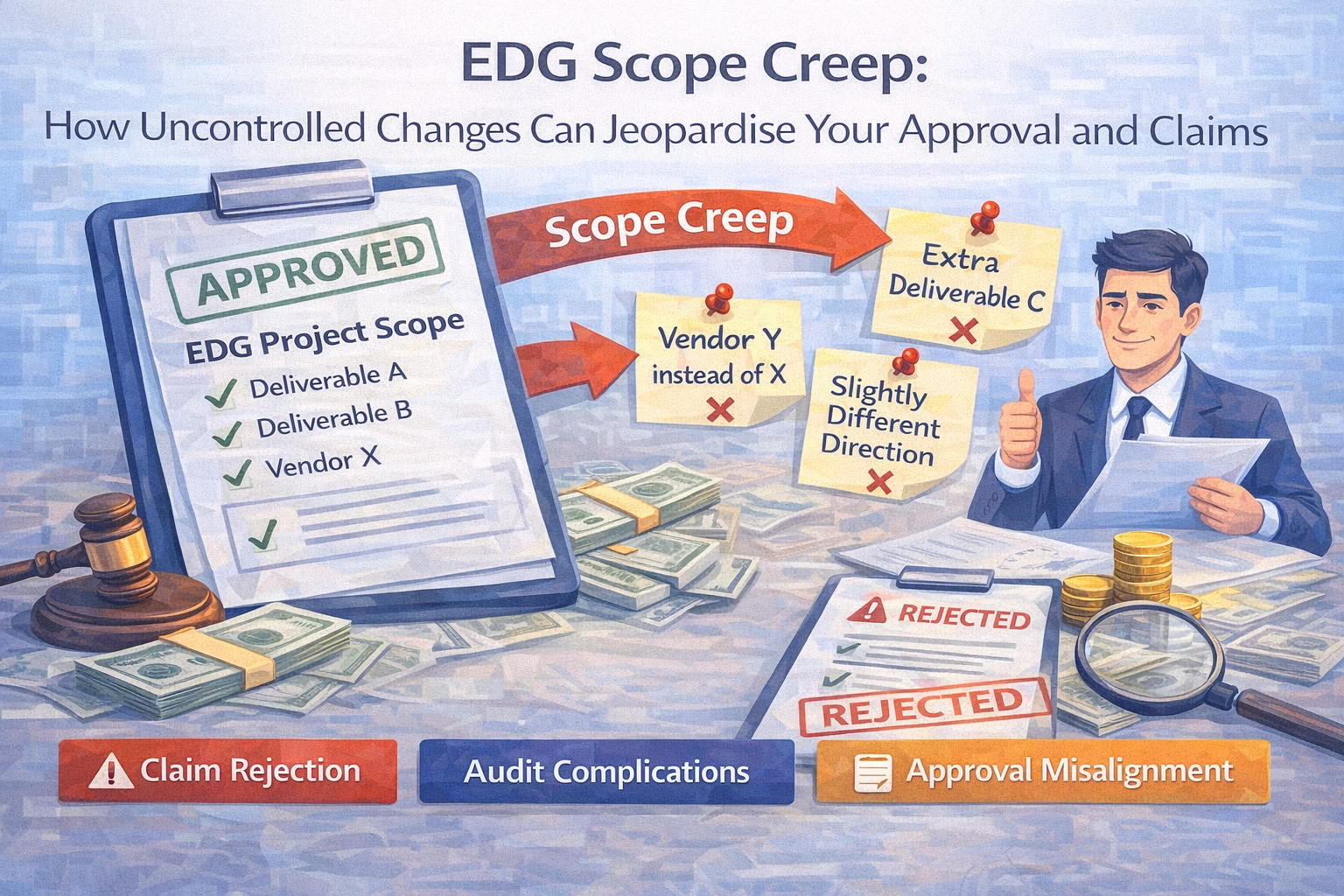
Many SMEs assume that once an EDG project is approved, they have flexibility to adjust along the way.
This is only partially true.
Uncontrolled scope changes—often referred to as scope creep—can create serious issues:
EDG approval is granted based on:
If your actual project deviates too far from what was approved, it raises a critical question:
“Is this still the same project we approved?”
If the answer is unclear, claim risk increases significantly.
Common scope creep issues include:
These changes may seem operationally reasonable—but they create compliance risks.
During claims and audit stages, reviewers assess:
1. Alignment with approved scope
Does the delivered work match what was approved?
2. Consistency of deliverables
Are outputs aligned with original objectives?
3. Justification for changes
Were changes formally approved?
4. Documentation trail
Is there clear evidence supporting any deviations?
5. Integrity of the project
Has the project remained fundamentally the same?
To avoid issues:
1. Treat approved scope as fixed baseline
All work should align with this unless formally changed.
2. Seek approval before making changes
Do not assume flexibility.
3. Document everything
Keep clear records of decisions and adjustments.
4. Maintain scope discipline internally
Ensure all stakeholders understand constraints.
5. Align vendor deliverables strictly
Vendors must follow approved scope.
Scope creep is rarely intentional.
It usually happens because:
But EDG is not designed for open-ended projects.
It is designed for defined, controlled execution.
Managing this well protects both approval and claims.
If your EDG project has evolved or you are considering changes, it is important to assess the implications before proceeding.
We help companies evaluate scope adjustments, manage compliance risks, and ensure alignment with approval conditions.
https://www.grant-consulting.org/contact
 WhatsApp us
```
WhatsApp us
```