
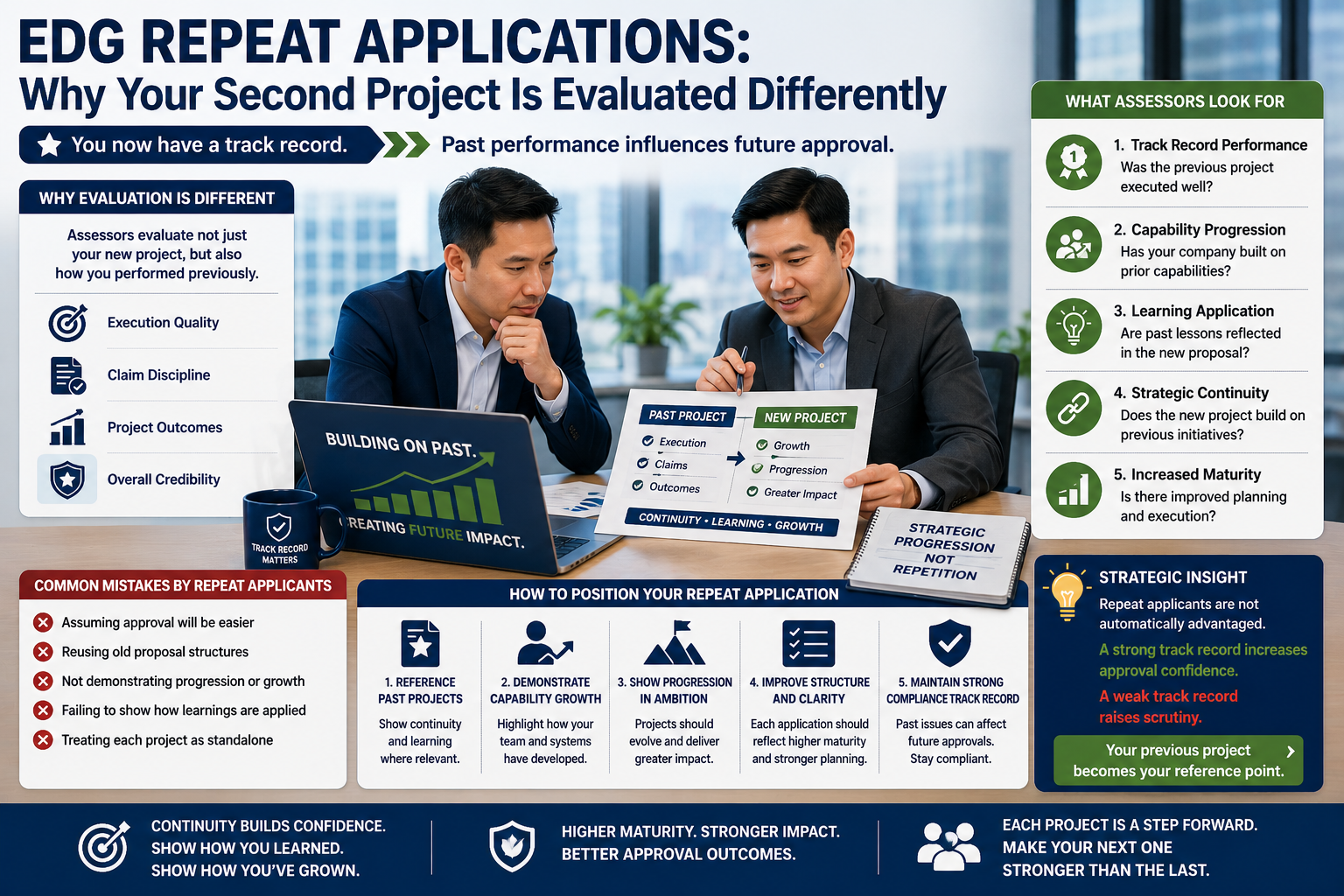
If you have already secured an EDG project, your next application enters a different category.
You are no longer a “new applicant.”
You now have a track record.
And that changes how assessors evaluate your application.
For repeat applicants, assessors are not just looking at:
They are also evaluating:
This includes:
Your past project becomes part of your current evaluation.
Common mistakes by repeat applicants include:
These create a perception of stagnation—or worse, complacency.
When reviewing repeat applications, case officers assess:
1. Track record performance
Was the previous project executed well?
2. Capability progression
Has the company built on prior capabilities?
3. Learning application
Are past lessons reflected in the new proposal?
4. Strategic continuity
Does the new project build on previous initiatives?
5. Increased maturity
Does the company demonstrate improved planning and execution?
To strengthen your next application:
1. Reference past projects where relevant
Show continuity and learning.
2. Demonstrate capability growth
Highlight how your team has developed.
3. Show progression in ambition
Projects should evolve, not repeat.
4. Improve structure and clarity
Each application should reflect higher maturity.
5. Maintain strong compliance track record
Past issues can affect future approvals.
Repeat applicants are not automatically advantaged.
They are simply held to a different standard.
A strong track record:
A weak one:
Your previous project becomes your reference point.
If you are preparing a second or subsequent EDG application, it is important to position it as a progression—not a repeat.
We help companies build continuity across projects, demonstrate capability growth, and strengthen approval confidence.
https://www.grant-consulting.org/contact
 WhatsApp us
```
WhatsApp us
```