One of the most frustrating outcomes for SMEs is this:
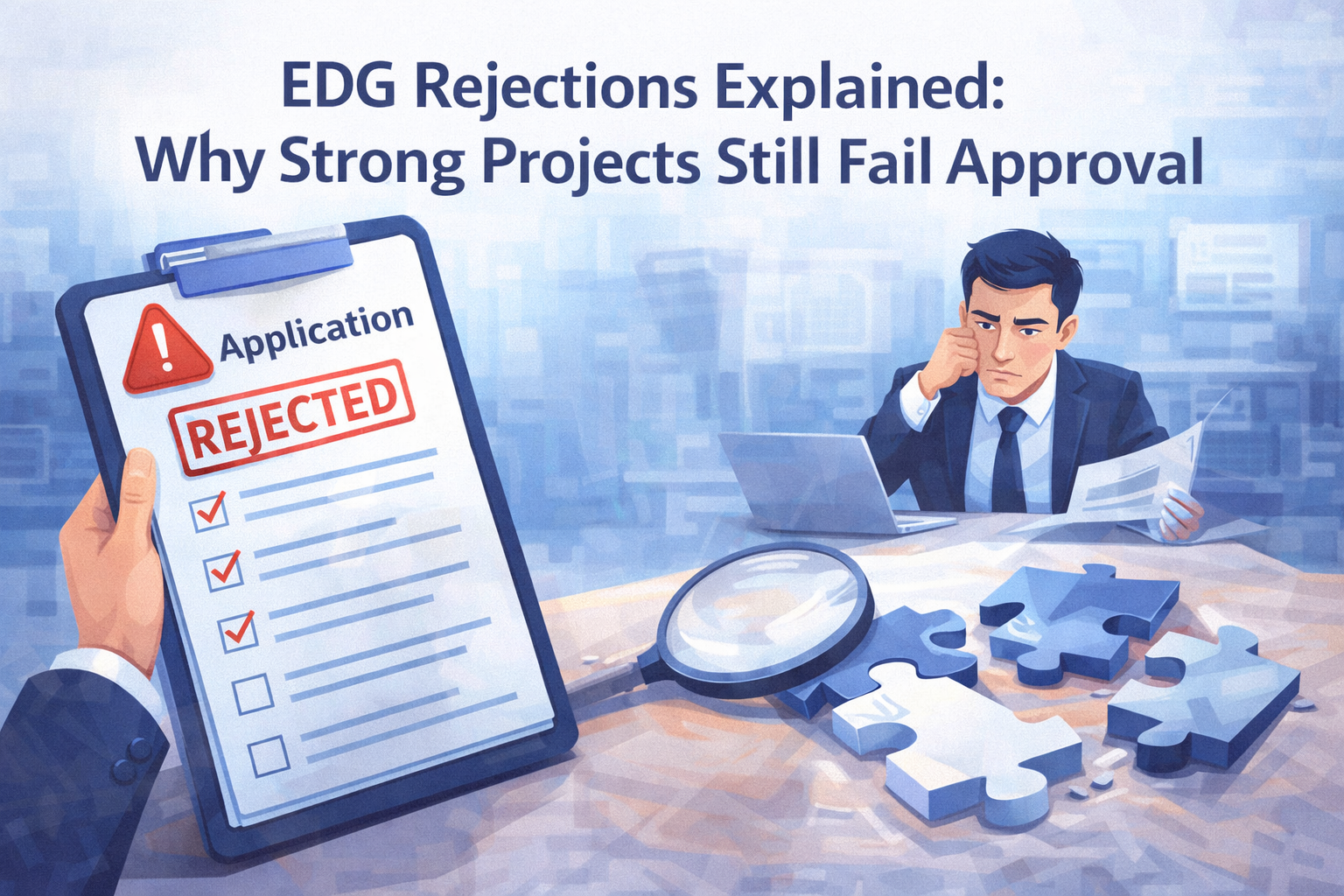
A well-thought-out project, a credible vendor, and a detailed application—yet the result is rejection.
This happens more often than most realise.
Because EDG approval is not based purely on how “good” a project looks.
It is based on how credible, coherent, and executable it appears from an assessor’s perspective.
Many companies assume that:
“If the idea is strong, approval will follow.”
In reality, assessors are evaluating something different:
“Is this a project we can confidently support with public funds?”
This shift in perspective explains why strong-looking applications still fail.
Rejected applications often share similar patterns:
These are not obvious failures—but they introduce uncertainty.
And uncertainty reduces approval confidence.
Beyond the written proposal, case officers are assessing:
1. Internal ownership
Does the company clearly own the project, or is it vendor-driven?
2. Logical consistency
Do problem, solution, scope, and outcomes align clearly?
3. Execution readiness
Does the company have the ability to follow through?
4. Risk level
Are there signals that the project may not deliver as intended?
5. Strategic relevance
Is the project meaningful to business growth, not just operational improvement?
If any of these areas are weak, approval probability drops—even if everything else looks strong.
A project can be objectively “good” but still fail due to:
1. Weak narrative structure
Assessors cannot clearly follow the logic of the proposal.
2. Misaligned positioning
The project is framed as improvement instead of transformation.
3. Over-reliance on vendors
The company appears passive rather than driving the initiative.
4. Insufficient justification
Key decisions—scope, cost, vendor—are not well supported.
5. Hidden risk signals
Inconsistencies or gaps create doubt during evaluation.
To reduce rejection risk:
1. Strengthen narrative clarity
Ensure every section connects logically.
2. Demonstrate ownership
Position the company as the driver of the project.
3. Align all components
Problem → solution → scope → outcomes must be coherent.
4. Justify key decisions
Explain why this vendor, this scope, this cost.
5. Remove ambiguity
Applications should feel clear, deliberate, and well thought through.
The biggest misconception about EDG is this:
Approval is not about having a strong project.
It is about having a project that appears low-risk, well-structured, and credible under scrutiny.
That distinction is what separates approvals from rejections.
If you have a project in mind or have faced rejection before, it is worth reviewing how your application is positioned.
We help companies identify hidden weaknesses, strengthen proposal structure, and align applications with how assessors evaluate risk and credibility.
Reach out to us before your next submission.
 WhatsApp us
```
WhatsApp us
```