
Getting rejected can feel frustrating.
Especially when the project seemed strong.
But an EDG rejection is not a dead end.
It is a signal.
And if interpreted correctly, it can significantly improve your next application.
Many SMEs respond to rejection by:
All three are mistakes.
Because most rejections follow identifiable patterns.
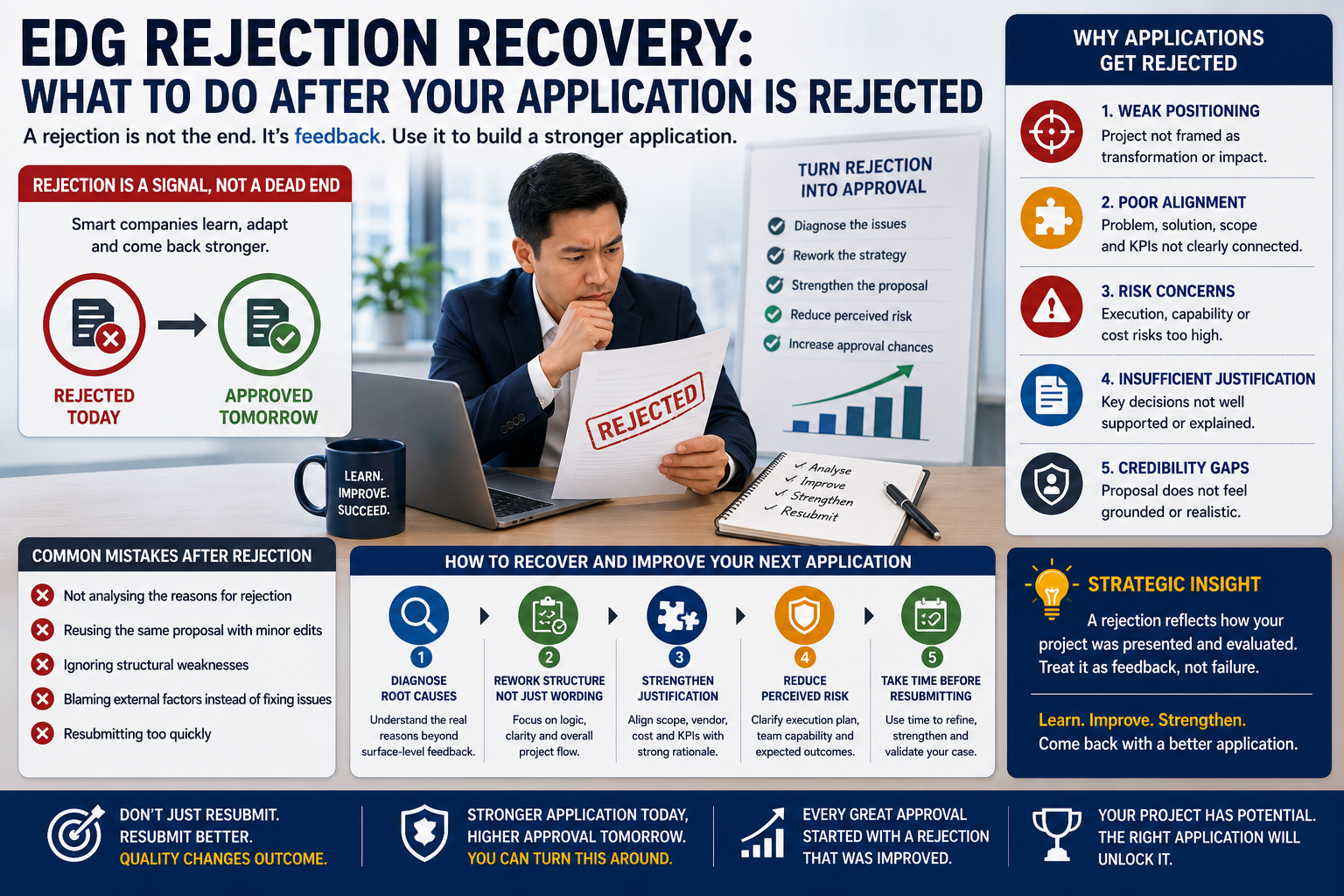
Common post-rejection mistakes include:
These approaches usually lead to repeat rejection.
Rejections are usually driven by:
1. Weak positioning
The project was not framed as transformation.
2. Poor alignment
Problem, solution, scope, and KPIs did not connect clearly.
3. Risk concerns
Execution, capability, or cost risks were too high.
4. Insufficient justification
Key decisions were not well supported.
5. Credibility gaps
The proposal did not feel grounded or realistic.
To improve your chances on resubmission:
1. Diagnose root causes properly
Go beyond surface-level feedback.
2. Rework structure—not just wording
Focus on logic, not language.
3. Strengthen justification across all areas
Scope, vendor, cost, and KPIs must be aligned.
4. Reduce perceived risk
Clarify execution, capability, and outcomes.
5. Take time before resubmitting
A rushed resubmission rarely succeeds.
A rejection is not a reflection of your project alone.
It is a reflection of how your project was presented and evaluated.
Companies that treat rejection as feedback:
Companies that ignore it:
If your EDG application has been rejected, it is critical to understand why before resubmitting.
We help companies diagnose rejection causes, restructure applications, and significantly improve approval chances.
https://www.grant-consulting.org/contact
 WhatsApp us
```
WhatsApp us
```