Many SMEs assume that EDG approval is based on how strong their idea is.
In reality, approvals are often determined by something far less obvious:
risk signals.
Case officers are trained to assess not just potential — but credibility, execution risk, and intent.
And most rejections happen because of red flags that are never explicitly stated.
A project can look strong on paper — clear objectives, reasonable budget, good vendor.
Yet still get rejected.
Why?
Because assessors are not only asking:
“Is this a good project?”
They are asking:
“Is this a safe project to support with public funds?”
If your application triggers even a few concerns, approval probability drops significantly.
Most SMEs focus on:
But this often backfires.
Common mistakes include:
These don’t strengthen your application — they raise suspicion.
From an evaluation standpoint, case officers are scanning for consistency and credibility.
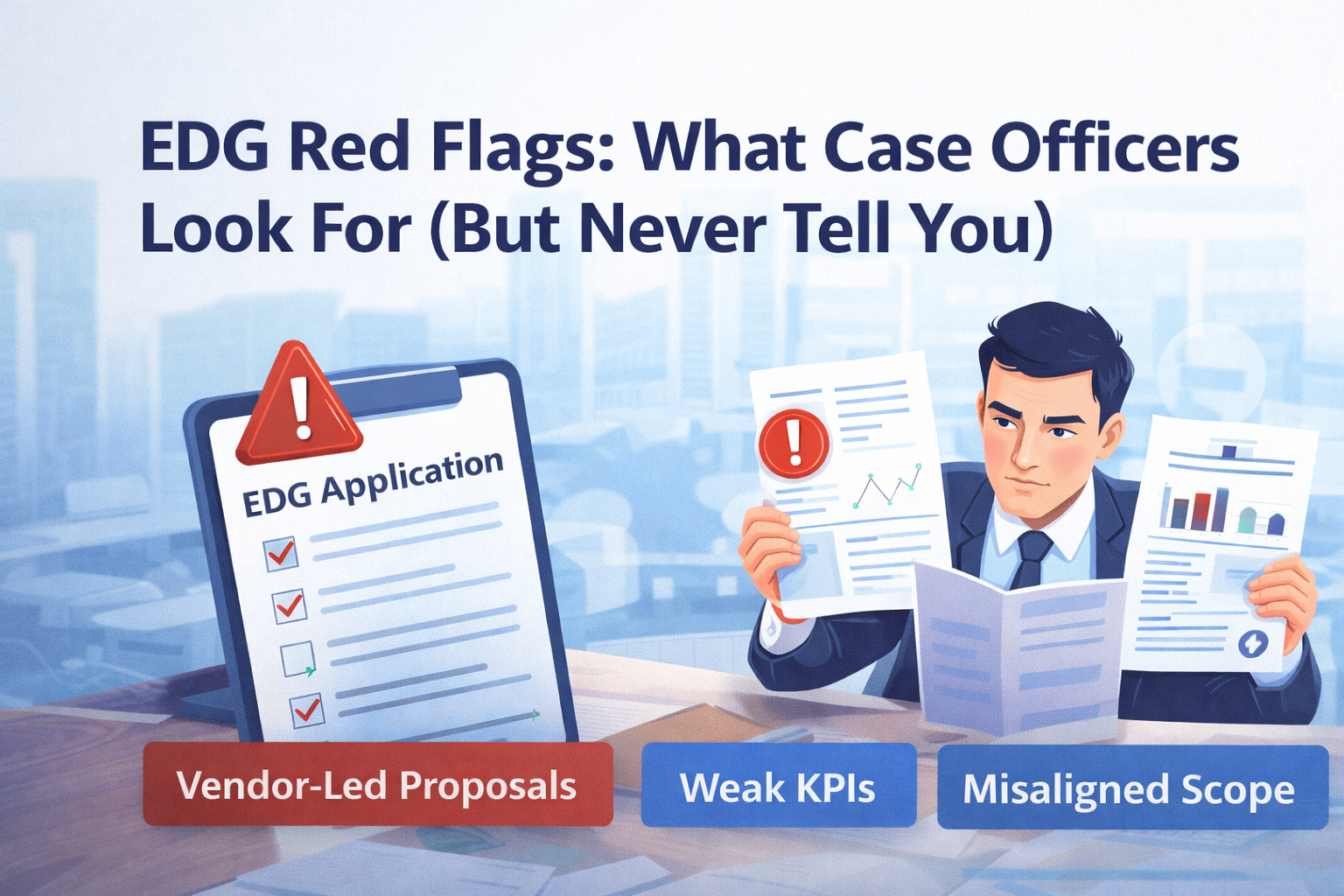
Some of the biggest red flags include:
1. Misalignment between problem and solution
If your problem statement does not clearly justify the proposed scope, it signals poor project design.
2. Vendor-led proposals
If the proposal reads like it was written by the vendor (instead of the company), it raises concerns about ownership.
3. Unrealistic outcomes or KPIs
Overpromising results without a clear execution path suggests lack of operational grounding.
4. Budget inconsistencies
If cost items don’t match scope, or appear inflated, this triggers financial scrutiny.
5. Lack of internal capability
If the company does not demonstrate the ability to execute or sustain the project, risk increases.
To avoid these red flags, your application must demonstrate:
1. Clear ownership
The project should clearly come from internal business needs — not vendor suggestions.
2. Logical flow
Problem → gap → solution → outcome must connect seamlessly.
3. Measured ambition
Strong, realistic outcomes are better than aggressive but unsupported claims.
4. Cost defensibility
Every major cost item should be explainable and proportionate.
5. Execution readiness
Show that your team understands what needs to be done — beyond just hiring a vendor.
EDG is not just evaluating your project.
It is evaluating:
The strongest applications feel internally driven, logically structured, and operationally grounded.
Not “consultant-written” or “vendor-packaged”.
If you are preparing an EDG application and want to avoid hidden red flags that could quietly derail your approval, we can help.
We focus on structuring applications from an assessor’s perspective — ensuring your proposal is credible, defensible, and aligned with evaluation expectations.
Reach out to us for a discussion before submission.
 WhatsApp us
```
WhatsApp us
```