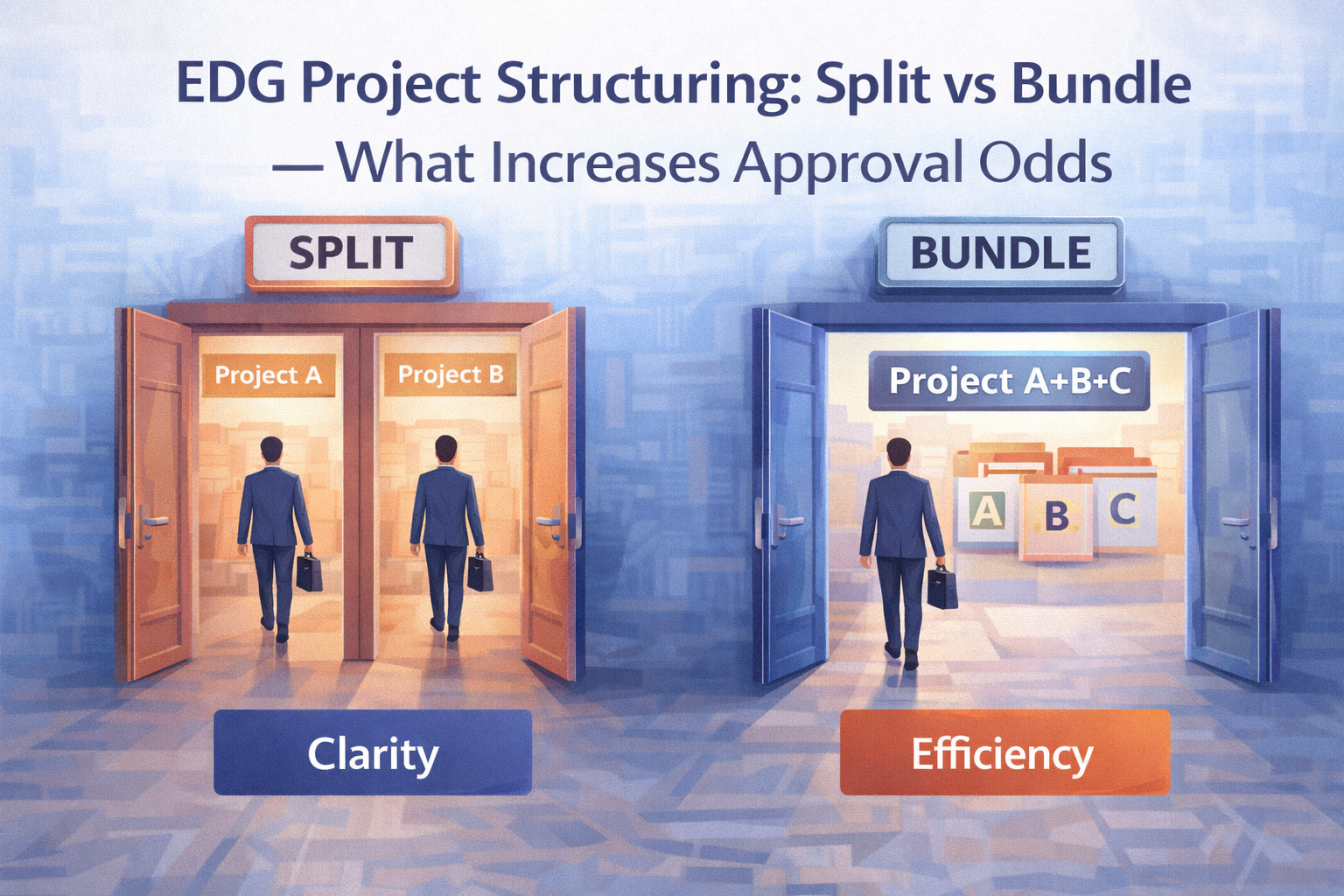
One of the most overlooked decisions in EDG applications happens before writing even begins:
How you structure the project.
Should you submit:
This decision has a direct impact on how assessors evaluate risk, clarity, and feasibility.
Many SMEs assume that bundling everything into one project is more efficient.
But from an evaluation standpoint, larger projects often introduce:
On the other hand, overly fragmented projects can appear:
So structuring is not just administrative—it is strategic.
Common structuring mistakes include:
These approaches reduce clarity and increase evaluation risk.
When reviewing project structure, case officers assess:
1. Scope coherence
Does the project feel like a single, well-defined initiative?
2. Complexity vs clarity
Is the project manageable and understandable?
3. Risk containment
Can the project be executed successfully within its defined scope?
4. Logical sequencing
Are activities structured in a way that makes sense?
5. Justification of scope size
Is the scale appropriate for the company’s capability?
Bundling works better when:
Example:
Strategy + system design + pilot implementation forming one transformation journey.
Splitting is better when:
Example:
Strategy development first, followed by implementation in a separate phase.
A useful rule:
If your project feels difficult to explain simply, it is probably too large or poorly structured.
Assessors favour projects that are:
Not necessarily bigger.
If you are unsure whether to split or bundle your EDG project, it is worth getting this right before submission.
We help companies structure projects in a way that improves clarity, reduces perceived risk, and aligns with how assessors evaluate applications.
https://www.grant-consulting.org/contact
 WhatsApp us
```
WhatsApp us
```