Most SMEs focus on what activities to include.
Very few think about in what order those activities should happen.
But sequencing matters more than most realise.
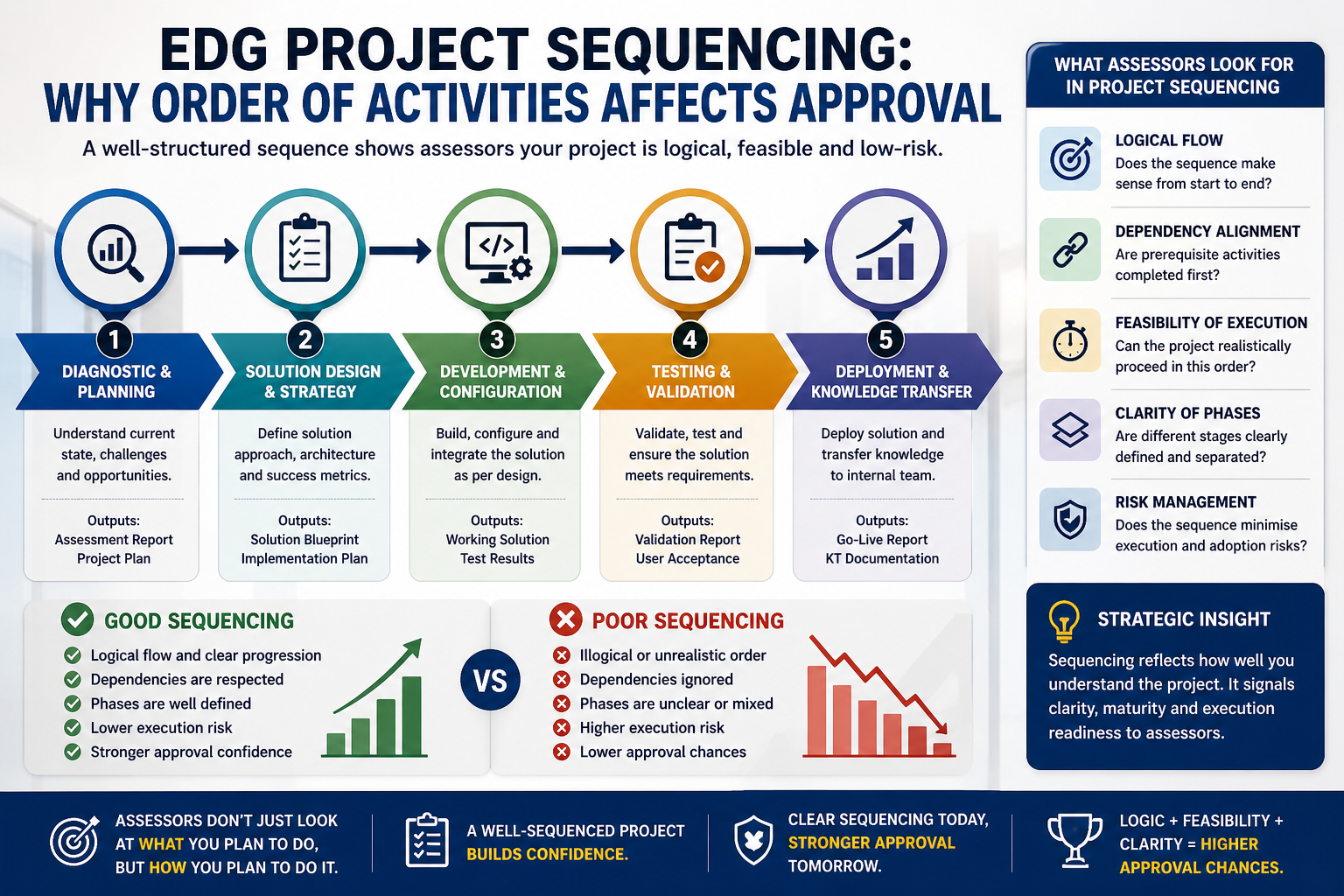
Because activity order directly affects how assessors interpret:
An EDG project is not just a list of tasks.
It is a structured journey.
If activities are poorly sequenced, the project can appear:
Even if the individual components are valid.
Common sequencing mistakes include:
These issues reduce clarity and increase perceived risk.
When evaluating sequencing, case officers assess:
1. Logical flow
Do activities follow a clear and sensible progression?
2. Dependency alignment
Are prerequisite steps completed before dependent ones?
3. Feasibility of execution
Can the project realistically proceed in this order?
4. Clarity of phases
Are different stages clearly defined?
5. Risk management
Does the sequence minimise execution risk?
To improve approval chances:
1. Start with diagnostic or planning stages
Avoid jumping straight into execution.
2. Separate phases clearly
E.g. strategy → design → implementation → validation.
3. Respect dependencies
Ensure each activity builds on the previous one.
4. Avoid unnecessary overlaps
Only overlap when justified.
5. Align sequencing with outcomes
Activities should logically lead to defined KPIs.
A well-sequenced project signals:
A poorly sequenced one signals confusion—even if the idea is strong.
Assessors often use sequencing as a proxy for:
“Does this company actually know how to execute this project?”
If your project activities feel unclear or difficult to structure, it is worth refining sequencing before submission.
We help companies design project flows that are logical, defensible, and aligned with how assessors evaluate feasibility.
https://www.grant-consulting.org/contact
 WhatsApp us
```
WhatsApp us
```