
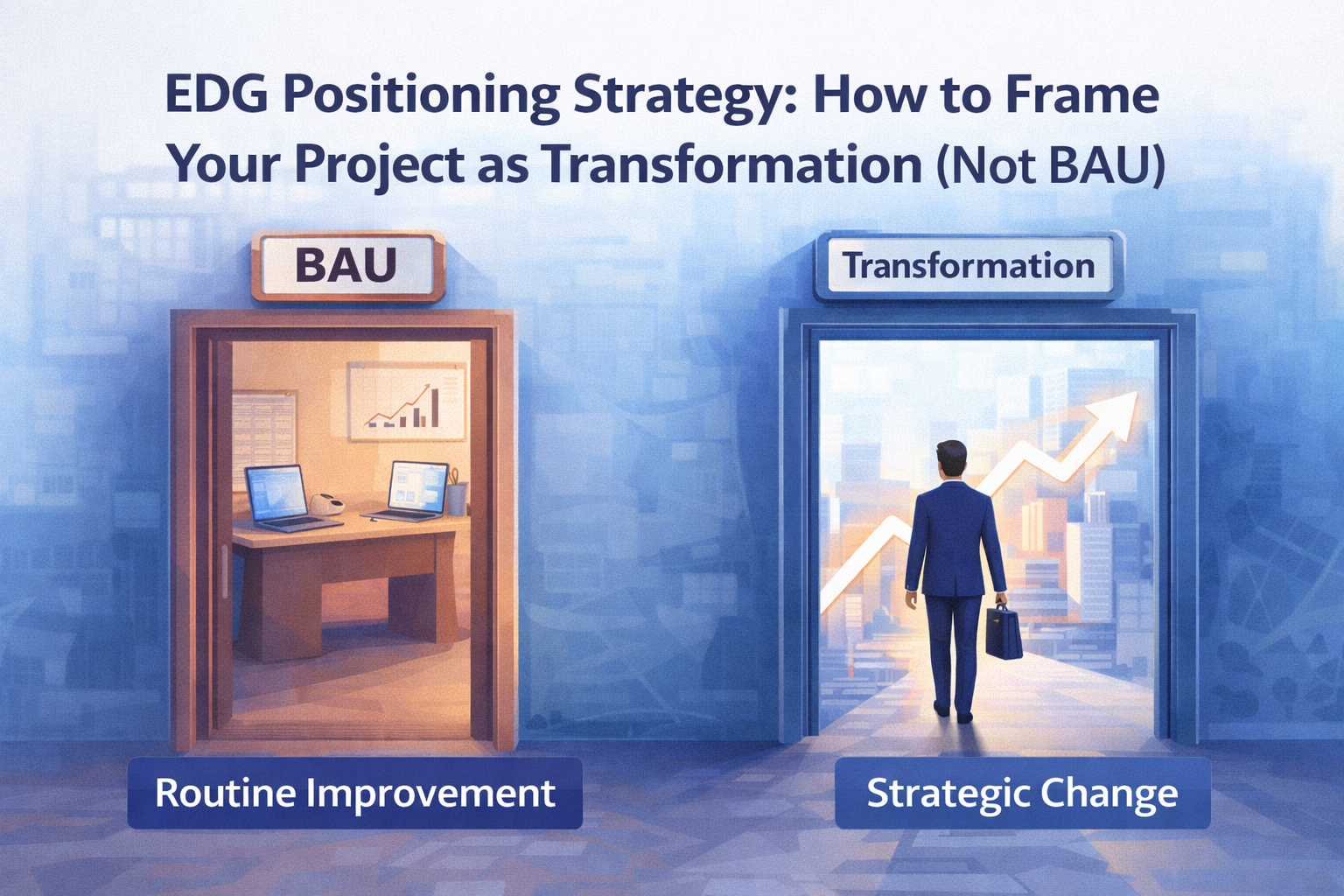
One of the most misunderstood aspects of EDG is this:
Many companies think upgrading, improving, or implementing something new automatically qualifies as “transformation.”
It doesn’t.
From an assessor’s perspective, most rejected applications fall into one category:
business-as-usual (BAU).
EDG is not designed to fund routine improvements.
It is designed to support step-change transformation.
If your project looks like:
…it is very likely to be classified as BAU.
And BAU projects are rarely supported.
Most SMEs unintentionally position their projects as BAU by:
This creates a proposal that feels operational—not transformational.
To determine whether a project is transformational, assessors evaluate:
1. Magnitude of change
Does the project fundamentally change how the business operates?
2. Capability shift
Is the company building new capabilities, or just improving existing ones?
3. Strategic intent
Is the project linked to long-term growth, competitiveness, or market expansion?
4. Business model impact
Does the project enable new revenue streams, markets, or ways of operating?
If these elements are not clearly demonstrated, the project is often classified as BAU—even if the investment is significant.
To avoid BAU classification, your application must clearly show transformation.
1. Define the “before” state clearly
Explain current limitations, inefficiencies, or capability gaps in concrete terms.
2. Show a step-change, not incremental improvement
Position the project as enabling something previously not possible.
3. Focus on business impact, not tools
Instead of describing what you are implementing, explain what it enables.
4. Link to strategic outcomes
Tie the project to growth, expansion, or competitiveness—not just efficiency.
5. Demonstrate capability building
Highlight how the project strengthens internal capabilities—not just external support.
A useful way to test your application:
If your project can be described as:
“We are improving how we currently operate”
…it is likely BAU.
But if it can be described as:
“We are enabling a new way of operating that was not previously possible”
…it is much closer to transformation.
That distinction often determines approval.
If you are unsure whether your project may be classified as BAU, it is better to address this before submission.
We help companies position their projects clearly as transformation—ensuring alignment with how assessors evaluate impact and intent.
Reach out to us for a discussion.
 WhatsApp us
```
WhatsApp us
```