
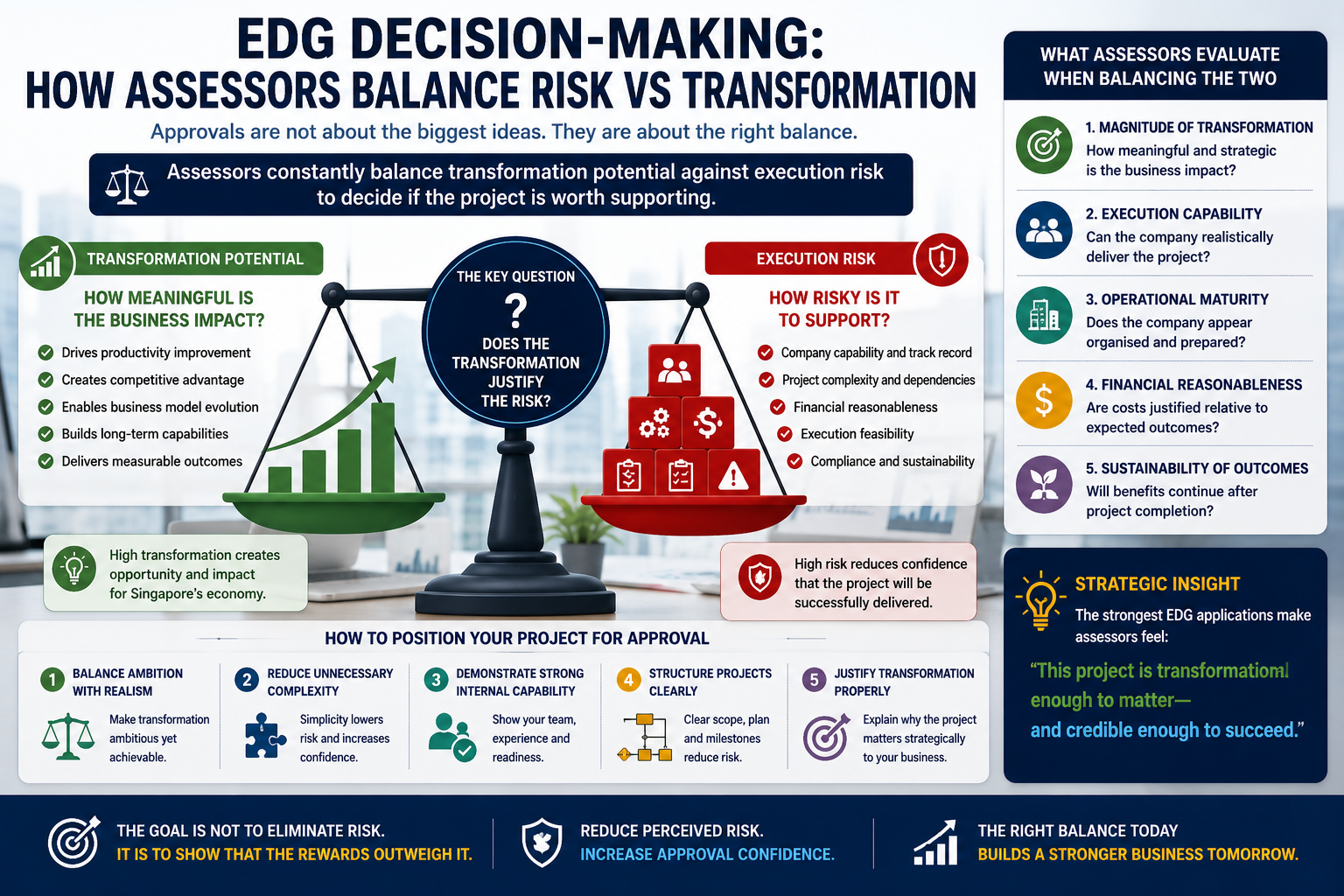
Many SMEs believe EDG approvals are driven mainly by transformation potential.
That is only half the picture.
The other half is:
risk.
Every EDG application is effectively evaluated through one core tension:
Understanding this balance changes how you structure your application entirely.
A highly transformational project can still be rejected if risk is perceived as too high.
Conversely, a lower-risk project with credible execution may be approved more easily.
This means approval is rarely about “best idea wins.”
It is about:
“Does the transformation justify the risk?”
Common misunderstandings include:
These create applications that look exciting—but difficult to support confidently.
When balancing risk vs transformation, case officers assess:
1. Magnitude of transformation
How meaningful is the business impact?
2. Execution capability
Can the company realistically deliver the project?
3. Operational maturity
Does the company appear organised and prepared?
4. Financial reasonableness
Are costs justified relative to expected outcomes?
5. Sustainability of outcomes
Will benefits continue after project completion?
To improve approval confidence:
1. Balance ambition with realism
Transformation should feel achievable.
2. Reduce unnecessary complexity
Complexity increases perceived risk.
3. Demonstrate strong internal capability
Capability reduces execution concerns.
4. Structure projects clearly
Clarity lowers risk perception.
5. Justify transformation properly
Explain why the project matters strategically.
The strongest EDG applications are not necessarily the most ambitious.
They are the ones that make assessors feel:
“This project is transformational enough to matter—and credible enough to succeed.”
That balance is the core of EDG decision-making.
If you are unsure whether your project is positioned too aggressively—or not transformational enough—it is worth reviewing before submission.
We help companies balance ambition, clarity, capability, and risk to maximise approval confidence.
https://www.grant-consulting.org/contact
 WhatsApp us
```
WhatsApp us
```