
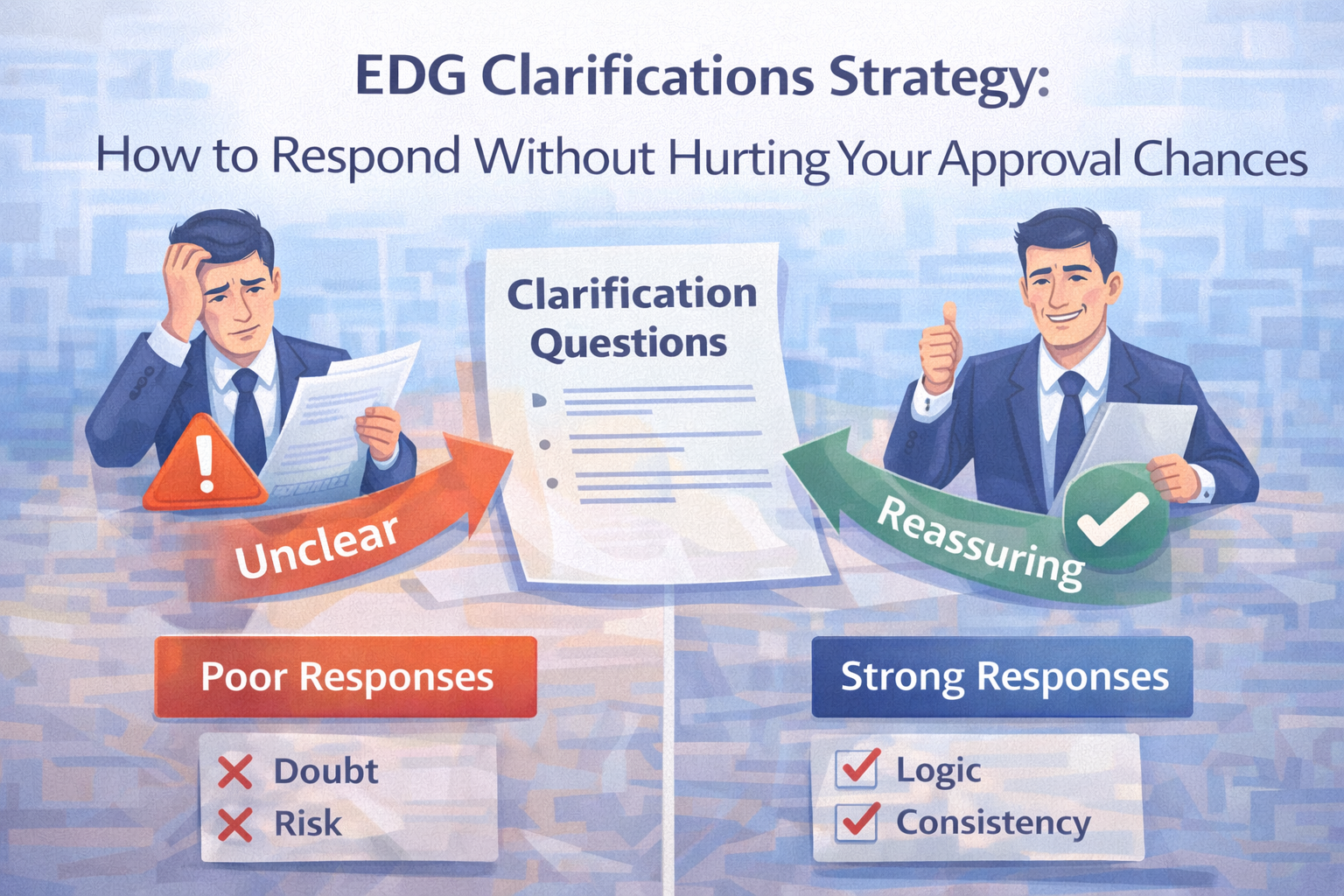
Many SMEs panic when they receive clarification questions.
They shouldn’t.
Clarifications are not a negative signal.
But poor responses can turn a salvageable application into a rejected one.
Clarifications are part of the evaluation process.
They typically indicate:
How you respond determines whether those concerns are:
Common mistakes when responding include:
These responses often create more doubt, not less.
When reviewing clarification responses, case officers assess:
1. Consistency
Do responses align with the original proposal?
2. Clarity
Are answers direct and easy to understand?
3. Completeness
Does the response fully address the question?
4. Stability of scope
Does the project remain coherent after clarification?
5. Reduction of risk
Does the response resolve concerns or introduce new ones?
To handle clarifications properly:
1. Understand the intent behind the question
Clarifications often signal deeper concerns—address those.
2. Stay consistent with your proposal
Avoid introducing contradictions unless necessary—and explain clearly.
3. Be precise and direct
Answer the question clearly before adding context.
4. Reinforce your original positioning
Use clarifications to strengthen—not change—your narrative.
5. Avoid unnecessary scope changes
Major shifts can reduce credibility.
Clarifications are not just Q&A.
They are a second evaluation layer.
A strong clarification response does more than answer questions—it reassures assessors that:
Weak responses do the opposite.
If you have received clarification questions and are unsure how to respond, it is critical to get this right.
We help companies interpret clarification intent and craft responses that strengthen approval confidence rather than weaken it.
https://www.grant-consulting.org/contact
 WhatsApp us
```
WhatsApp us
```