
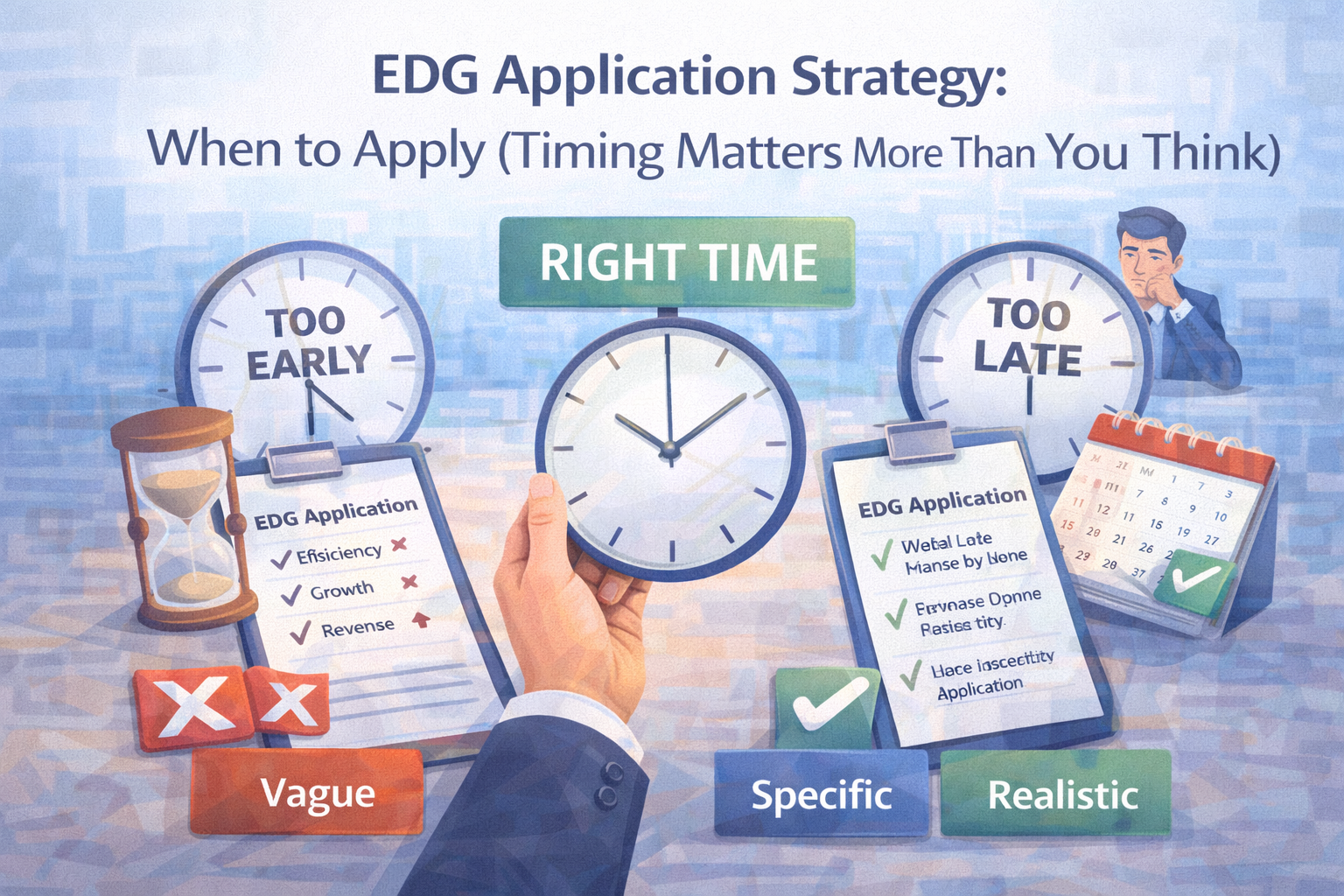
Most SMEs focus on what to submit.
Very few think about when to submit.
But timing plays a bigger role than most realise.
A strong project submitted at the wrong time can face delays, heavy queries, or even rejection.
From an assessor’s perspective, timing signals readiness.
If you apply too early:
If you apply too late:
Both reduce approval confidence.
Common timing mistakes include:
These mistakes weaken the application before evaluation even begins.
When reviewing timing, case officers assess:
1. Project readiness
Is the proposal mature, structured, and well thought through?
2. Decision stage
Has the company already committed to execution?
3. Planning depth
Does the application reflect proper preparation?
4. Alignment with project lifecycle
Is the application submitted before project commencement?
5. Intent clarity
Is the company genuinely seeking support, or formalising a pre-made decision?
You should apply when:
This is the “optimal window” for submission.
You should delay submission if:
Submitting too early often leads to more clarifications—and lower approval confidence.
EDG is designed to support planned transformation, not ongoing execution.
A good rule:
If your project feels rushed, incomplete, or already underway—it is probably the wrong time to apply.
The strongest applications feel:
That combination signals low risk.
If you are unsure whether your project is ready for submission, it is worth assessing timing before applying.
We help companies determine the right submission window and ensure applications are positioned at the optimal stage for approval.
https://www.grant-consulting.org/contact
 WhatsApp us
```
WhatsApp us
```